


The iconic 70-year-old spy plane is receiving updates to its AN/ALQ-221 Advanced Defensive System.
Despite ever changing plans to retire the type in the next few years, the U.S. Air Force’s U-2 Dragon Lady continues to play a crucial role in providing vital ISR (Intelligence, Surveillance, and Reconnaissance) to U.S. top military leaders. With the U.S. involved in combat operations in the Middle East and, previously, in the Caribbean, the aircraft, 70 years after its first flight, now more than ever before needs software updates to ensure its EW (Electronic Warfare) system can detect and counter emerging threats in contested airspace.
For this reason, BAE Systems was recently awarded a contract to support and sustain the U-2’s AN/ALQ-221 Advanced Defensive System (ADS). According to a company press release, “Under the contract, BAE Systems will provide continuous field service support for the aircraft’s electronic warfare (EW) system, complete repairs to maintain system availability, and provide software updates so it can detect and engage new threats.”
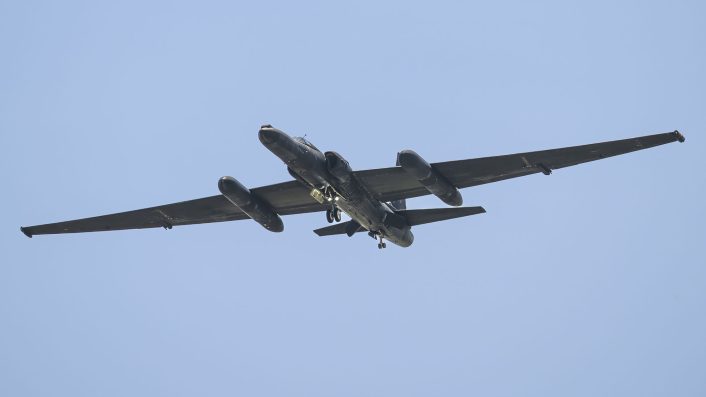
“The AN/ALQ-221 system provides integrated radar warning and electronic countermeasures that equip U-2 pilots with situational awareness and self-protection capabilities. The system includes long-range sensors and onboard processing, enabling the U-2 to operate in contested airspace and provide vital intelligence, surveillance, and reconnaissance information to decision-makers.”
“The Advanced Defensive System for the U-2 is part of BAE Systems’ long legacy in electronic warfare,” said Tim Angulas, U-2 product area director at BAE Systems, in the release. “Evolving, modernizing, and sustaining EW systems is in our DNA. Our efforts ensure they can operate effectively throughout their lifecycles.”
“BAE Systems has continuously matured and advanced the ADS during the system’s 60-year lifespan, and it is an integral part of the U-2’s modernization program. The aircraft’s unique, modular design and open avionics architecture allow BAE Systems to quickly develop, test, and field capabilities to support battlespace operations. The AN/ALQ-221 Advanced Defensive System is sustained by experts at BAE Systems’ facility in Nashua, New Hampshire and by dedicated field service representatives.”
Indeed, notwithstanding its age, the U-2 features an open avionics architecture that has allowed the U.S. Air Force to use the type as a flying lab for new capabilities. For instance, on Sept. 22, 2020, a U-2 from Beale Air Force Base, California, flew for the first time a Kubernetes cluster to pool available on-board computing power and run advanced machine learning algorithms on four individual, flight-certified computers. In a second test, on Oct. 16, 2020, Kubernetes was used to deploy “improved automatic target recognition algorithms” in an unspecified test application/sensor aboard the aircraft.
Sundown
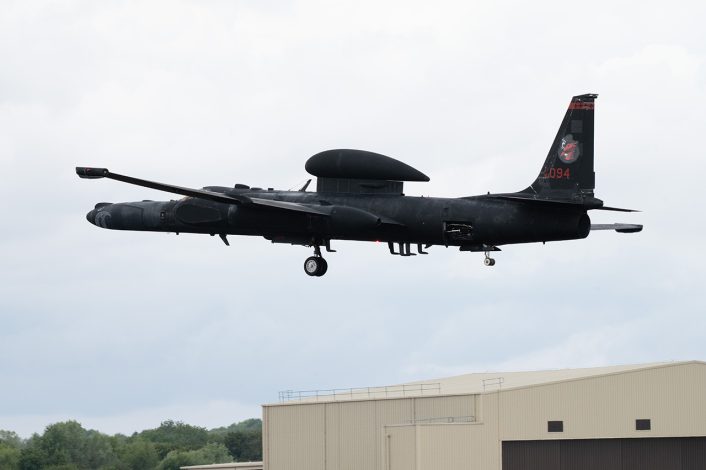
The Dragon Lady was due to retire from the U.S. Air Force in 2026, and some aircraft have already been withdrawn ahead of this date. However, as has happened previously, the aircraft’s retirement date is a subject of intense scrutiny by Congress and we may well see the type continue to operate beyond the end of this year. In fact, U-2s are still engaged in active intelligence, surveillance, and reconnaissance missions on a daily basis from forward operating locations, and these show little sign of slowing down, quite the contrary.
U-2s are home based at the 9th Reconnaissance Wing, Beale Air Force Base, California, but are rotated to operational detachments worldwide, including RAF Fairford, UK; Osan Air Base, South Korea, and RAF Akrotiri, Cyprus. The latter sustained damage from an Iranian kamikaze drone launched in retaliation for the U.S. and Israeli air strikes, earlier this month.
An Iranian one-way drone struck RAF Akrotiri, a British air base in Cyprus, hitting a hangar used for U.S. U-2 spy planes.
A 30-ft hole was blown in the hangar wall.
No casualties and equipment inside was reportedly undamaged.
The Shahed-type drone likely launched from… pic.twitter.com/nCf3SESbjM
— Clash Report (@clashreport) March 5, 2026
While many of the U-2’s original functions are now covered by satellites, the ability to rapidly reconfigure U-2 airframes with different sensor payloads and task the aircraft to different locations in real time mean there is still significant utility to be gained from its use.
Unmanned aircraft can take some of this burden, and indeed there are plans for unmanned aircraft to begin operating from RAF Fairford in the near future. However, the RQ-4 Global Hawk, which is the closest unmanned alternative to the U-2, has a smaller payload than its manned competitor.
The RQ-4 itself is due to be withdrawn in the years to come, being succeeded by more capable aircraft like the classified and provisionally named “RQ-180“, but remains in frequent operational service likely due to lower operational costs and the more flexible basing allowed by a publicly acknowledged aircraft type.
SNOOP 01 (U-2 spy plane) just called NICOSIA ATC descending out of FL600 aka 60,000 feet for recovery back into RAF Akrotiri, Cyprus. 😎🤙 pic.twitter.com/Yg5azqtGZs
— Thenewarea51 (@thenewarea51) February 28, 2026
source
