


By Karl Sinclair
 Feb. 19, 2026, © Leeham News: The normally reserved Airbus (AB) CEO Guillaume Faury had some strong words for engine-maker Pratt & Whitney (P&W), at the annual video conference reporting results for the 2025 financial year.
Airbus is ready to “enforce contractual rights” with regard to the engines being supplied to the airframe maker from P&W (corporate speak for “You’ll be hearing from our lawyers”), in an effort to meet delivery requirements.
The issue is centered around the resources that Pratt is deploying to remedy the problems caused by powdered metal coating contamination misstep, which is hampering production of both the A320neo and the A220 families.
According to Airbus, the engine-maker has focused more effort on addressing in-service fleet issues, while eschewing its responsibility to provide engines to the aircraft OEM for deliveries.
This is hindering Airbus’s efforts to increase production as it seeks to meet its commitments to airlines and lessors.
“On the A320 family, the continued failure to commit to the number of engines ordered by Airbus is negatively impacting this year’s guidance and the ramp-up trajectory for this year. As a consequence, we now expect to reach the rate of between 70 and 75 aircraft a month by the end of 2027, stabilizing at a rate of 75 thereafter,” said Faury.
Whether this is simply sabre-rattling to force P&W to increase production by publicly calling them out is unclear.
Faury elaborated further in the earnings call, “Pratt & Whitney has resigned from the orders we had placed, and they had accepted for the volumes in 2026. We have to base our guidance on what they tell us now they’re willing to commit and deliver. We’ll continue to work hard to enforce our contractual rights, which we believe are not respected in that case…We are not happy with the outcome, but that’s what it is today.”
These are choice words in an industry where airframe and engine makers work closely together to meet their customers’ needs.
Company Results
Source: Airbus.
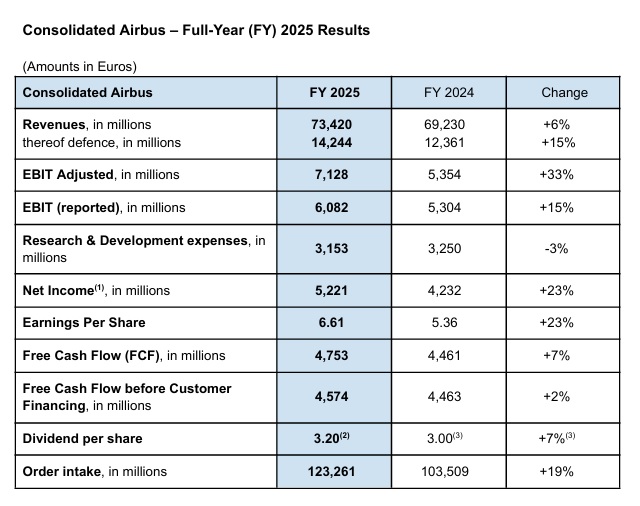
Company-wide, Airbus had a solid 2025. Revenues climbed €4.19bn, year-over-year (YoY), up 6%.
EBIT adjusted jumped a whopping 33%, up €1,774bn. Free-cash-flow (FCF) was up a modest 7% to €4.753bn and the net cash position rose to €12.2bn, up from €11.8bn at the beginning of the year. Order intake rose €19.752bn in 2025 to €123.261bn and the consolidated order book stood at €619bn at year-end.
In a nod to investors, Airbus increased its dividend to €3.20 per share, a 7% increase.
Division Revenues
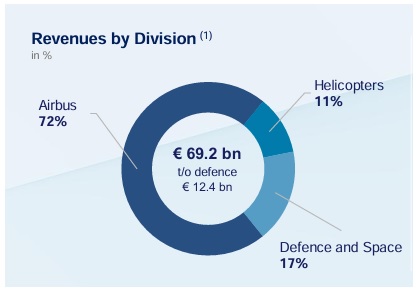
Airbus 2024 revenues by division. Source: Airbus.
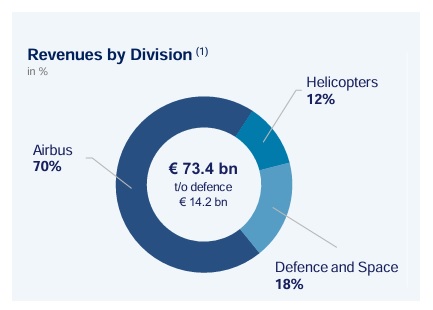
Airbus 2024 revenues by division. Source: Airbus.
Airbus commercial aircraft lost ground in the consolidated revenue pie in 2025, dropping to 70% of total company revenues. While this may be seen as a slipping of the commercial position in the company, given the spate of recent difficulties at Defence and Space (with 2025 seeing another modest charge of €73m to the A400 program being taken), many will take this as positive steps in the right direction for Defence.
Segment Results
Commercial Aircraft
During 2025, Airbus delivered a total of 793 aircraft, including 93 A220s, 607 A320neo family, 36 A330s, and 57 A350s (up from 766 deliveries in 2024). A220 handovers grew from 75 units in 2024 to 93 in 2025 and now account for 12% of commercial deliveries (up from 10% in 2024).
The original guidance at the beginning of the year called for a target of 820 deliveries in FY2025, which was revised mid-year to 790 aircraft. Guidance for 2026 now calls for 870 commercial deliveries in 2026, a ~10% increase, YoY.
Revenues rose to €52.577bn during the year (€50.646 in 2024), growing on an increased delivery tempo, up 3.8%. Services revenues increased at commercial aircraft to an 11% share of the pie (up from 10% in 2024), with platforms declining to 89%. EBIT adjusted jumped to €5.47bn (up from €5.093bn in 2024 – a gain of 7.4%) and a margin of 10.3%.
Returning to P&W
Faury is obviously displeased with the pressure Airbus is facing as it attempts to ramp up production to meet its future delivery targets.
As if to underline the issue, he addressed the Pratt & Whitney problem a third time in his comments, delving deeper into the details of the travails the engine maker faces.
“P&W have the combined needs at the moment of serving the production for new aircraft and serving the MRO capabilities for the recall campaign. [This is] linked to the metal powder and to the rather low durability of the engine and that puts stress on a number of bottlenecks, supply of certain parts which are too small in numbers to serve completely both needs and the MRO capability to retrofit all engines in service and reduce the number of AOGs….We are very frustrated that they have decided to reallocate more to the in-service because they miss global capability, and to the detriment of Airbus.”
Airbus is now targeting a rate of 13/mo for the A220 program in 2028, 70 to 75/mo at the end of 2027 for the A320 Family, 5/mo for the A330 program in 2029, and 12/mo for the A350 in 2028.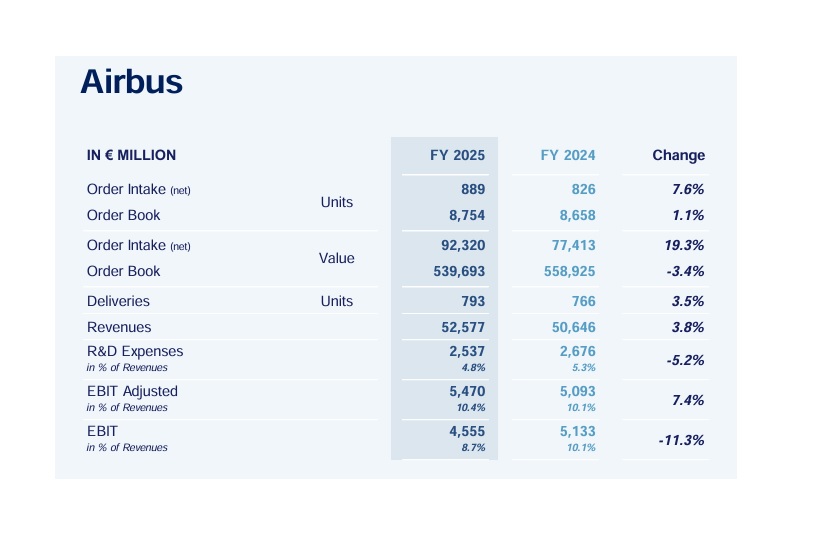
Airbus Commercial Aircraft summary. Source: Airbus.Airbus also took a €188m charge during the year, relating to the Spirit AeroSystems work packages acquisition and integration. This was to be expected, as part of the acquisition terms, Spirit (now Boeing) was required to pay Airbus some €500m at closing to fund the money-losing operation.
How much more Airbus will have to add in the future is unclear.
Helicopters
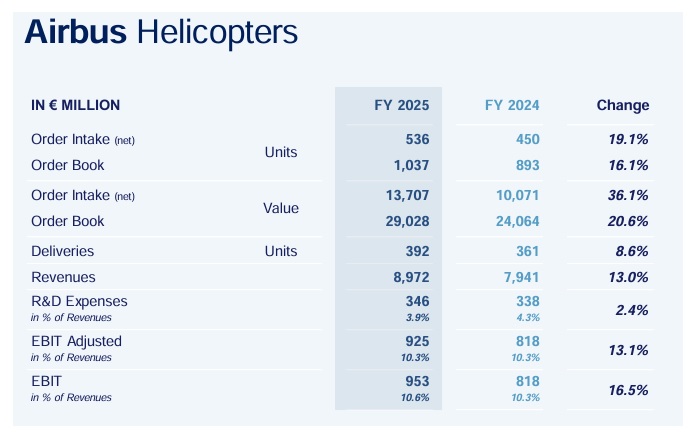
Airbus Helicopters also performed well in 2025, with increases across every metric.
Airbus Helicopters summary. Source: Airbus.
Revenues were up 13% to €8.972bn (€7.941 in 2024) on higher deliveries and services growth. This resulted in a 13.1% gain in EBIT adjusted to €924m (€818m in 2024). Deliveries were up during the year, hitting 392 units (361 in 2024), an 8.6% rise.
Defence and Space
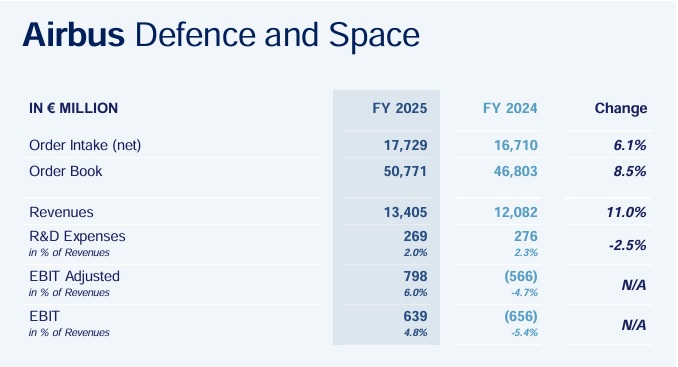
In FY2024, the segment took a €1.3bn charge linked to the Space program. Airbus has now put that in the rear-view mirror, and Defence and Space provided steady gains for the company in 2025.
Airbus Defence and Space summary. Source: Airbus.
Despite the aforementioned FY2025 charge to the A400 program of €73m, EBIT Adjusted was back in the black, earning €798m on revenues of €13.405bn, for a respectable 6% margin. The division also grew revenues by 11% during the year, up €1.323bn (from €12.802bn in 2024).
Work on the proposed joint venture with Leonardo/Thales (codenamed Bromo by Faury) is still ongoing and is not yet at the integration stage, according to Faury. There is still much regulatory and governmental work to be done, according to him. Last year was solid for Airbus, and management must be pleased with the financial results. However, they are obviously unhappy with the impediments facing the commercial segment, which are hampering the ramp-up efforts.
Related
source
