


German Chancellor Friedrich Merz has publicly questioned whether the Future Combat Air System (FCAS) can still deliver a jointly developed next-generation fighter jet, pointing to what he described as a growing mismatch between French and German operational requirements.
In an interview on the political podcast Machtwechsel, Merz said the program faces “a real problem” with its requirements profile, warning that if the issue cannot be resolved, “then we cannot sustain the project.”
Merz argued that France needs the next-generation aircraft to be both nuclear-capable and carrier-capable, requirements that the Bundeswehr does not currently share. He raised the question of whether FCAS could realistically proceed with two aircraft variants, and suggested Germany could explore building a new fighter with Spain and other partners if a compromise proves impossible. Merz also suggested Berlin should openly assess whether it even needs a crewed fighter in 20 years.
The NGF pillar at the heart of FCAS deadlock
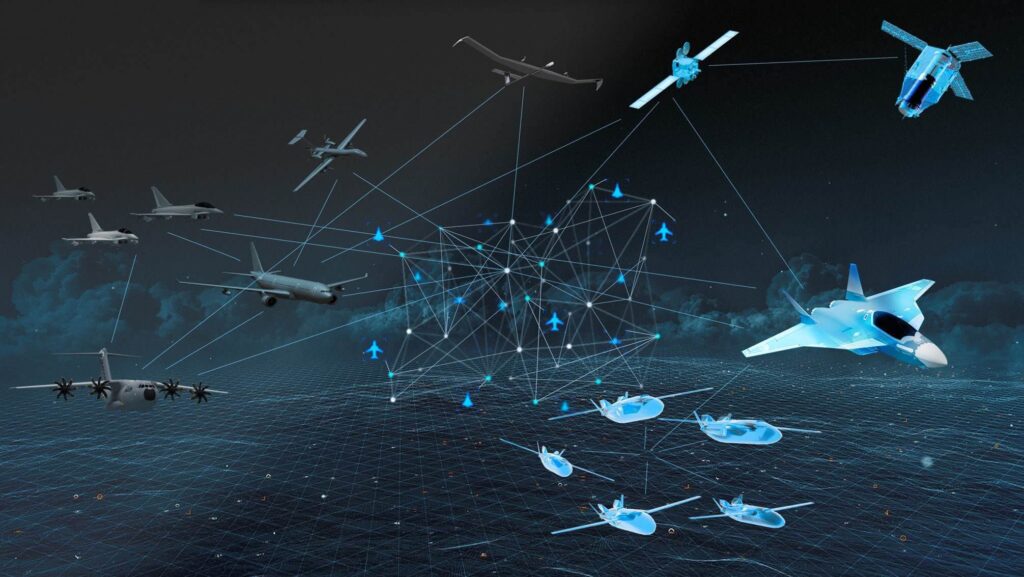
FCAS is envisioned as a “system of systems”, combining a crewed Next Generation Fighter (NGF) with uncrewed “remote carriers” and a networked “combat cloud” that connects sensors, effectors, and decision-making across domains. The program is intended to replace Germany’s Eurofighter and France’s Rafale from around 2040, and is estimated to cost more than €100 billion over its lifetime.
FCAS pillars overview
| Pillar | Prime Contractor(s) | Key Partners |
| Next Generation Fighter (NGF) | Dassault (FR) | Airbus (DE/ES) |
| Engine | EUMET: 50/50 joint venture between Safran (FR), MTU (DE) | ITP (ES) |
| Remote Carriers | Airbus (DE) | MBDA (FR), SATNUS (ES) |
| Combat Cloud | Airbus (DE) | Thales (FR), Indra (ES) |
| Sensors | Indra (ES) | Thales (FR), FCMS (DE) |
| Simulation | Airbus, Dassault, Indra | |
| Stealth/Discretion | Airbus (ES) | Dassault (FR), Airbus (DE) |
| Common Working Environment | Dassault, Airbus, Indra, EUMET |
The program’s recurring paralysis has largely been concentrated in the NGF pillar, where the question of industrial governance has never fully gone away. Under the original political bargain, the French side was expected to lead the fighter itself, a logic that quickly evolved into a dispute over design authority.
Dassault Aviation has argued that a combat aircraft program requires a single prime with clear design authority to avoid diluted responsibility, integration risk, and schedule drift. Airbus, representing German and Spanish industrial equities in the fighter pillar, has resisted what it views as an overly centralized model and has pushed for a more balanced leadership and workshare arrangement.
German officials and lawmakers have, in parallel, repeatedly signaled that a model perceived as “French primacy” would be politically difficult to sustain given the program’s scale and the level of German investment expected over time.
The dispute is not new. Tensions were already visible in 2021, when then-Chancellor Angela Merkel publicly questioned whether Germany’s role in the fighter pillar matched with the program’s stated partnership model.
“It is a project under French leadership, but it is still necessary that the German partners can be at a satisfactory level vis-à-vis their partners,” Merkel said at the time. “We must therefore see very precisely the questions of industrial property, the sharing of tasks, and the sharing of leadership.”
The governance fight later delayed the launch of demonstrator work, with public exchanges in 2022 over signature authority, the definition of “prime contractor,” and how responsibilities would be split before the Phase 1B demonstrator contract was ultimately awarded. While Phase 1B moved the program forward on paper, the next handover to a subsequent phase has repeatedly reopened the same argument.
After a political deadline slipped without a breakthrough in late summer 2025, defense ministers from France, Germany, and Spain met on December 11, 2025, to try to unblock the program. The talks again ended without an agreement, pushing the issue up to heads of government for a political decision.
A late “red line” and an open question
Merz’s intervention, however, introduces a new and rather surprising emphasis into the debate. France’s need to replace the Rafale across all its missions has always imposed constraints that pull design choices toward specific performance and integration requirements, while also requiring export readiness. None of these were late add-ons; they were part of the program’s logic from the outset, and they have been discussed publicly for years.
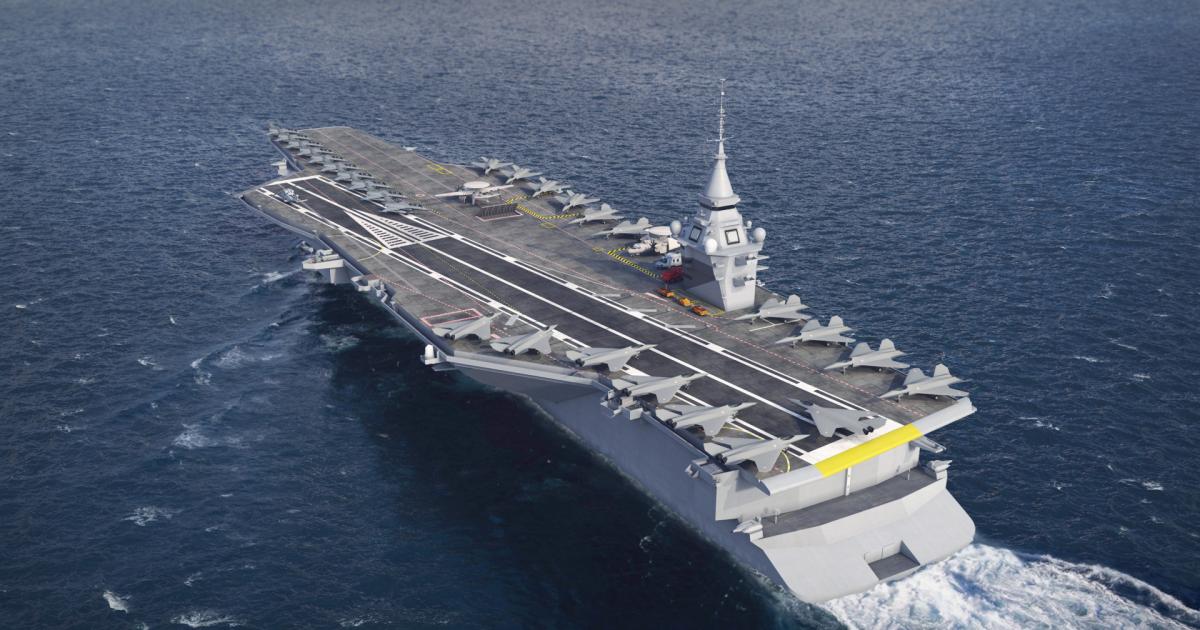
In fact, the carrier requirement has had second-order effects beyond the aircraft itself. With the NGF frequently described as larger and heavier than the Rafale, France’s next aircraft carrier has been sized accordingly. The PANG program has converged on a substantially larger design, commonly described at roughly 78,000 tons and about 310 meters in length, compared with 42,000 tons and 261 meters for the existing Charles de Gaulle.
That is what makes the timing of Merz’s argument stand out. Nearly nine years into the project, a long-known French baseline is now being framed as incompatible with Germany’s needs, even though it has been explicit and publicly discussed since the program’s inception.
Merz’s remarks also invite a question that has so far remained less explicit in the political debate: what exactly does the Luftwaffe want its post-Eurofighter force to look like? Beyond keeping the combat cloud and remote carriers alive, how does Germany define its future high-end air combat requirement, and how does that align with Berlin’s growing reliance on US platforms such as the Lockheed Martin F-35 for the NATO nuclear-sharing mission? The issue gains additional weight as Merz has also acknowledged exploratory talks with Emmanuel Macron on European nuclear deterrence cooperation.
source
