


Leaving the airspace above New York City at 2,455 miles per hour, SR-71 tail number 64-17972 would set a transatlantic speed record on Sept. 1, 1974.
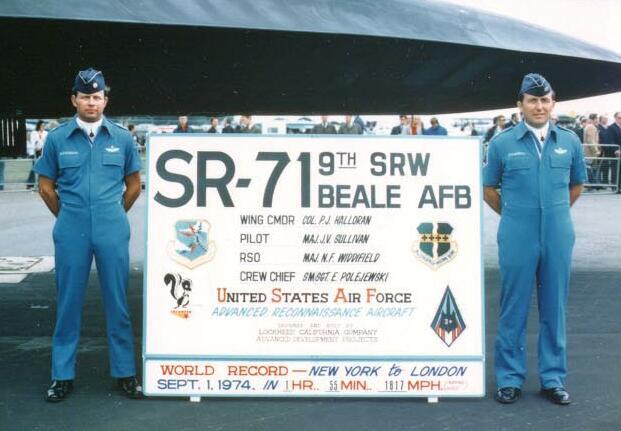
Stationed at Beale Air Force Base (AFB) California, SR-71 972 would become no stranger to setting world records. Crewed by pilot James Sullivan and RSO (Reconnaissance Systems Operator) Noel Widdefield, 972 would streak across the Atlantic in less than two hours before being welcomed with great fanfare at the Farnborough International Air Show.
Built For Speed
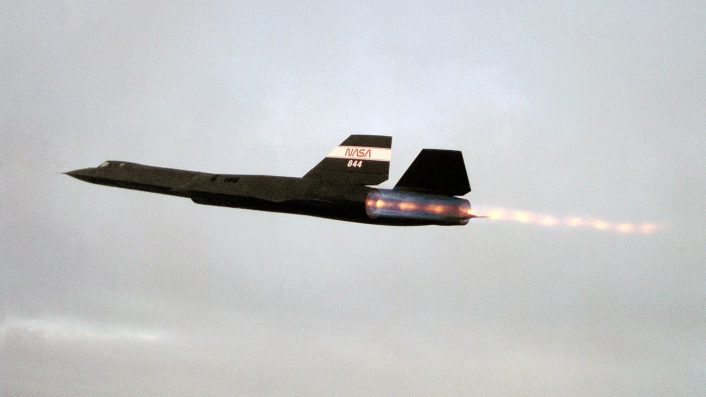
Lockheed’s SR-71 was designed to fly at great altitudes at great speeds to defeat enemy air defenses while performing strategic reconnaissance missions. A product of Clarence ‘Kelly’ Johnson’s famed ‘Skunk Works’, the aircraft was developed under extreme secrecy during the Cold War, incorporating many of the features of the A-12. The SR-71 closely resembled the A-12, but is heavier and longer to accommodate more fuel and reconnaissance gear.
Powered by a pair of Pratt & Whitney J58 engines consuming a special fuel known as JP-7, the aircraft was capable of speeds beyond Mach 3 and altitudes over 85,000 ft. A crew of two sat in two tandem cockpits in an aircraft constructed mostly of titanium and composite materials.

The unusual aircraft was named the ‘Blackbird’ because of its dark blue-black paint as well as being known as ‘Habu’ after a Japanese venomous snake. The SR-71 exhibited stealth characteristics thanks to the shape of the aircraft and materials used.
On Dec. 22, 1964, the SR-71 made its first flight with Skunk Works test pilot Bob Gilliland at the controls. A total of 32 Blackbirds would eventually be constructed with the type entering service in January of 1966. The SR-71 was officially retired by the United States Air Force (USAF) in 1990, with NASA (National Aeronautics and Space Administration) reactivating some before the last operational flight in 1999.
Fast Flight to Farnborough
The SR-71 was to be put on public display for the first time ever at the Farnborough International Air Show in Hampshire, United Kingdom. This show is a major biennial aviation, aerospace, and defense industry event.
In the past, the show only featured British equipment, with 1974 marking the first international show, although foreign aircraft had been admitted since 1966. A total of 31 foreign aircraft would participate, but one would steal the show after breaking a world record en route.
In July 1974, Major Jim Sullivan and Major Noel Widdifield were informed they would be attempting a world record flight previously held by pilots of the Royal Navy. Sullivan and Widdifield would fly an SR-71 from New York City to London before the aircraft was to be placed on display at Farnborough.
The United States was reeling from the Watergate scandal and the resignation of President Richard Nixon just three weeks before. In addition, the war in Vietnam hadn’t gone well. The country needed something to cheer about.
Behind the scenes were also plans at work to base SR-71 aircraft in Britain. The British had reservations the move might cause issues with relations in the international community. The American hope was a good showing at Farnborough in conjunction with a record-setting flight might sway things in favor of the United States.
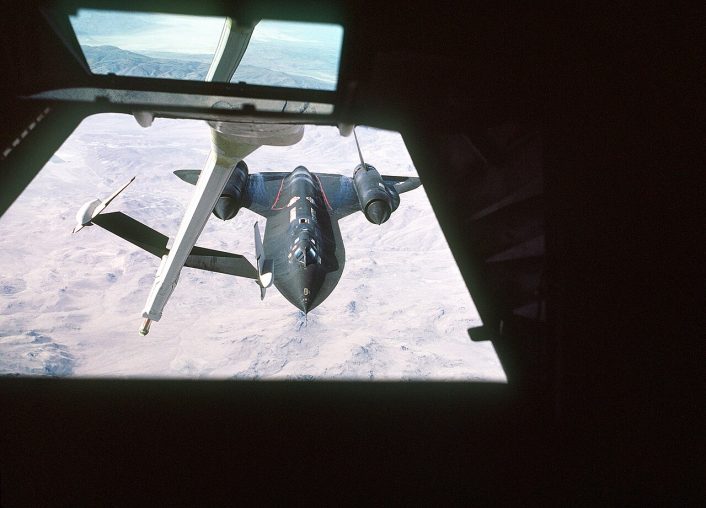
Sullivan and Widdifield would depart Beale AFB on Sept. 1, 1974, refueling above California from a KC-135Q Stratotanker after takeoff; continue on a southerly path and refueling around the Carolinas on the journey to New York flying around coast to avoid causing a sonic boom over populated areas. At a designated point (gate) high above the city, the Blackbird would start the journey, tearing through the skies at Mach 3.2. The record attempting flight was under way.
Requiring fuel once again, the SR-71 linked with a tanker near Greenland. An incident occurred along the way that was concerning in regards to achieving the record time from New York to London. At one point in the journey the Blackbird began to yaw suddenly, swiftly moving from side to side after losing thrust.
Known as an ‘unstart’, one engine had lost power because the bypass system partially failed as the shock wave placed in the throat of the inlet to decelerate the incoming air became misplaced. The situation was rectified by the automatic restart systems which repositioned the inlet cone moving the shockwave into the throat of the inlet with the engine being restarted. The aircraft went on to London without further incident.
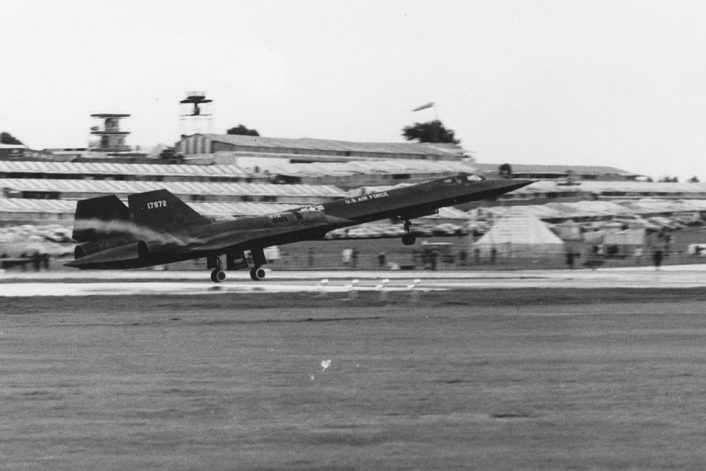
Crossing the designated point over London, the Blackbird had made the 3,490 mile trip in an astonishing one hour 54 minutes and 56.4 seconds, setting the world record, even with the inlet issue. The average speed was 1,806.964 mph.
A huge crowd along with media greeted Sullivan and Widdifield at Farnborough. A press conference was held and the two spoke via telephone with the new U.S. President, Gerald Ford, just sworn in with Nixon’s resignation.
SR-71 972 is now on display at the National Air and Space Museum Udvar-Hazy Center in Chantilly, Virginia, after continuing to set records even on the final flight to Dulles International Airport on Mar. 6, 1990 from California. The aircraft still attracts crowds and remains the center of attention today, just as it did at Farnborough back in 1974.
Blackbirds in Britain
It seems the record flight and public display of the Blackbird at Farnborough did persuade those in objection to reconsider allowing SR-71s on British soil. RAF (Royal Air Force) Mildenhall became the base which the SR-71 operated from during a period of 1976 to 1990.
Restrictions required UK permission before each sortie flown as well as each aircraft could not stay more than 20 days per visit. In 1982, Prime Minister Margaret Thatcher eased some of the restrictions, announcing a permanent detachment, designated Det 4, with two SR-71s assigned. The UK would maintain control over more sensitive missions. This detachment would cease in 1989 with the last Blackbird departing Jan. 18, 1990.
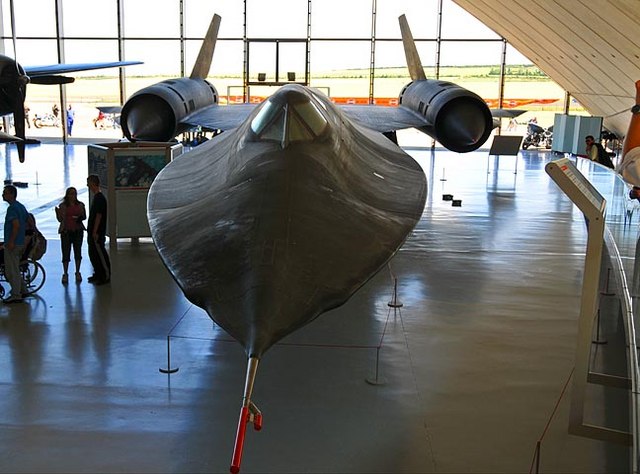
SR-71 64-17962 was donated to the UK for public display at the Imperial War Museum in Duxford. It is still on display there today.
source
