

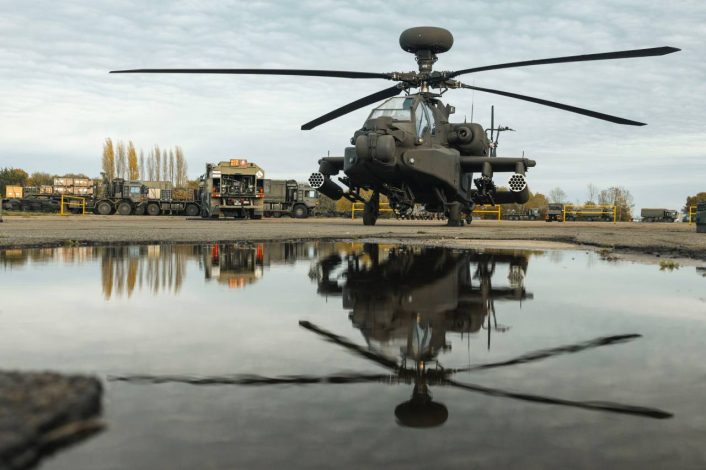
Throughout November, up to 50 British and French helicopters have been staging operations across the UK in a major exercise involving around 2,000 personnel.
Exercise Pinion Titan commenced on Nov. 3rd, 2025, and will draw to a close on Dec. 3rd. The month long exercise is led by the UK’s 1st Aviation Brigade, who oversee the majority of the British Army’s aviation capability. Taking part in the exercise are British Army Air Corps Wildcat AH1s and AH-64E Apaches, Royal Air Force Chinooks, and French Army Gazelles. Royal Air Force C-17 Globemaster IIIs and A400M Atlas C1s have also been noted flying in and out of airfields hosting exercise events.
Alongside the British and French contingents, the exercise is being supported by planning officers from the U.S. Army’s Europe-based 12th Combat Aviation Brigade. An Italian Army Dornier Do-228 was also spotted flying into Wattisham, where Pinion Titan initially kicked off, in the exercise’s opening days. Though an Italian presence has not been officially confirmed, this aircraft presumably carried a small number of Italian Army personnel either to observe or join with the administrative parts of the training regime.
Speaking at the beginning of the month, Brigadier Nick English, Commander of the 1st Aviation Brigade, said “Exercise Pinion Titan marks the end of a modernisation programme started when 1st Aviation Brigade was formed in 2020. Every one of our soldiers, vehicles, and helicopters is going into the field for us to test our capabilities together. We will be working closely with the RAF, our French and US allies, and integrating cutting-edge technologies such as drones and advanced communications systems. This exercise demonstrates that 1st Aviation Brigade is one of NATO’s most capable and ready formations, prepared to defend the UK and our allies.”
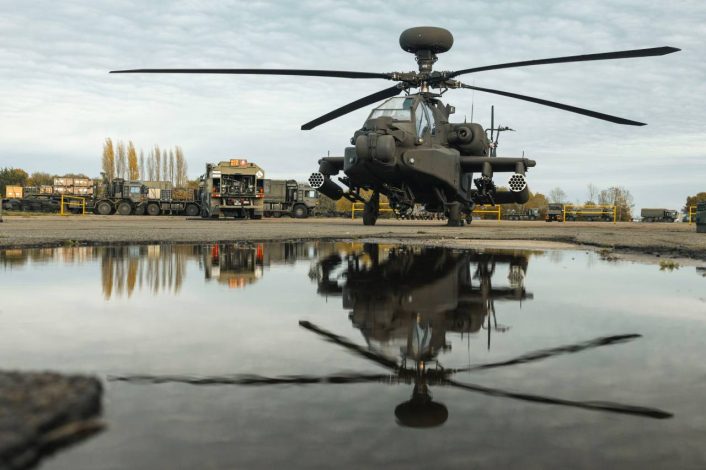
Operations commenced with an ‘elephant walk’ of 24 helicopters – 10 Wildcats, 8 Apaches, 2 Chinooks, and 4 Gazelles – taking off in formation from Wattisham’s runway. Wattisham is home to the Army Air Corps’ frontline Apache units and was transferred to the British Army in 1993, having previously been a base for F-4 Phantoms as RAF Wattisham.
“An elephant walk is a striking demonstration of strength and readiness. Preparing four different types of aircraft to fly together is a significant engineering and logistical achievement. It proves to us and to potential adversaries that we have the teamwork and coordination needed for real-world combat operations,” Brigadier English added.
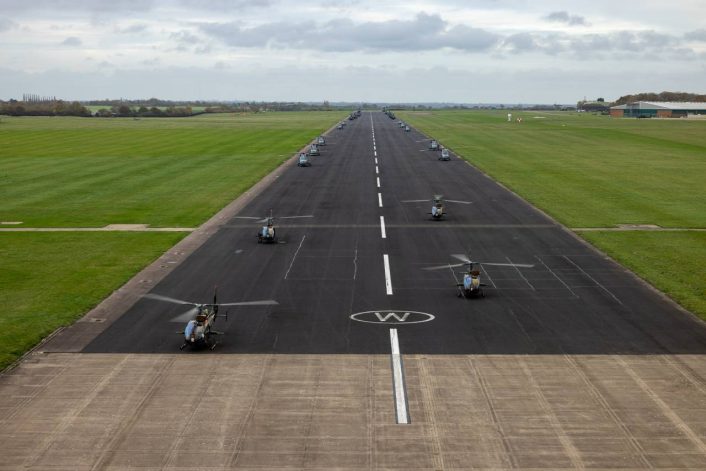
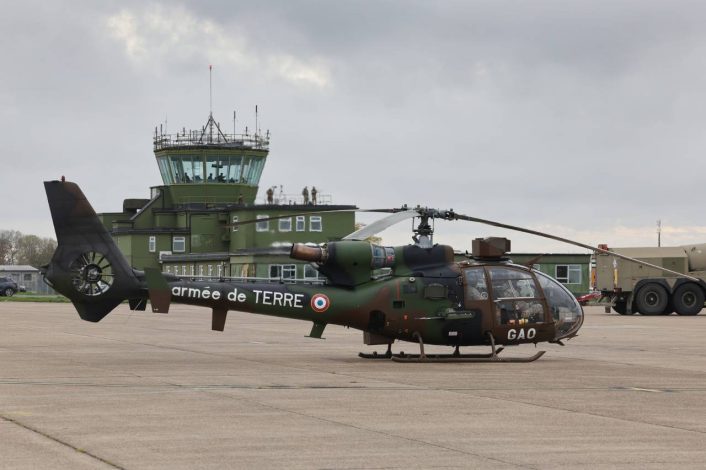
The French Gazelles, hailing from 3e Régiment d’Hélicoptères de Combat (3rd Combat Helicopter Regiment) at Base Lieutenant Étienne Mantoux in northeastern France, are tasked to work in tandem with the British Apaches to protect troop-carrying Chinooks. Various images show one of the helicopters, which are very much in the twilight years of their flying careers (the type having already been withdrawn from UK service), equipped with a crew-served M134 minigun in the side-door.
Leading the French forces was Capitaine Damien, who said: “We are very proud to participate in this major exercise, which is a great opportunity to enhance our operational readiness.”
“For most of the soldiers, it is their first time working with allied forces, but we can see that France and Britain share a common military culture. This will lead to smooth integration and the development of a joint force with solid tactical capabilities.”
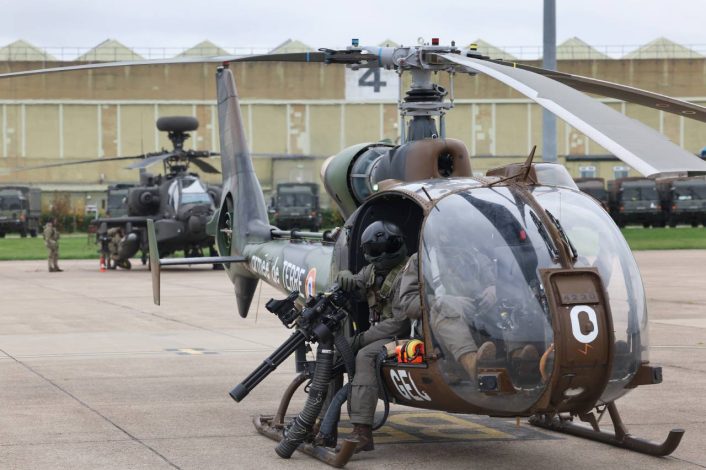
The other three Gazelles were equipped with the Viviane infrared sighting system mounted on the roof of the cab, along with empty weapon rails on each side of the aircraft. The rails, in frontline service, would carry HOT-2 anti-tank missiles, which are guided using the Viviane unit.
The British Army’s Wildcats put their integrated MX-15Di electro-optical/infra-red (EO/IR) turrets to use for reconnaissance, identifying potential threats and gathering information for operational planning.
Flights Across the Country
Using forward operating locations (FOLs) established by ground forces including at Dishforth, Catterick and Otterburn, the helicopters branched out from Wattisham to undertake operations in various parts of the UK. These different locations all force crews to contend with unique terrain and climate considerations, including bitterly cold temperatures and snow-laden landing sites in Scotland.
The downwash from helicopter rotors during landings in snowy conditions can cause whiteout, similiar to the brownout effect experienced when landing on sand or loose dirt. This reduces visibility effectively to zero and represents a significant risk – it is, though, a key skill for military pilots that they need to be trained for. For British helicopter pilots, training for snow and ice operations is usually undertaken during deployments to Bardufoss Air Station, Norway, which offers a much better guarantee of the required conditions compared to the UK’s own climate.
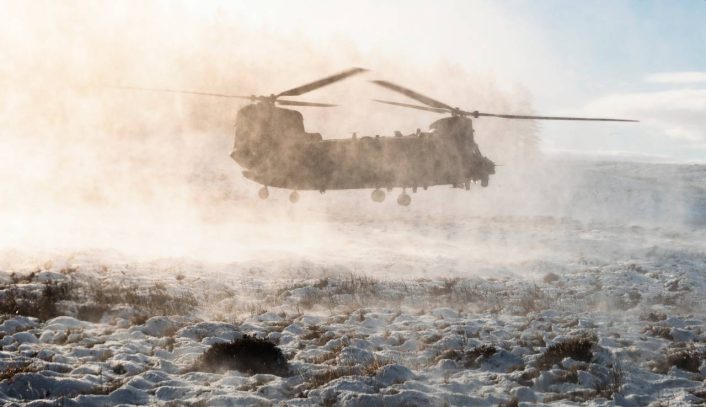
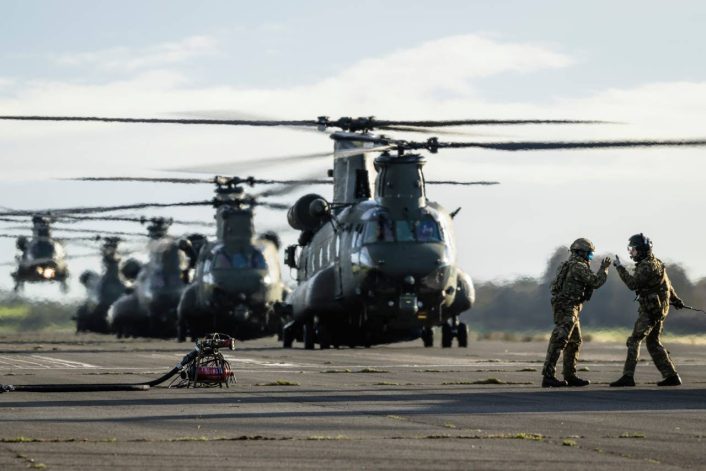
With the retirement of the Puma HC2 earlier this year, the Chinook is now the RAF’s sole aircraft contribution to the Joint Aviation Command (formerly Joint Helicopter Command). The RAF operates the largest number of Chinooks outside of the U.S. military, flying three variants: Chinook HC6s are new-build CH-47F standard aircraft delivered in the early to mid 2010s, HC6As are older aircraft which underwent an upgrade programme to bring them roughly alongside the new aircraft, and HC5s are from a batch procured for special forces use with larger fuel tanks on each side of the fuselage. Some of the oldest HC6As will be replaced by 14 new Chinooks based on the H-47ER standard, the first examples of which are currently being constructed.
🚁 Chinook Force in Action on Exercise Pinion Titan
From troops to artillery to air defence, the Chinook Force delivers unmatched reach and agility, keeping UK defence ready for anything. 💪@BritishArmy #AirMobility #JointOperations #RAF pic.twitter.com/jVSAZTsWas
— Royal Air Force (@RoyalAirForce) November 24, 2025
Alongside the protection of the Chinooks, the Apache and Gazelle helicopters have also taken on a deep strike role to target simulated hostile artillery sites and supply depots – many of which may have been identified for them by Wildcats flying reconnaissance missions.
Keeping the Helicopters Flying
Support units are critical for enabling the helicopters to operate effectively from dispersed locations, providing fuel, maintenance equipment, communications capabilities, and security. Units providing these facilities for Pinion Titan include the Joint Helicopter Support Squadron, 90 Signals Unit, the RAF Tactical Supply Wing, forming a Brigade Support Group (BSG) led by 7 Aviation Support Battalion, Royal Electrical and Mechanical Engineers (REME).
🚁 Ex Pinion Titan: The Chinook Force is operating with NATO across the UK. Supported by 90 SU, JHSS & TSW, and using Agile Combat Employment to work from derelict buildings, forests or tents – showing true adaptability. #RAF #ChinookForce #ACE #NATO pic.twitter.com/1Ut6ZLltGQ
— RAF Odiham (@RAF_Odiham) November 20, 2025
Staff Sergeant Georgia Sewell, a supply chain operator serving with 132 Aviation Squadron, Royal Logistic Corps – a sub-unit of 7 Battalion, REME – said “We stock everything from rations to rotor blades, and prepare it to go where it’s needed. It may not be the most exciting job, but it is vital. Our motto is ‘no fly without supply’.”
“The Brigade Support Group is an incredibly capable unit because of the extraordinary breadth and depth of skills that our soldiers have,” said Lieutenant Colonel Andrew Huggins, commanding officer of 7 Battalion, REME. “It takes a huge range of supporting functions to deliver combat aviation. The dedicated work of all of our soldiers – from a chef cooking in a field kitchen to an avionics technician repairing a helicopter’s faulty sensor – contributes equally to operational success.”
source
