

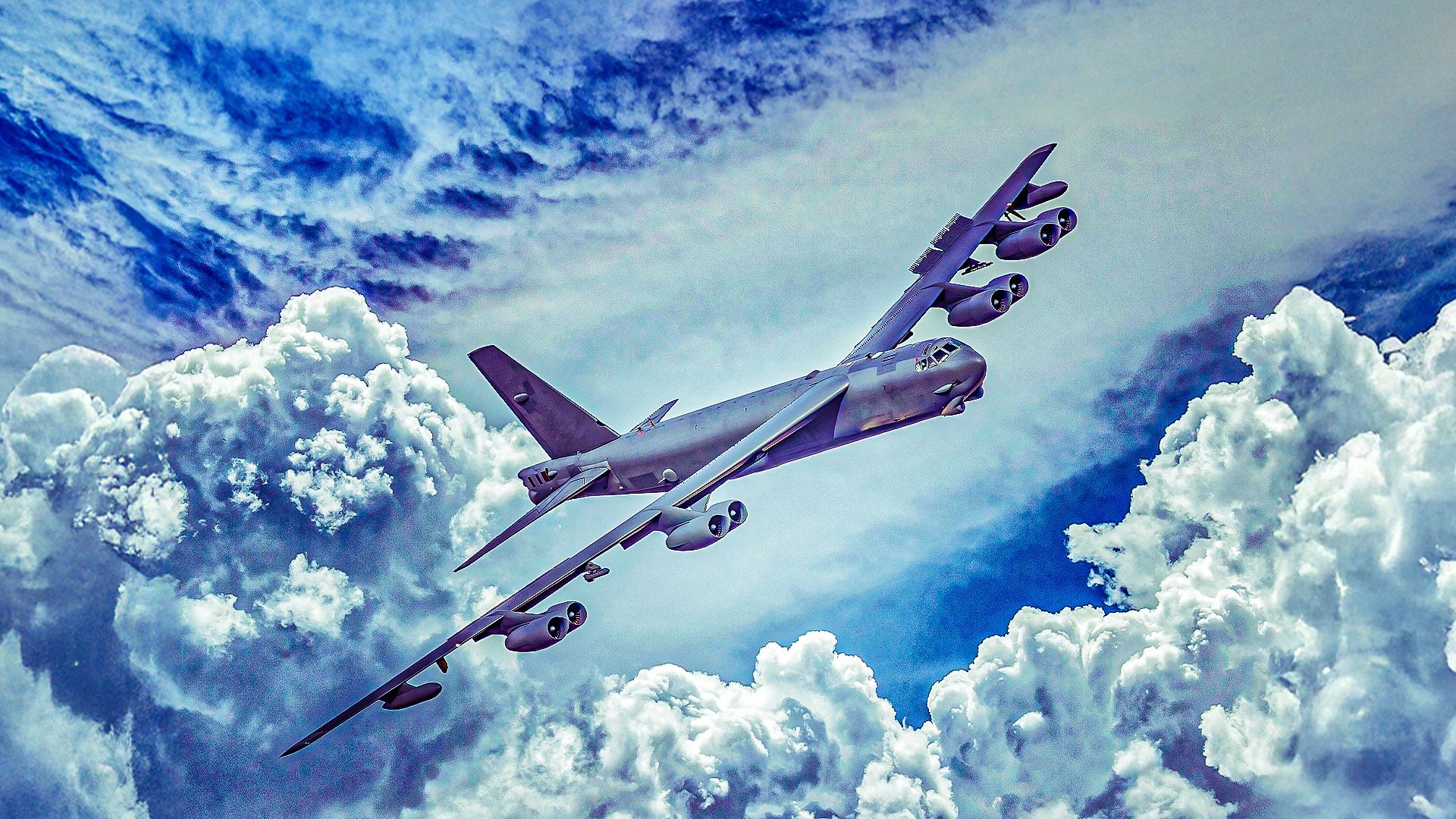
In November 2025, the United States Air Force deployed an unknown number of Boeing B-52 Superfortress bombers to its Moron Air Base in southern Spain. Ironically, the B-52 is both famous for being one of the oldest military aircraft still in service (they were built 1952-1962), while also being a symbol of American power. Thanks to their size, payload capacity, relatively low operating expenses, and evolved role, they remain relevant and powered and have avoided obsolescence, unlike most other aircraft types.
These days, Spain is a close NATO ally and the bombers are welcome there, but that hasn’t always been true. One of the first experiences Spain had with the Boeing B-52 Superfortress strategic bombers was getting four nukes dropped on it (more on that later). Here is what to know about why the United States Air Force deployed B-52 bombers to Spain.
USAF Deployed B-52s To Spain

In November 2025, the United States Air Force announced it had deployed B-52 bombers from their base at Barksdale Air Force Base in Louisiana. These arrived at Moron Air Force in Spain to conduct multilateral training exercises. The exercises included Sweden, Finland, Lithuania, and other US Allies and partners. It should be noted that the only permanent bases for the B-52s are in the continental United States.
The bombers are part of Bomber Task Force Europe 26-1, and their deployment “enables U.S. Air Force bomber aircrews to refine tactics, increase flexibility and strengthen coordination with Allies, increasing warfighting capabilities and readiness through exercising and operating side-by-side.” But while the bombers were sent to Spain, the Air Force emphasized the impact on the opposite end of the continent.
The USAF said that by having these forces and assets deployed and training with allies, it is better postured to respond rapidly to emerging threats and maintain a deterrent along Europe’s Eastern Flank and the High North. While in Spain, the US B-52. The bombers trained against simulated ground and air threats to better prepare to act decisively to counter threats and gain air superiority.
It’s Common For US Bombers To Deploy

There is little remarkable about the B-52s turning up in Spain. The USAF regularly deploys its B-52s, B-1s, and B-2s around the world for training, as a show of support for its allies, and warnings to its adversaries. That said, not all deployments are equal. For example, in early 2025, the USAF deployed B-2 Spirits to Diego Garcia in the Indian Ocean in a very clear warning to Iran. They were joined in Diego Garcia by B-52s.
As history had it, these bombers did strike Iran, although they flew nonstop from the United States, underscoring the fact that the US can fly its bombers nonstop to almost anywhere in the world. In 2025, other times the US has deployed B-52s have included February, when they flew close to the borders of Russia and Belarus, and October, when they flew off the coast of Venezuela. B-1s have also been flying and flexing off Venezuela.
|
US Air Force B-52 Stratofortress |
|
|---|---|
|
Dates built |
1952-1962 |
|
Date entered service |
1955 |
|
Number remaining in service |
72 |
|
Role |
Strategic heavy bomber |
|
Planning retirement date |
After 2050 |
This is also not an ability Russia has with its bombers or what’s left of its bombers after Operation Spiderweb. On that day, Russia lost around 20% of its operational bomber fleet. Russian bombers are mostly restricted to operating near Russia, including around Alaska and Northern Europe. This is because the Russian Air Force lacks tankers. The United States used many more tankers in its single raid on Iran than Russia possesses in total. The Russian Air Force has around 19 tankers, which are mostly tasked with enabling strategic bomber patrols.

Top 10 Active US Military Aircraft With The Longest Range
Endurance is a game-changer in modern combat missions—discover the ten US military aircraft the range envelope further than ever.
Morón Air Base: A Major US Base

Morón Air Base is located in southern Spain, around 35 miles southeast of Seville. The base is shared by US and Spanish forces, although only the Spanish flag is flown. It is a major base for the US Air Force in Europe — Air Forces Africa. The base functions as a major transit point for US forces flying to and from the Middle East.
As aircraft, such as bombers, fighter jets, or transports, fly to the Middle East, they can touch down at the base or be refueled by US tankers taking off from the base along the way. This is what happened earlier in 2025. The US flew large numbers of KC-135 and KC-46 tankers to Morón, which then refueled other aircraft as they passed through.
The United States Air Force says, “Morón Air Base is a vital link in any operation moving east from the United States due to its strategic location close to the Mediterranean and the Middle East, its massive flight line, long runaway, aircraft refueling systems and excellent weather.” The 496th Air Base Squadron is stationed at the base. The 496th is a crucial part of the 65th Air Base Group in Lajes, Portugal, which operates under the 86th Airlift Wing in Ramstein, Germany.
B-52 Now A Stand-Off Delivery Truck

The role of the B-52 has changed significantly over the years. When they were designed and built, they were designed to fly directly over targets and drop dumb bombs on targets, WWII-style. They even came with tail guns to defend themselves from enemy fighter jets. This continued to the end of the Vietnam War when the US amassed its B-52s to target Hanoi; reportedly, one or two Vietnamese fighter jets were even downed by the tail guns.
However, the B-52s also suffered heavy and unsustainable losses in these raids. Since then, the tail guns have been removed and dumb bombs replaced by stand-off missiles. Similar to how Russia is using its bombers, the B-52 is now a lumbering delivery truck with the radar cross-section lighting up any radar like a Christmas tree. The B-52 will not go into contested airspace; it is the job of the B-2 Spirit to penetrate air defenses unseen.
This is set to continue. The Air Force is developing the next-generation B-21 Raider stealth bomber to operate in the most contested of environments. Meanwhile, the service plans to retire its remaining B-1 Lancers in the 2030s, followed by the B-2 Spirits in the 2040s as the B-21 Raiders arrive in large numbers. The B-52 and B-21 are set to be the seemingly oddest pairing, representing the oldest and most cutting-edge capabilities of the US Air Force.

The Last Boeing‑Built Heavy Bomber Still Airworthy
Discover the veteran Boeing warbird still on duty.
When A B-52 Nuked Spain

The number of nuclear accidents in the 1950s and 1960s is enough to give anyone pause. Even more so when one considers these are only the incidents known about, and other powers, like the USSR, didn’t report their nuclear mishaps. In the 1960s, Spain was a neutral country. But in 1966, a US Air Force B-52G bomber collided midair with a KC-135 tanker over the Spanish village of Palomares.
The B-52 was carrying four B28FI Mod 2 Y1 thermonuclear bombs. Three fell on the land near Palomares, while the fourth was lost at sea. The conventional explosives on two of the nukes exploded on impact and contaminated the area with plutonium. The US quickly recovered the three on land, but the one at sea proved tricky. The US was only able to find it after an 80-day search.
These nukes had an explosive power 100 times that of the one dropped on Japan’s Hiroshima. As the BBC put it in an April 2025 article, “[for Spain] the nuclear age had fallen on them from a clear blue sky.” Times have changed, and today these B-52s over Spain will not be routinely carrying around hydrogen nuclear bombers. Still, there are three (known) US nuclear bombs somewhere lost in the ice of Greenland, in the Philippine Sea, and in the swamps of Georgia. These have never been found.
The US’s Heavy-Weight Archer Deploys Around The World

The B-52s being deployed to Spain is normal. It is part of the US’s efforts to enhance its own capabilities by training with allies, while also warning adversaries and reassuring allies. Their deployments off the coast of Venezuela or to Diego Garcia in the Indian Ocean are perhaps more significant, as these are warnings not to be ignored.
The US will continue to operate its fleet of 72 remaining B-52s into the 2050s. They are currently being upgraded with Rolls-Royce engines and upgraded to the B-52J variant to keep them relevant. While the B-21 may be a night ninja sneaking unseen through the night, nothing could be more untrue about the B-52. Even so, while their original role was direct bombing, it is now a stand-off. To use an analogy, it was designed to be a boxer, getting up close and personal, but now it is an archer with a very large quiver.
B-52s and other bombers can be seen deployed to various US-allied bases around the world, including Australia, South Korea, NATO states, and elsewhere. The major Andersen Air Force Base on Guam is set up to handle all US bomber types. But most of the time, they are at home at their bases: Barksdale Air Force Base, Louisiana, and Minot Air Force Base, North Dakota.
source
