

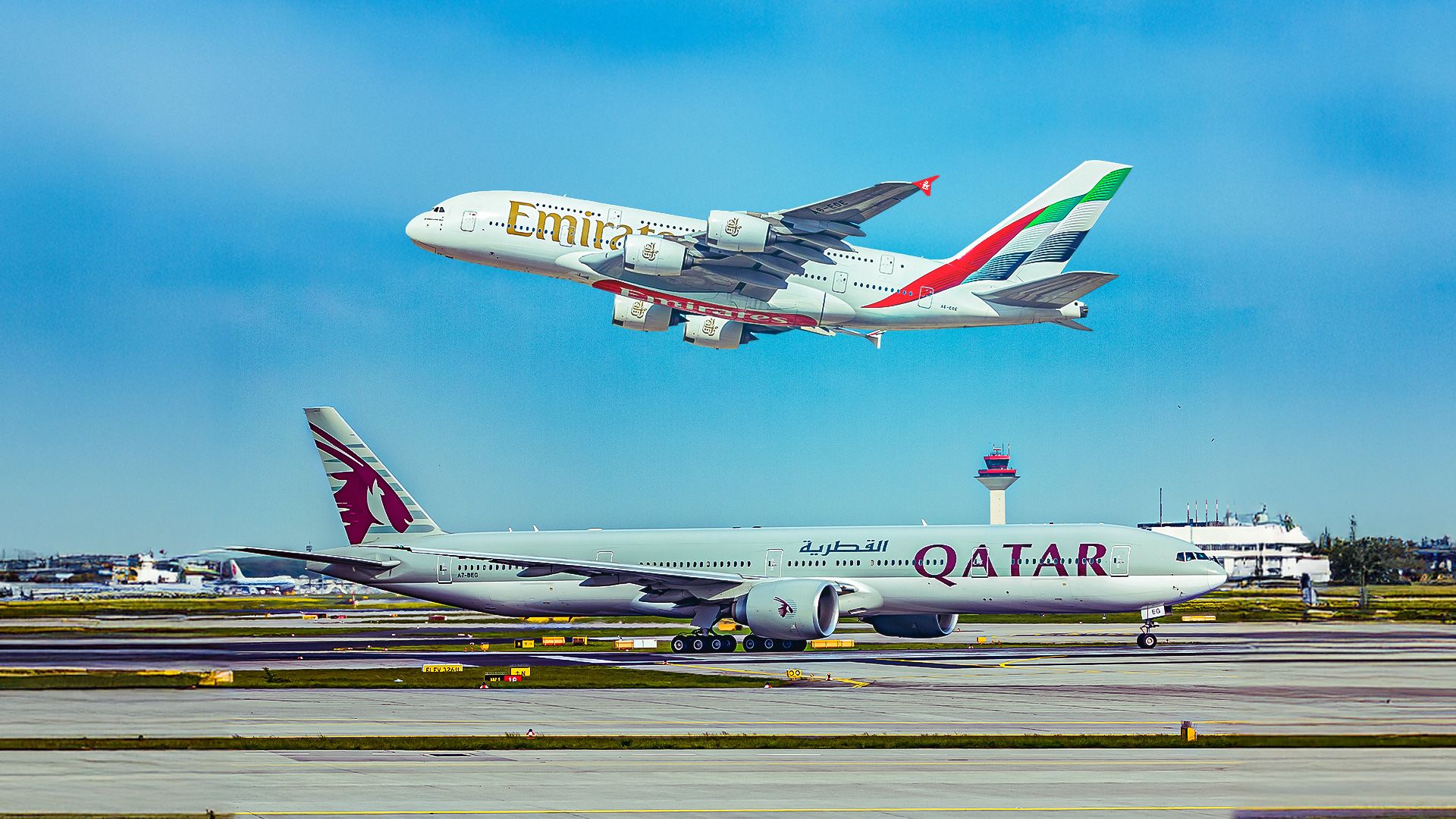
Which Middle Eastern giant comes out on top when we look specifically at ultra-long-haul flying:  Emirates or
  Qatar Airways? It matters because both carriers have built global reputations around stretching the limits of long-range connectivity, competing to carry millions of travelers in luxury between far-flung destinations across six continents. Understanding which airline performs better in the longest sectors, measured by network depth, seat capacity, or aircraft efficiency, reveals a great deal about how each Gulf carrier intends to dominate the future international travel market.
Emirates relies heavily on its Airbus A380 and Boeing 777-300ER fleets to operate high-capacity, long-distance routes from Dubai. Meanwhile, Qatar Airways adopts a more diversified fleet strategy, utilizing the Airbus A350-900, Airbus A350-1000, Boeing 777-200LR, and 777-300ER to serve its global network from Doha. This article uses Cirium, an aviation analytics company’s schedule data, combined with fleet and operational information published by each airline, to compare their performance on ultra-long-haul markets, generally defined as routes exceeding 7,000 miles or those requiring more than 14 hours of flight time. We’ll analyze flight frequency, ASMs (available seat miles), average sector length, equipment selection, and strategic priorities to determine which carrier “wins” when distances become extreme.
What Is The Short Answer?

The short answer is that Emirates leads in overall ASM volume on ultra-long-haul routes, primarily because its A380-powered network includes exceptionally dense markets such as Sydney, Melbourne, and Los Angeles. However, Qatar Airways offers a broader variety of ultra-long-haul city pairs, relying on smaller but efficient Airbus A350 variants and achieving strong average mileage figures across more routes. Emirates wins in raw capacity; Qatar Airways wins in network coverage and fleet efficiency.
Cirium data also shows that Emirates routinely generates 100–328 million ASMs per month on major long-haul routes, such as DXB–SYD (326,890,960 ASMs) and DXB–MEL (208,375,830 ASMs, with the A380). Meanwhile, Qatar Airways’ top long-haul markets, like DOH–MEL (157,685,760 ASMs in 30 days) and DOH–SYD (119,209,860 ASMs), produce smaller monthly totals but still represent a diversified range across the Americas, Oceania, and Asia.
Historically, Emirates has pursued a “super-hub” strategy built on very high-capacity aircraft, while Qatar Airways emphasized fleet flexibility and market breadth. The Cirium data reflects these structural differences. Emirates’ A380-heavy long-haul operation naturally results in higher ASMs on individual sectors, while Qatar’s A350-centric approach produces lower overall ASMs per route but often higher average miles per seat, thanks to the aircraft’s long-range efficiency.
The Factors That Influence Both Airlines’ Strategies

Several variables influence our perception of what constitutes “better” in ultra-long-haul flying, including seat capacity, range performance, load flexibility, fuel efficiency, and network design. Airlines serving very long routes must balance demand peaks, aircraft economics, and cargo capacity, all while maintaining operational reliability over 14–17-hour mission lengths. For Emirates, the defining factor is capacity per departure. With the huge Airbus A380 offering 489–615 seats depending on configuration, the airline’s ASMs naturally dwarf competitors.
On the contrary, Qatar Airways relies instead on fleet versatility: the A350-900, A350-1000, and 777-200LR offer long-range capabilities with reduced fuel burn, allowing the carrier to expand its ultra-long-haul presence across more city pairs. Flight frequency also plays a role. Some Qatar routes, such as DOH–MEL, offer 60 flights per month, compared to Emirates’ typical 30-flight cycle on many long-haul city pairs.
A good example is DOH–DFW, where Qatar uses both the Airbus A350 and the Boeing 777 to generate 77.7 million ASMs in 30 days. Compare this with DXB–LAX, where Emirates utilizes the A380 to generate 121 million ASMs, despite having fewer total long-haul frequencies overall. The strategic difference is clear: Emirates concentrates massive capacity in fewer long sectors; Qatar spreads long-reach service across more markets with adaptable aircraft.

Sky-High Luxury: Comparing Qatar Airways & Emirates’ Premium Suites
Discover how Qatar Airways and Emirates premium suites stack up in the sky-high world of luxury travel: suite doors, double-beds, showers, and more!
Emirates Vs Qatar Management Strategy

Both airlines have publicly commented on their long-haul strategy. Emirates emphasizes the role of high-capacity aircraft in supporting global hub economies, often highlighting the A380’s cost-per-seat advantage. Qatar Airways, meanwhile, promotes the A350 family as the most fuel-efficient long-haul platform in operation, consistent with its award-winning focus on operating flexibility and passenger comfort.
Emirates repeatedly notes on its official website that the A380 remains a cornerstone of long-lasting global demand, enabling the airline to “maximize connections with fewer movements.” Tim Clark, the Emirates president, has always been known as an A380 supporter, and in his interview to Airline Ratings he commented on fuel efficiency and cost per seat the following: “When I fly an A380 from Dubai to Los Angeles with 515 people it burns 13 tons of fuel an hour … With two flights of the 787-9 … the fuel cost per seat on the A380 is cheaper than on the 787.” Clark has also repeatedly called for a re-engined A380, saying newer engines could deliver up to 25% fuel-burn savings.
Meanwhile, Qatar Airways positions the A350 as its “long-range flagship,” with CEO Akbar Al Baker previously commenting that he was “extremely pleased” with the A350-1000’s performance, especially its fuel efficiency, when Qatar Airways tweaked its order to include more of them, as per Fortune Magazine. In a separate interview, he also criticized the A380’s environmental footprint, noting that per block-hour, the Airbus A350 emits 20% less than the Airbus A380.”
These two philosophies directly influence the data. Emirates’ capacity-first mentality means it dominates headline ASM figures. Qatar’s efficiency-centric approach means it often leads in average sector length and aircraft utilization efficiency, as shown in the Cirium data, where many Qatar routes average 7,300–9,000 miles per flight cycle, particularly DOH–AKL (9,011 miles on the 77L).
Other Long Haul Champions

It’s worth comparing Emirates and Qatar to other ultra-long-haul carriers, such as  Singapore Airlines, Qantas, or Air New Zealand, whose “ultra-long-haul identities” are even more pronounced. Although both Emirates and Qatar are known to operate many long-haul routes, airlines like Singapore and Qantas operate routes that push even further into 18- to 19-hour territory.
But here our comparison is becoming more about apples to oranges. Qatar and Emirates rely on a hub-and-spoke model that spreads ultra-long-haul flying across dozens of aircraft and city pairs. Qantas and Singapore operate niche ULH routes such as SYD–DFW and SIN–JFK that rely on strict load restrictions and specialized A350-900ULR or 787 9 variants. They do not generate the same ASM volume per month because their schedules lack the 30–60-flight cycles seen in Gulf carrier operations.
Thus, while Qantas or Singapore may operate the single longest route by block time, Emirates and Qatar continue to dominate frequency-based ultra-long-haul economics, offering multiple daily long-range departures to cities like Sydney, Melbourne, and Los Angeles. Their business model prioritizes volume, not the longest possible range.

Emirates Vs. Etihad Airways Vs. Qatar Airways: Which Carrier Wins To The United States?
The Middle Eastern Three’s showdown in the world’s largest aviation market. Who’s ahead, and who’s behind?
Main Challenges

No comparison between the two carriers is complete without noting operational constraints and market challenges. Emirates’ reliance on large aircraft means reduced flexibility when demand fluctuates. Qatar seems much more diversified and thus more resistant to disruptions, but not 100% safe from them.
For instance, Emirates cannot easily right-size on thinner ultra-long-haul routes, forcing it to drop or seasonally adjust services. Meanwhile, Qatar’s dispute with Airbus over the grounding of its A350 fleet in 2021–2022 temporarily forced frequency cuts on several long-range markets. Cargo capacity also differs: Emirates’ 777-300ER fleet offers substantial belly cargo capability, whereas the A350-900 is more limited.
Emirates vs Qatar Fleet Overview:
|
Aircraft Type |
Emirates |
Qatar Airways |
|---|---|---|
|
Fleet size (total) |
269 active aircraft |
235 active aircraft |
|
Average fleet age |
~11.1 years |
~10.2 years |
|
Main aircraft families |
Airbus A380, Boeing 777, Airbus A350 |
Airbus A320 family, A330, A350, Boeing 777, 787 |
|
A380 |
94 active, total: 116 |
8 A380-800s |
|
A350-900 |
13 recently delivered A350-900 in the fleet |
34 A350-900 |
|
A350-1000 |
– |
25 in service + ordered |
|
Boeing 777-200LR |
10 in service |
7 in service |
|
Boeing 777-300ER |
118 in service |
57 in service |
|
777X / Future 777 |
Big 777-9 order to replace aging 777-300ER in the future |
Qatar has 777-9 on order as well (but smaller confirmed number) |
|
Narrow-body (single-aisle) |
Very limited (VIP use only) / none in mainline (only wide-bodies in mainline) |
A320-200 (27 in service); A321neo on order |
Source: planespotters.net
For travelers and aviation enthusiasts, it’s important to monitor fleet availability, schedule reshuffles, and geopolitical impacts, all of which can directly influence both route length and frequency. Emirates may dominate today in ultra-long-haul ASMs, but Qatar can quickly shift its fleet mix to reinforce a market, something Emirates cannot replicate with the same dexterity.
Overall Takeaway

So, which airline wins on ultra-long-haul flying – Emirates or Qatar Airways? Based on the Cirium data and each airline’s fleet strategy, the answer depends on the metric. Emirates dominates in sheer capacity, using large aircraft to generate massive ASMs on long-distance routes. Qatar Airways excels in route diversity and efficiency, using a broader mix of modern long-range aircraft to cover more city pairs across similarly long distances.
For most travelers, the difference comes simply down to preference: Emirates often wins for onboard space and A380 comfort, while Qatar frequently leads in cabin consistency and fleet modernity, especially across the A350 family. Both airlines offer leading-class ultra-long-haul experiences, but they serve slightly different strategic purposes in the global airline network.
Emirates is preparing for next-generation widebodies like the 777X and Qatar Airways is continuing to expand its A350-1000 operations, and the race for ultra-long-haul dominance will only intensify. If fuel prices remain high, Qatar’s efficiency edge may grow. But if global leisure demand continues to surge, Emirates’ high-capacity model could maintain its ASM supremacy.
source
