

When  Singapore Airlines’ Airbus A350-900ULR completed the 15,344-kilometer flight between Newark and Singapore with just two engines, it marked a turning point for long-haul aviation. Ultra-long-haul flights that once belonged exclusively to four-engine aircraft can now be operated more efficiently by modern twinjets. With Europe’s push towards carbon-neutrality and mandatory SAF blending adding pressure on fuel-hungry quadjets, four-engine aircraft are increasingly viewed as high “environmental-cost” assets.
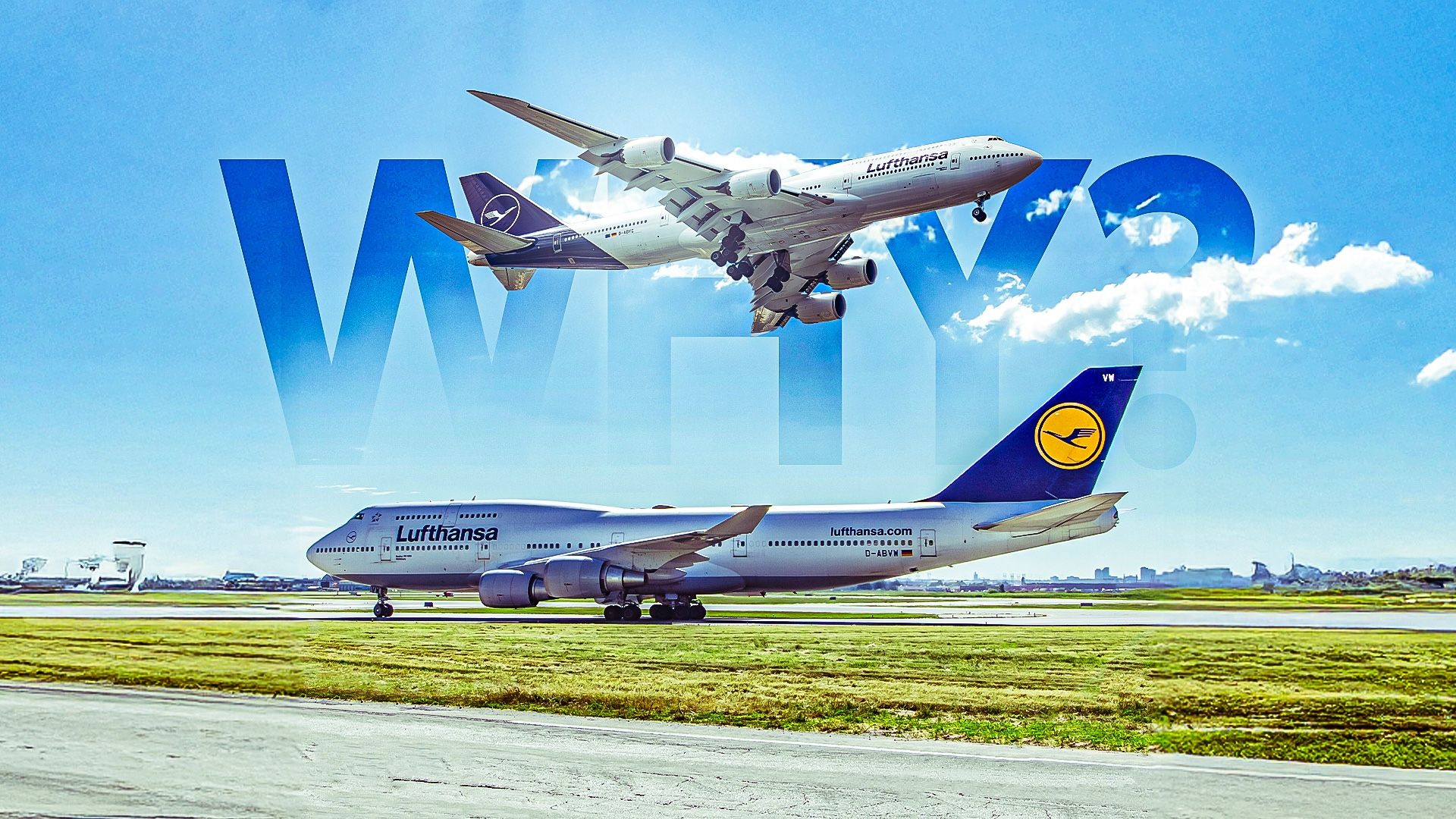
Yet  Lufthansa stands apart. While most airlines have retired the Boeing 747, the German flag carrier still operates two different generations of the iconic Jumbo Jet the Boeing 747-400 and the Boeing 747-8 at a meaningful scale. Even as the airline renews its fleet with A350s, 787s, and eventually the 777X, Lufthansa continues to fly more “Queens of the Skies” than almost any other carrier. Why? The answer lies in how each variant was designed, what roles they serve, and how they fit into Lufthansa’s broader long-haul strategy.
Two Queens, Two Jobs

Since its relaunch in 1953, Lufthansa has built its global identity around long-haul flying. Frankfurt has become one of Europe’s busiest international hubs, supported by Germany’s strong manufacturing and business sectors that generate steady premium demand. This environment has long made widebodies, especially the 747 central to Lufthansa’s network strategy.
For Lufthansa, the 747 has always been more than a large aircraft. It has been a symbol of German aviation strength and a core part of the airline’s long-haul presence. So when the airline received its first 747-8 in the early 2010s, the decision reflected more than nostalgia. Lufthansa did not want an ultra-large aircraft like the Airbus A380, nor did it want to rely solely on smaller twins like the Airbus A350. It needed a right-sized aircraft capable of carrying a large premium cabin and strong cargo loads across a variety of long-haul markets, and the 747-8 fit that role perfectly.
The 747-400, meanwhile, had already defined an entire era of Lufthansa long-haul flying. Throughout the 1990s and 2000s, it connected  Frankfurt Airport with North America and Asia, effectively becoming the wings of a newly unified Germany. Today, however, the two variants serve very different roles. Lufthansa now operates 19 747-8s as its flagship, deploying them on premium, ultra-long-haul routes such as Frankfurt–Los Angeles and Buenos Aires. The aircraft features both First Class and one of the largest Business Class cabins in the fleet. By contrast, the eight remaining 747-400s, now 23 to 27 years old, act as high-capacity aircraft on traditional long-haul markets or as backup when demand peaks.
|
Lufthansa |
Boeing 747-400 |
Boeing 747-8 |
|---|---|---|
|
Overall length |
70.67m |
76.3m |
|
Wingspan |
64.44m |
68.4m |
|
Height |
19.41m(63ft 8in) |
19.33(63ft 5in) |
|
MTOW |
396,890kg |
447,700kg |
|
Range |
7,260miles |
7,730miles |
Delays to the 777X and limited A350 and 787 deliveries have extended the 747-400’s service life, while the 747-8 has become nearly irreplaceable on Lufthansa’s highest-yield routes. These aircraft are not simply “old versus new”; they are two different pillars supporting Lufthansa’s long-haul network in distinct and strategic ways.
Built For Different Eras

When Boeing developed the 747-400 in the late 1980s, long-haul expansion was a top priority for many global airlines. The industry needed an aircraft that could fly farther, carry more passengers, and operate more efficiently than the earlier 747 Classics. Boeing responded with a major modernization program that produced the 747-400, a significantly more advanced “high-tech Jumbo.”
The 747-400 introduced a full glass cockpit, eliminating the need for a flight engineer and enabling two-pilot operations. New winglets improved aerodynamic efficiency, while PW4000 and CFM6 engines offered better range and fuel burn. Lufthansa, which participated directly in the development advisory group, played a key role in shaping the aircraft; the 747-400 was not just a purchase for the airline, it was a project that helped influence. The 747-8, however, was born from a different strategic era. In the 2000s, Airbus launched the A380, sparking the superjumbo race. Rather than designing an all-new very large aircraft, Boeing extended the 747 program by incorporating 787-derived technology, redesigned wings, new GEnx-2B engines, and a stretched fuselage. The result was the 747-8, the longest passenger aircraft ever built, and a more modern alternative for airlines that still needed high capacity.
|
Lufthansa |
First class |
Business |
Premium Economy |
Economy |
|---|---|---|---|---|
|
Boeing 747-400 |
67 seats |
32 seats |
272 seats |
|
|
Boeing 747-8 |
8 seats |
80 seats |
32 seats |
244 seats |
These different origins are reflected clearly in their missions. The 747-400 was built as a long-range workhorse for the global expansion of the 1980s and 1990s, while the 747-8 was designed as a premium-oriented, high-capacity response to the superjumbo era. Their cabin layouts reinforce this: Lufthansa’s 747-400 carries 67 Business, 32 Premium Economy, and 272 Economy seats, whereas the 747-8 features 8 First Class suites, 80 Business seats, 32 Premium Economy, and 244 Economy seats, highlighting its focus on premium revenue. In short, the 747-8 is designed for yield, while the 747-400 is built for capacity. They represent two fundamentally different market philosophies, and Lufthansa continues to use both to meet the varied demands of its long-haul network.

Delayed Again: Boeing 777X Delivery Timeline Pushes Back To 2027
The long-awaited next-gen widebody will wait even longer to debut.
Why Lufthansa Keeps Both Jumbos

Lufthansa considers the 747-8 one of its true flagships for good reason. Frankfurt is a highly slot-constrained hub with strong business demand and significant cargo traffic, and very few aircraft can satisfy all three requirements as effectively as the 747-8. For the airline, the type is not simply a newer quadjet, it is a strategic asset and a core part of its premium identity.
The aircraft is one of Lufthansa’s primary First Class platforms and is ideally suited to high-yield, ultra-long-haul routes such as Frankfurt–Los Angeles, Buenos Aires, and Tokyo Haneda. Its large Business Class cabin, strong belly-cargo capability, and slot efficiency make it exceptionally profitable in markets where premium seats and cargo matter most. The 747-400 now serves a more pragmatic purpose. Although aging, it remains a valuable high-capacity tool in a post-pandemic market where long-haul demand has rebounded sharply. It allows Lufthansa to maintain seat supply on busy routes without relying solely on newer twinjets.
Its continued presence in the fleet is largely driven by necessity. Delays to the Boeing 777X and slower-than-expected deliveries of the A350 and 787 mean Lufthansa does not yet have enough replacement aircraft. At the same time, the 747-400 is fully depreciated, making it inexpensive to operate and still profitable on certain high-demand routes. In short, Lufthansa flies the 747-8 because it wants to, but it keeps the 747-400 because, for now, it has to.
Why the 747-8 Isn’t Replaceable

A common question among passengers and aviation fans is: “Why not simply replace the 747-8 with the A350 or 787?” On the surface, this seems logical, but Lufthansa’s network requirements are more complex than a direct swap.
The 747-8 fits Lufthansa’s long-haul profile in ways modern twinjets cannot fully replicate. It is tailored to premium markets between Europe, North America, and Asia, where Business Class demand is consistently strong. At Frankfurt, one of Europe’s most congested hubs, the 747-8 also maximizes revenue per slot, something smaller aircraft struggle to match. Even on ultra-long-haul routes, it carries strong payloads and generates balanced passenger and cargo revenue. With 80 Business Class seats, it is particularly well-suited to corporate-heavy destinations that anchor Lufthansa’s global network.
The 747-400, meanwhile, cannot disappear overnight. Lufthansa does not yet have enough A350s or 787s to replace its full long-haul capacity, and maintaining network scale is strategically essential in a competitive European market. Continued delays to the 777X have extended the 747-400’s life, making it a necessary stopgap until new aircraft arrive. During periods of strong demand, the type remains a reliable high-capacity tool that Lufthansa can deploy quickly. Both aircraft still serve critical but different roles in Lufthansa’s long-haul strategy.

Why Didn’t Boeing Build The 747-9?
Unveiling the Mystery of Boeing’s Shelved 747-9
The Downsides Of Keeping Two Queens

Operating two different four-engine types inevitably brings additional costs. The 747-400’s age is now a major challenge. Most remaining aircraft are 24 to 28 years old, leading to higher maintenance needs, longer ground time, and fuel efficiency well below that of modern twins like the A350 and 787. As worldwide retirements accelerate, sourcing parts has also become more difficult, adding further complexity to keeping the type in service.
The 747-8, though far more modern, is not without limitations. Its GEnx engines improve efficiency, but it remains a quadjet with higher fuel and maintenance costs than comparable twin-engine aircraft. It is also most economically viable on specific long-haul routes with strong and consistent premium demand. And because the 747-8 is unique within Lufthansa’s fleet, it is less flexible to redeploy than more common twinjets, even though it performs exceptionally well in the markets it is designed for.
Despite these drawbacks, Lufthansa has a clear long-term plan: the remaining 747-400s are expected to retire around 2026–2027, while the 747-8 is set to remain a core long-haul aircraft well into the 2030s.
Lufthansa: The 747’s Last home

As more A350s, 787s, and eventually 777Xs enter the fleet, the 747-400 will gradually disappear from Lufthansa’s schedules. The 747-8, however, is poised to remain the last regularly scheduled four-engine flagship operated by a major European carrier and a central pillar of the airline’s ultra-long-haul strategy.
Lufthansa’s current network environment is shaped by a unique combination of factors: consistently strong premium demand, a highly developed cargo operation, and one of Europe’s most slot-constrained hubs at Frankfurt. Together, these conditions create a scenario where operating a large, premium-heavy aircraft like the 747-8 is not only viable but strategically advantageous. In markets where seats, cargo capacity, and slot efficiency all matter at once, the 747-8 continues to offer Lufthansa capabilities that smaller twinjets simply cannot match.
Taken together, these factors point to a striking conclusion: Lufthansa may well become the last airline to truly call the Boeing 747 “home” flying two generations of the Queen of the Skies long after most of the world has moved on.
source
