

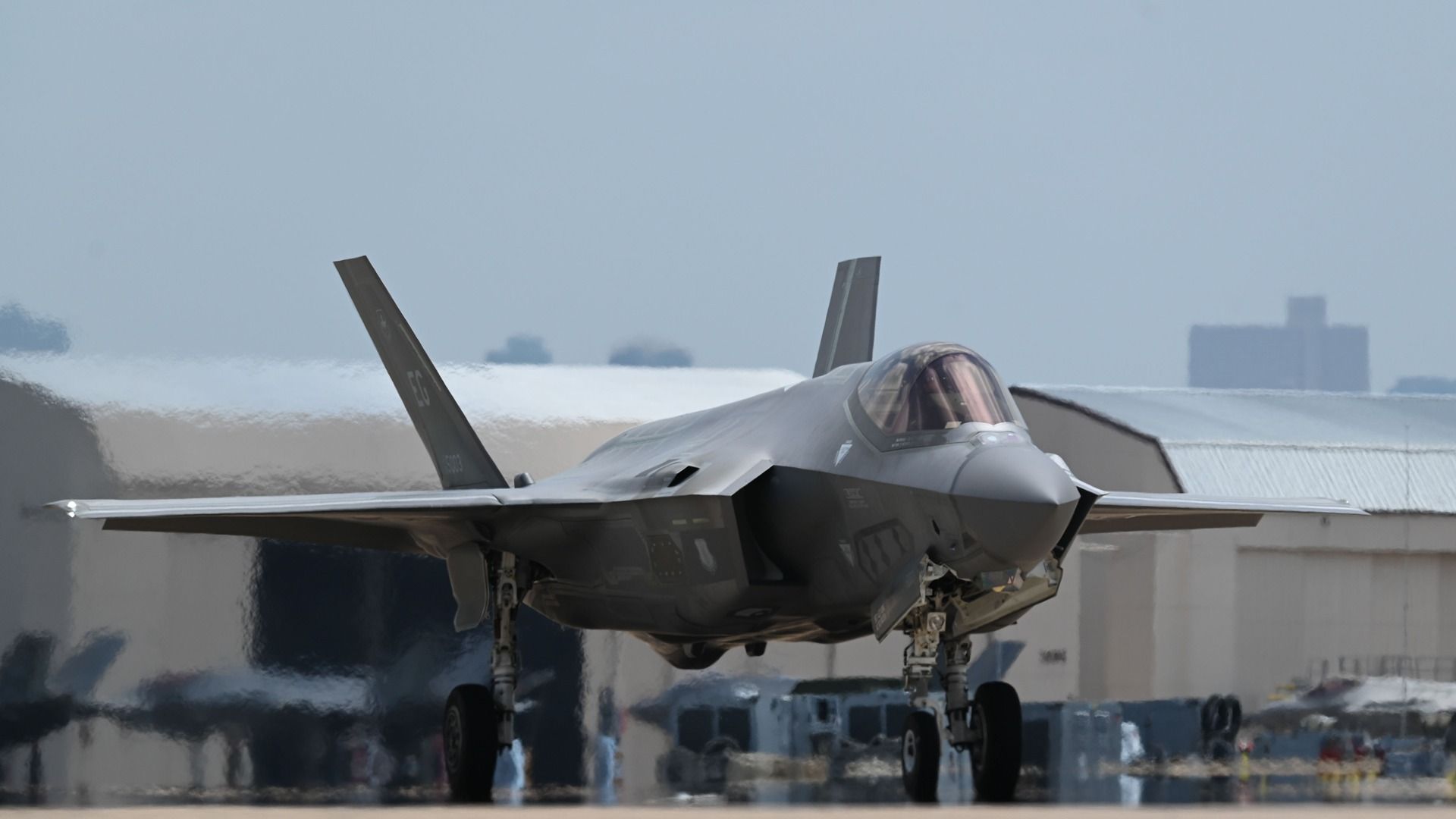
Reporters at the  2025 Dubai Airshow, which is currently underway, were granted a direct update from the executive level of Lockheed Martin. The F-35 Lightning II stealth fighter is the company’s highest demand warplane, and the global fleet has consistently grown since its introduction in 2016 to now be over 1,200 strong and counting.
Demand for the aircraft has been very high in recent years, the United States plans to acquire almost 2,500 by itself, while there are 19 other air forces also building up their fifth-generation fighter fleets. Yet, he company is not planning to ramp up output as it would overstrain the global supply chain, which is still recovering from the Coronavirus-era cutbacks.
Smooth Operations

Steve Sheehy, vice president of aeronautics strategy and business development at LM, addressed the press, saying: “Can we? The answer is yes.” The manufacturer is currently producing about 13 jets a month with an annual total just under 160 units. There have been some ups and downs over the past few years of production, but the assembly line has not been the issue.
The primary final assembly and checkout (FACO) facility is located at the US Air Force “Bomber Plant” in Fort Worth, Texas. The mile-long facility was originally created for B-24 Liberator bombers during World War II, but has since evolved to how some of the most advanced aircraft projects, now including the F-35. Parts made around the world are sent to Texas for the primary assembly process.
There have been some issues in the past with suppliers that fabricate parts like the fuselage, tail, wings, and engine components. Currently, the supply chain appears to have stabilized based on remarks from LM. Steve Sheehy was quoted as giving these remarks at the Dubai Airshow in a report by Breaking Defense on the morning of Wednesday, November 19:
“The center fuselage is not a bottleneck any longer. So that’s not it… It’s not just a single issue. We want to keep our suppliers at a steady rate.”
The F-35’s Future

The F-35 stealth fighter is the second fifth-generation fighter in the history of the United States, but it is also more than that. It has grown to become the single largest defense program ever undertaken by the American Military. In addition to bringing a new level of capability to the Air Force, Navy, and Marines, it has achieved a remarkable feat of strategic and logistical planning.
Sharing one common airframe across all the services of the American military and allied nations dramatically enhances not only the tactical capabilities of every user but also greatly reduces lifetime costs and makes its industrial base and supply chain vastly more resilient. The current projection for total production is estimated to be over 3,000 jets at this time. The Air Force, however, does have a potential plan to increase production significantly.
In order to maximize the near-future advantages of the F-35 as well as upgraded legacy fighters like the Boeing F-15EX, the USAF is considering steeply increasing the manufacturing rate to produce 100 just for the Air Force every year on top of other orders. To do so would require a much higher level of funding, which is unlikely to be granted under current conditions, even as the Air Force now draws the largest share of the US defense budget.

The World’s Largest Air Forces By F-35 Numbers
How the top F-35 flyers compare.
A Global Effort

There are also final assembly lines located at Cameri, Italy, which are operated by Leonardo Aerospace. This is the only plant in Europe, and its primary purpose is to assemble F-35A and F-35B variants for the Italian Air Force and Navy, as well as the Netherlands. Mitsubishi Heavy Industries also operates an FACO in Nagoya, Japan. This plant assembles F-35A variants exclusively for the Japan Air Self-Defense Force.
The Air Force is considering bringing in additional suppliers from partner Nations under the original Joint Strike Fighter (F-35) Consortium, such as Rheinmetall in Germany. At the same time, some customers like Canada and Switzerland may be considering reducing their total acquisition quantities.
A controversial new customer is currently being considered as a potential 20th operator, Saudi Arabia, but has not been finally approved. The coming months will be telling as to the long-term future of the F-35 production, whether or not it will expand or shrink.
source
