

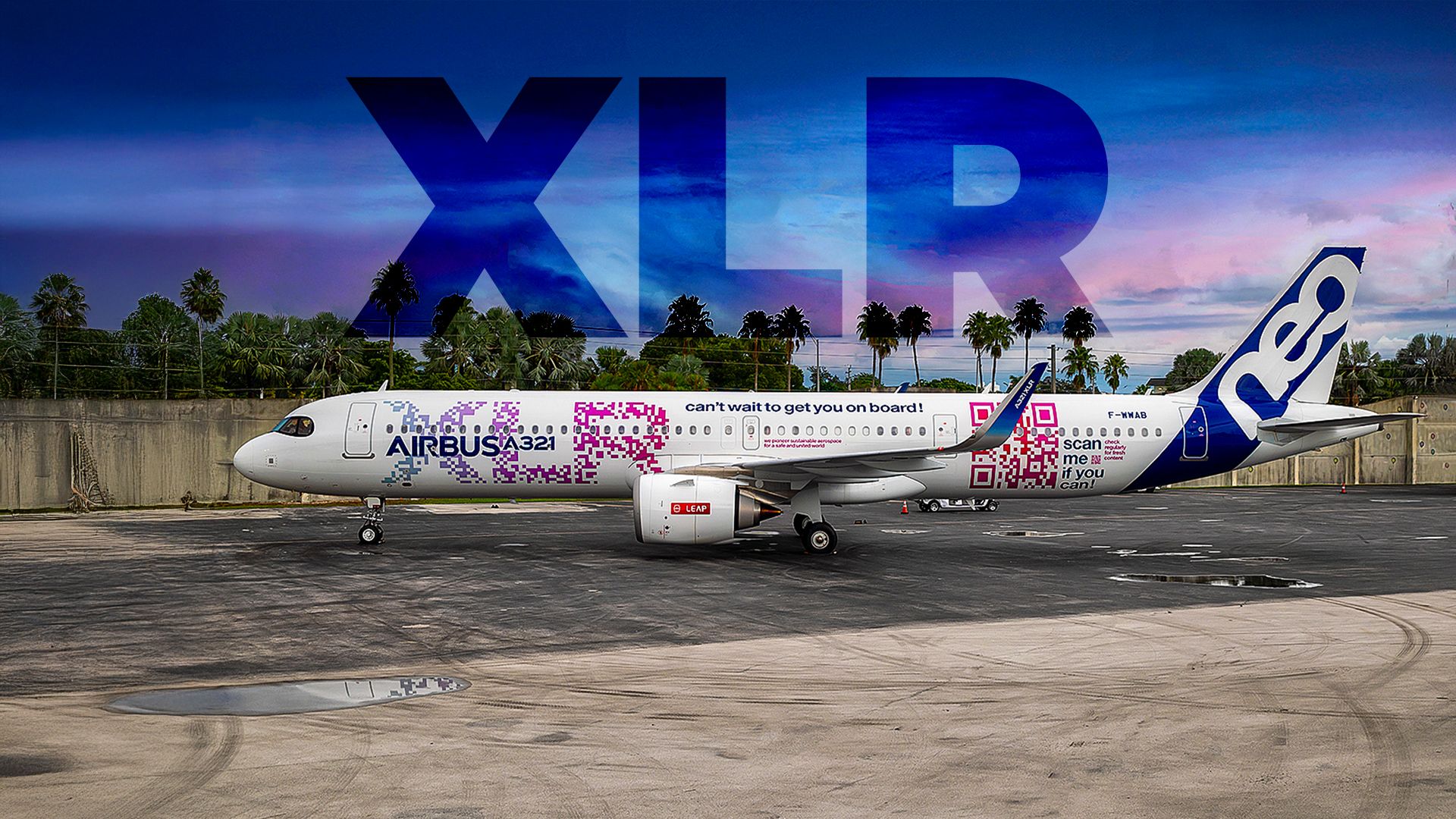
We live in an era where many airlines are constantly seeking ways to unlock new routes and improve cost-efficiency. The emergence of long-range single-aisle aircraft has significantly reshaped the aviation landscape.
In our guide, we will explore how Airbus has revolutionized long-haul travel, but not with massive widebody jets as one might think, but through the clever evolution of its single-aisle family. We’ll look in particular at how the deployment of the Airbus A321LR and subsequently, the Airbus A321XLR changed the game: opening up new direct routes, enabling operators of all kinds to fly thinner long-haul markets, and making narrowbodies viable in what used to be a widebody domain.
From Narrowbody To Long-Reach: The Rise Of The A321LR

To start, the transformation truly began with the A321LR. The A321neo family had been successful in extending the range compared to earlier single-aisle jets, but the Long Range (LR) version pushed things even further. With additional center tanks, a higher maximum takeoff weight (MTOW) of around 97 tons, and a range of about 4,000 nautical miles (7,400 km) in a two-class 206-seat configuration, the A321LR enabled operators to serve thinner long-haul markets that were previously only accessible to widebody aircraft.
What this meant in practice was that airlines could open routes, such as trans-Atlantic services from smaller European airports to secondary US and Canadian cities, or deploy narrowbody aircraft on intra-regional long-haul markets, with lower seat costs and a lower risk of underfilling. Indeed, because the A321LR shares commonality with other A320 family aircraft (cockpit, maintenance, and training), the operational cost base is lower than that of a widebody.
From a commercial standpoint, the A321LR was a stepping stone: it demonstrated that narrowbody economics could carry you beyond familiar short- to medium-haul segments, and could in fact offer airlines a new way to serve “long but thin” markets. This challenged the prevailing logic that only widebody aircraft could operate on long-haul routes. By doing so, Airbus set in motion a new paradigm. Which, in fact, wasn’t so new, as Boeing had already tried to fill in this “middle of the market” gap with its successful Boeing 757 model. It’s unfortunate that Boeing ceased production of this aircraft and did not present a viable alternative. So, Airbus seized this opportunity and provided a plane that many airlines were seeking.
Game-Changer Moment: The A321XLR Opens New Routes

While the A321LR made an impact, the true revolution came with the introduction of the A321XLR. Airbus morphed the single-aisle design further: increasing MTOW to around 101 t, adding a permanent Rear Centre Tank (RCT) holding approximately 12,900 liters of fuel, and extending range up to approximately 4,700 nm (8,700 km) or about 10 hours of flight time. Airbus describes the A321XLR as “the lowest-risk solution for airlines to open new long-haul routes.”
Industry observers recognized the shift. An analysis from Skift states that “this plane is about to change the industry, adding that the A321XLR “looks set to reshape the economics of international flying for airlines and provide greater point-to-point connectivity.” From a market perspective, by early October 2024, Airbus had nearly 500 A321XLRs on order, indicating strong interest from airlines, according to the Aviation Week Network.
|
Variant |
Range |
Typical seats (2-class) |
Key benefit |
|
A321LR |
4,000 nm (7,400 km) |
180-220 |
First narrowbody long-haul step |
|
A321XLR |
4,700 nm (8,700 km) |
180-220 |
Extra-long range single-aisle opens new routes |
The table highlights how Airbus has extended the capability of the single-aisle platform, enabling airlines to consider direct services that were previously uneconomic or impossible. What this means for airlines is indeed revolutionary: they can serve new city-pairs, avoid hub dependency, and operate with lower risk.
For example, more minor origin/destination pairs. Consider secondary cities in Europe, such as those on the US East Coast, or intra-Asia/Australasia flows, as viable options. The A321XLR thus flips the model: rather than only “big plane, high volume,” you can have “smaller but long-reach, fine-tuned to demand”. That is precisely what is happening with many airlines that have ordered this aircraft type.

The Striking Differences Between The Airbus A321LR & A321XLR
The A321LR is designed with the flexibility to have more tanks while the XLR is designed to permanently serve longer-haul routes.
Narrowbody Advantage On Traditional Long-Haul Markets

Having established that Airbus has extended single-aisle reach, the next layer is analyzing how this impacts traditional long-haul operators and route economics. The deployment of the A321LR/XLR allows carriers, even those historically operating widebodies, to be more cost-effective on low-capacity routes.
For example, consider a long-haul market where demand is steady but insufficient to justify operating a widebody twin-aisle every day. Using a narrowbody aircraft like the A321XLR, the operator can lower seat costs, reduce weight, and simplify logistics while still offering long-haul comfort. Airlines can capture revenue on “thin long-haul” corridors with better economics, characterized by lower fuel burn per seat, fewer crew members, and less complexity. According to Airbus, the A321XLR offers up to 30% lower fuel burn and CO₂ emissions per seat compared to previous-generation aircraft.
Moreover, narrowbody long-haul aircraft enable traditional carriers to open new routes without incurring the full risk of widebody operations, or to supplement existing widebody capacity during seasonal peaks or off-peak markets. Airbus itself frames the A321XLR as “complementing widebody aircraft by serving the same routes at off-peak times or in cases of significant seasonal variation in demand.”
This unlocks operational flexibility: an airline can scale up or down capacity, test new markets with lower commitment, and challenge legacy hub-and-spoke models by offering more point-to-point services. As noted in recent industry coverage in Business Insider, “Your next ride across the Atlantic may be smaller than you expected,” with narrowbodies increasingly used for trans-Atlantic flights.
The Broader Impacts: Route Networks, Airlines, Passengers

Building on the previous sections, it becomes clear that the introduction of the A321LR/XLR is not only about aircraft specifications, but about the broader re-engineering of airline networks and strategies. For airlines, these jets change the way they think about connectivity. Secondary airports become direct long-haul nodes rather than feeders into hubs. Carriers can diversify their route portfolios, reduce their dependence on large-volume flows, and open new city pairs that were previously dismissed.
For passengers, benefits include fewer transfers, new city destinations, and often competitive fares, thanks to the cost efficiencies of narrowbodied long-haul aircraft. The cabin experience has also improved: the A321XLR features Airbus’s “Airspace” interior, which includes comfort features typically associated with widebody aircraft, such as larger bins, improved lighting, and full-flat business seats in some layouts.
From a network planning perspective, airlines can match capacity more closely to demand. In effect, the capability divide between short- and medium-haul (single-aisle) and long-haul (twin-aisle) is being blurred. The A321XLR allows single-aisle aircraft to encroach into what was twin-aisle territory.
Operationally, the benefits are substantial: the A320 family’s commonality means that airlines already operating A320 or A321 aircraft find the step to XLR less disruptive. Training, maintenance, and spares all benefit. As Airbus highlights, the A320 family strategy embodies a genuine family concept, featuring cockpit commonality and flexible deployment.
In short, the ripple effects go across airlines, airports, passengers, and the economics of air travel. The model of “fill a big plane or don’t fly” is being challenged by “fly with the right size plane for the route”.

Can The Airbus A321XLR Replace Widebody Aircraft on Long-Haul Routes?
Is there a place for both narrowbody and widebody aircraft on long-haul routes?
Challenges And Considerations

Of course, this revolution is not without caveats. Airlines and operators must still weigh several practical factors before ditching the widebodies (and no, widebodies cannot be entirely replaced, and they shouldn’t). First, cabin comfort expectations: although the narrowbody cabins are now very capable, some passengers still expect twin-aisle widebody comfort on longer flights, such as more aisles, larger and comfortable lavatories, wider seats, etc.
Some carriers may need to manage passenger perception when deploying narrowbodies on long-haul. For example, the A321XLR offers full-flat business seats and Airspace cabin features, but its narrower fuselage still imposes certain limitations, and many travelers might feel more uncomfortable or even claustrophobic in a narrowbody during a long-haul flight.
Second, operational range vs payload: extending a single-aisle to long-haul often means trade-offs in payload or range, meaning that airlines may need to reduce seat count, limit cargo, or accept a lower margin per seat to reach farther. The certification process for the A321XLR even saw Airbus adjust its range expectations due to the weight added for the fuel tank.
Third, economics remain very route-specific: while narrowbodies reduce the cost per seat, the absolute revenue potential is lower than that of a large widebody. If demand grows substantially, airlines may still require widebody capacity for high-density long-haul markets. So narrowbody long-haul is a complement, not a full replacement. The right aircraft on the right route with the right cabin configuration still matters, and we will see both narrow and widebody aircraft flying together for a long time to come.
What’s Next: Future Outlook For Long-Haul Single-Aisles

Now let’s consider where the revolution may lead. With the A321XLR already making headlines, we can anticipate several trends.
Firstly, more airlines (including legacy carriers) will deploy long-haul single-aisles on “thin” trans-oceanic markets or niche point-to-point services. As noted earlier by Business Insider, the data indicate a strong uptick in narrowbody trans-Atlantic flights, with around 56,500 scheduled in 2025, a 50% increase over 2019.
Secondly, aircraft manufacturers will respond: Airbus will continue to refine the platform, and competitors (e.g., Boeing with a New Mid-Market Airplane (NMA) concept and possibly lesser-known players from China and Russia) may accelerate the development of their own mid-market or long-range narrowbody solutions. The competitive pressure and market shift may yield innovation.
Thirdly, airlines may restructure their fleets and networks accordingly. Some widebody routes may transition to narrowbody operations if demand is lower; some airports may see new nonstop services that were previously unviable; and hub-and-spoke operations may evolve toward more point-to-point connectivity.
Looking ahead, expect more airlines to adopt this model, more “unexpected” airports to establish direct connections, and increased competitive pressure on traditional widebody routes. In the evolving world of aviation, practicality often trumps scale, and Airbus’s long-range A321 variants have shown how.
source
