

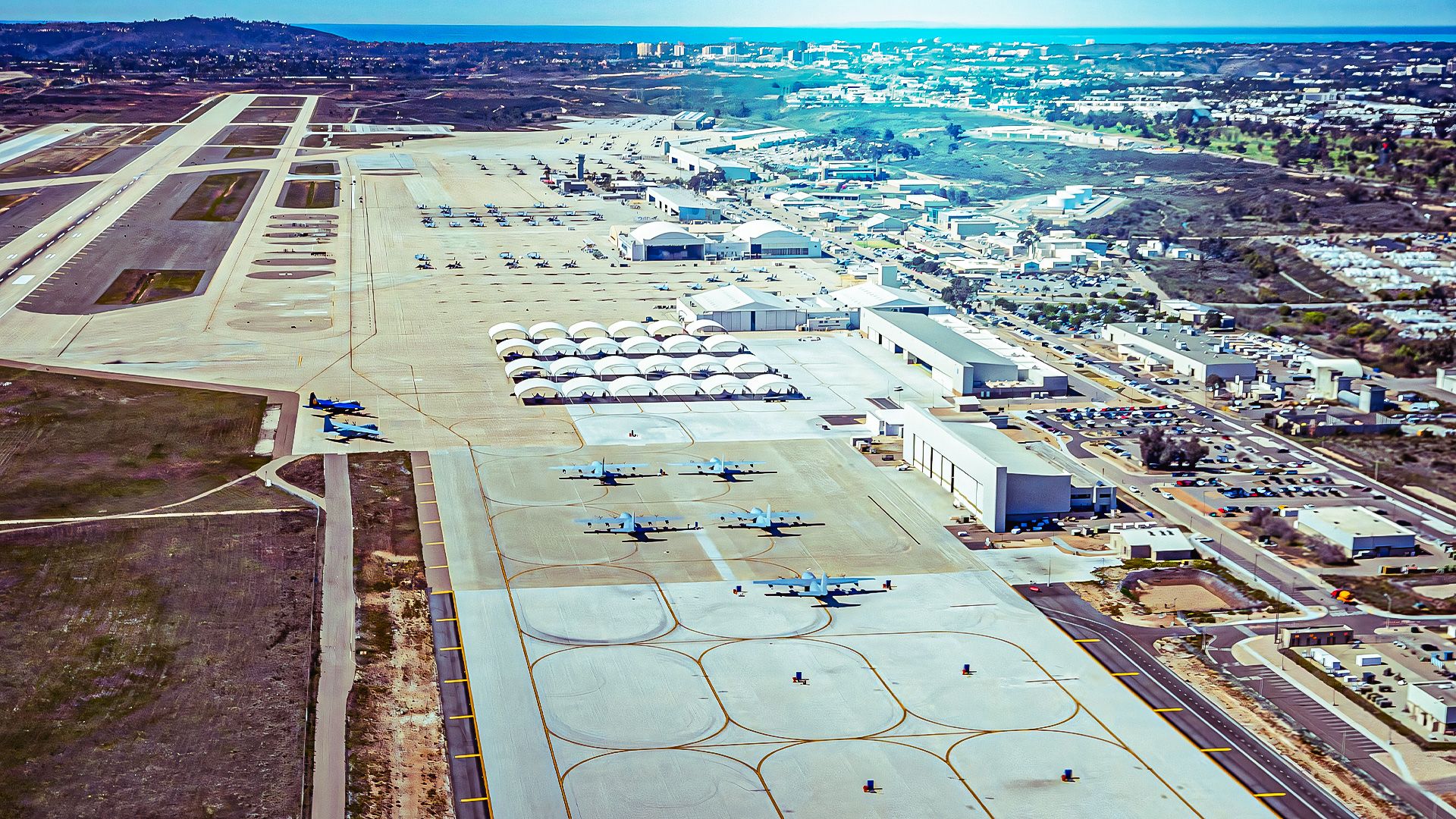
The United States Air Force has some of the largest and most famous military bases anywhere in the world. But when it comes down to size, the question is which one is ultimately the largest of all the air bases. In this review, we are going to break down the seven biggest pieces of real estate owned by the USAF anywhere in the world.
As the largest air force of any military on the planet, the USAF not only has thousands of aircraft but also numerous ballistic missile sites and extensive facilities to support operations and logistics. So let’s get down to it and go down the list, starting with the smallest entry first.
7
Fairchild Air Force Base
21 square miles (56 square kilometers)

Fairchild AFB is located just southwest of Spokane, Washington. The base is a critical component of the Air Mobility Command and serves as one of the largest aerial refueling hubs in the USAF. The host unit, the 92nd Air Refueling Wing, operates a large fleet of KC-135 Stratotanker aircraft.
The base is also home to the Air Force’s only Survival, Evasion, Resistance, and Escape School. This facility trains roughly 20,000 students annually on how to survive being shot down and captured under the worst conditions possible.
The 36th Rescue Squadron supports both the SERE School and the entire Pacific Northwest region across a four-state area. The Air National Guard’s 141st Air Refueling Wing and the Joint Personnel Recovery Agency, as well as an Armed Forces Reserve Center, are all located at Fairchild AFB.
6
Kirtland Air Force Base
68 square miles (175 square kilometers)

Kirtland AFB is home to the nuclear command and Logistics arm of the Air Force Global Strike Command. The unit is a critical component of the US nuclear triad. The Space Force’s Delta 15 is headquartered at Kirtland. The base is one of the largest employment sources in the state of New Mexico, with 20,000 personnel, including troops and civilians.
The base also hosts the Air Force Research Laboratory Directed Energy Directorate and the Space Vehicles Directorate. These units are focused on the development of advanced laser, microwave, and space-based technology.
The base supports over 100 mission partners and units, including the Department of Energy’s Sandia National Laboratories and Los Alamos National Laboratory, the Defense Nuclear Weapons School, and various Air National Guard and Reserve units.
5
Edwards Air Force Base
469 square miles (1,214 square kilometers)

Edwards AFB is very deep in the Mojave Desert of Southern California, where it is home to around people doing some of the most advanced flight testing and research performed anywhere in the world. The base hosts the US Air Force Test Pilot School as well as NASA’s Armstrong Flight Research Center in the Air Force Research Laboratory. A number of government agencies and leading aerospace companies like Lockheed Martin, Boeing, and Northrop Grumman maintain permanent facilities on their campus.
Edwards is the headquarters for the Air Force Test Center. The bed of Rogers Dry Lake provides a 65 square mile natural runway that offers a virtually perfect emergency landing area as well as a testing surface for many experiments. The base also has the largest anechoic chamber in the world for testing aircraft electronic and radio frequency systems.
Air Force Captain Chuck Yeager was the first human being to break the sound barrier when he flew the Bell X-1 rocket plane over the speed of sound at Edwards AFB in 1947. Since then, Edwards has been at the forefront of jet development with the X-Plane series of increasingly faster supersonic prototypes being developed at the base.
The development of stealth technology also had its first steps at Edwards with the Lockheed Martin F-117 Nighthawk in the 1980s. Lockheed’s Skunk Works division also developed the F-22 Raptor and F-35 Lightning II at Edwards. Northrop Grumman tested the B-2 Spirit stealth bomber extensively at Edwards, and its successor, the B-21 Raider, is now flying over its airfield.
NASA and Lockheed are testing the X-59 Quesst (Quiet Supersonic Technology) at Edwards, which is working toward a low-boom design that will allow for renewed supersonic commercial aircraft development. It took its first flight at the end of October 2025. The base was even home to the NASA space shuttle program until 1991.
4
Eglin Air Force Base
724 square miles (1,875 square kilometers)

Located in the northwest corner of Florida, dubbed the Panhandle, Eglin AFB is the primary test and evaluation center for all USAF weapons, navigation, and guidance systems. This installation hosts almost 20,000 military, civilian, and contractor personnel from the Air Force, Army, and Navy. The space force also has AN/FPS-85 radar on the campus for space surveillance.
The Air Force Special Operations Command has a large presence on the base, including the Air Force’s only Reserve Special Operations Wing, the 919th. The 33rd Fighter Wing is located on the base, which is a joint training unit for both pilots and maintainers of the Lockheed Martin F-35A Lightning II.
To facilitate the weapons-centric mission of Eglin AFB, the base manages a vast overwater range extending into the Gulf of Mexico. McKinley Climatic Laboratory tests aircraft and equipment under severe weather conditions, and the Air Force Research Laboratory’s Munitions Directorate calls Eglin home as well.
3
Hill Air Force Base
2,657 square miles (6,928 square kilometers)

Hill AFB manages the Utah Test and Training Range, which is a 1,490 square mile expanse of desert used for testing and tactical training. Hill AFB is home to the first F-35 fighter wing that became operational in the USAF, the 388th Fighter Wing. The 75th Air Base Wing is responsible for running Hill AFB facilities.
The Ogden Air Logistics Complex at Hill AFB manages the life cycle sustainment of the Lockheed F-22 Raptor, F-35 Lightning II, F-16 Fighting Falcon, C-130 Hercules, and A-10 Thunderbolt II. The command is also responsible for the Minuteman III Intercontinental Ballistic Missile.
The 419th Fighter Wing of the US Air Force Reserve is also stationed at Hill AFB. The wing flies the F-16 ‘Viper,’ as the jet is nicknamed, and deploys alongside active-duty units to support combat forces. As many as 20,000 troops and civilians work on the base to support the mission of all the different units stationed at Hill AFB.
2
Barry M. Goldwater Air Force Range
2,969 square miles (7,689 square kilometers)

The Barry M. Goldwater Air Force Range is one of the premier military training ranges in the United States. The enormous base is used for realistic combat training, not only for US service branches, but also for allied partner nations’ militaries. The vast expanse of the range allows for extensive real-world, live-fire air-to-air and air-to-ground tactical training. Around 15,000 people work at the range of the bases associated with it.
In addition to being instrumental as a joint forces, combined arms combat training facility, the base allows for advanced electronic warfare and other tactical scenarios. Range is jointly managed by both Luke AFB and Marine Corps Air Station Yuma. The Army National Guard also uses the range extensively. Almost all Marine Corps Aviation units train at this base before deployment to combat theaters.
Luke AFB is the primary fighter pilot training facility in the US Air Force. The base also recently transitioned to be the main training center for the F-35A Lightning II aircraft for both US pilots and pilots from any of the 19 other nations that also operate the Joint Strike Fighter, as the F-35 is also known. The base is home to the 56th Fighter Wing, which is the largest fighter wing in the USAF.
1
Nellis Air Force Base Complex
5,000 square miles (12,950 square kilometers)

The main facility of Nellis AFB is situated in the northeastern corner of the Las Vegas Valley, hosting 15,000 troops and civilian staff. The base has long been a hub for advanced combat Aviation training. Every year, the International Air Warfare exercise known as ‘Red Flag’ is held at Nellis. The airfield is home to the Air Force Warfare Center as well as the 99th Air Base Wing and the aerial demonstration team known as the Thunderbirds.
The gargantuan military complex includes the Nevada Test and Training Range, Creech AFB, and the Tonopah Test Range (TTR). In addition to hosting foreign Air Forces for joint training exercises, the base has a permanent presence of other services, including the Navy, Army, and Marine Corps. Sandia National Laboratories is also located on the base complex, within the boundaries of the TTR facility.
NTTR encompasses approximately 3 million Acres of restricted airspace and land, which is home to the famed, highly classified Area 51 (Groom Lake), as well as TTR. These facilities Have Been instrumental in the development of iconic Advanced aircraft like the Lockheed U-2 Dragon Lady, SR-71 Blackbird, and F-117 Nighthawk. In addition to the Skunk Works projects, Area 51 hosts captured aircraft from adversaries that are reverse-engineered.
Sandia National Laboratories is part of the US Department of Energy. Its primary mission is to ensure the maintenance, security, safety, and reliability of the US nuclear weapons stockpile. The laboratory also contributes to the development of border security technology, renewable energy technology, missiles, advanced computing, satellites, and spacecraft.
Creech is located in Indian Springs, 45 miles north of the main base. It serves as a hub for the testing of remotely piloted aircraft (RPA) and forthcoming collaborative combat aircraft. The vast expanse of the base exists as a safety buffer as well as a physical barrier that enhances the secrecy of the classified activities by leveraging simple geography.
The massive range includes numerous Military Operations Areas and Restricted Areas that are used for a myriad of military training activities as well as research and development. Aircraft, missiles, drones, and other weapon systems are all tested, developed, and stored within the grounds of Nellis AFB.
source
