

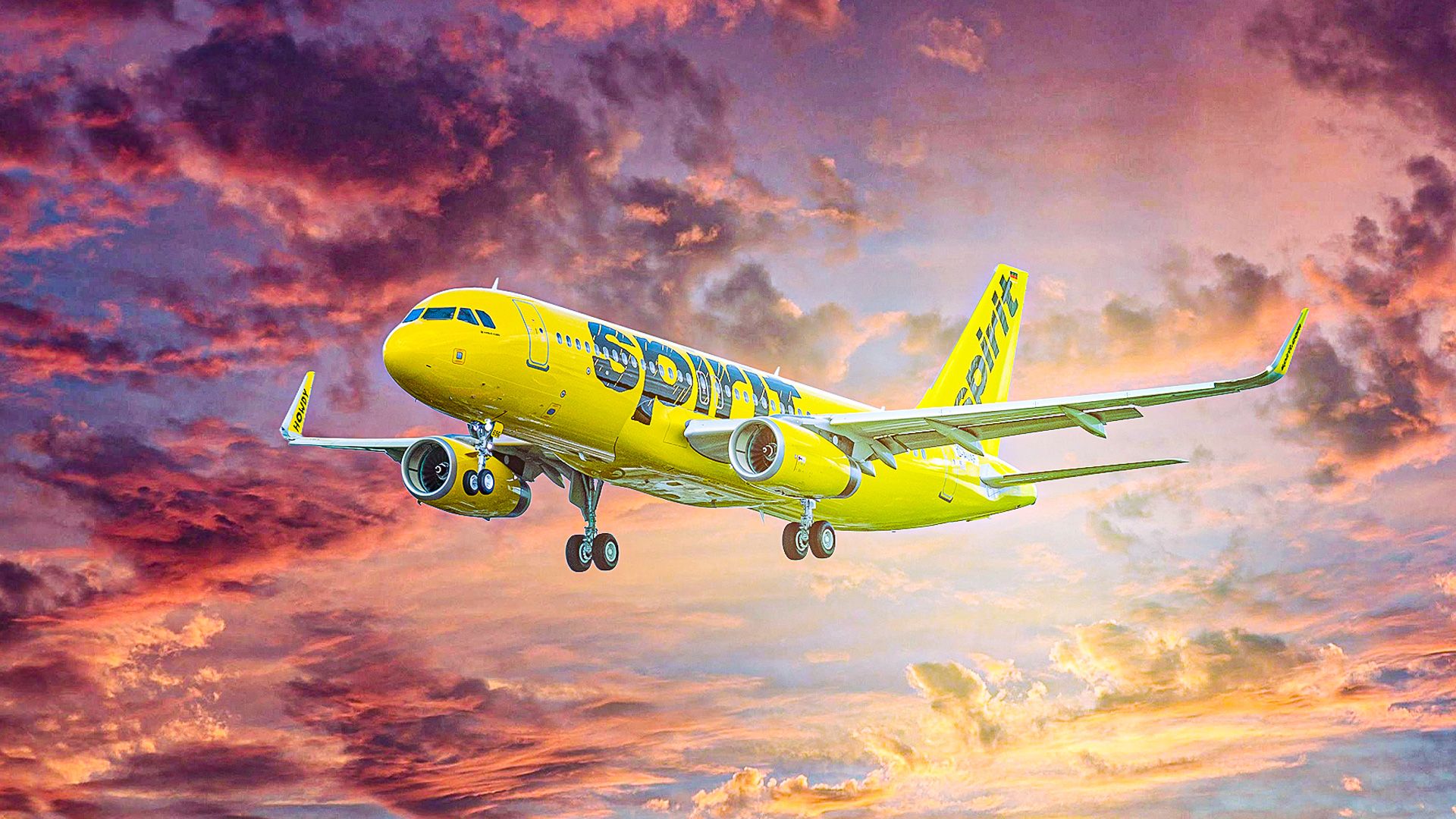
Spirit Airlines is one of the key players in the ultra-low-cost sector of the modern commercial aviation industry in the United States of America. It has made its name with cheap fares, a bright yellow livery, and a reliance on ancillary fees, but, in recent years, the carrier has begun to also consider premium offerings. What has remained consistent, however, is its all-Airbus fleet.
Spirit Airlines used to fly rear-engined DC-9 and MD-80 family narrowbody twinjets from US-based planemaker McDonnell Douglas, but now favors those offered by the European manufacturer. Its fleet today features a fascinating mix of previous and current generation models, with the portfolio as a whole only getting newer and newer. Let’s take a closer look at Spirit’s fleet.
The New Generation

According to present fleet data made available by ch-aviation, Spirit Airlines currently has a grand total of 214 aircraft at its disposal. Of these 123 (57.5%)are from the new A320neo series, split between 91 A320neos and 32 A321neos. The former aircraft are 4.4 years old on average, while the latter have a figure of 1.5 years, compared to a fleet-wide mean of 6.5 years old.
aeroLOPA shows that Spirit’s A320neo and A321neo jets both have eight ‘Big Front’ seats, with these being laid out four-abreast in a 2-2 configuration that mirrors that of domestic first class at US legacy carriers. Behind these are 174 economy seats on the A320neo and 227 on the A321neo. Spirit was the first US airline to get the A320neo in 2016, when Airbus’s John Leahy said that:
“The A320neo family is the aircraft of choice among the world’s airlines, and we appreciate our customers’ confidence in our leading single-aisle family with its unbeatable productivity and fuel efficiency.”
Older Aircraft

On the older side of things, Spirit Airlines also currently has 91 aircraft at its disposal (42.5%) from the older Airbus A320ceo family. Much like with the A320neo series, the standard A320-200 is the more popular of the two variants that Spirit Airlines flies at present, with 62 examples in its fleet (plus two historical units). These are its oldest jets, as they clock in at an average of 11.2 years old.
Meanwhile, Spirit Airlines’ 29 examples of the Airbus A321-200 (plus eight historical units) are 8.8 years old on average, putting them just above the previously noted fleet-wide mean figure of 6.5 years old. As far as the configurations of Spirit Airlines’ older aircraft go, its A320-200s mirror its A320neo jets when it comes to their layout, with eight ‘Big Front’ and 174 economy class seats.
However, the larger Airbus A321-200 is slightly different to the new A321neo with regards to its seating configuration, and represents a slightly lower-density affair. Indeed, while both jets have right ‘Big Front’ seats, there is only space for 220 economy passengers on the A321-200, compared to 227 on the A321neo. As a result, their standard sear pitch is marginally less tight.
Outstanding Orders

Spirit Airlines also used to fly the short-fuselage Airbus A319-100, with ch-aviation showing that 35 examples of the type served the carrier over the years. Despite being its smallest Airbus jets, they had the largest ‘Big Front’ cabin, with 10 of these seats ahead of 135 in economy. Spirit initially ordered A319neo jets to replace them, but shelved these purchases back in 2023.
Instead, the carrier opted to convert these orders to the larger A321neo. At the time, Spirit represented around 40% of the backlog for the A319neo, and its withdrawal has raised considerable question marks over the long-term viability of the program. Following this conversion, Spirit Airlines now has another 32 examples of the stretched-Airbus A321neo on order.
The carrier also has outstanding orders for another 25 examples of the standard Airbus A320neo. However, there is some uncertainty surrounding the future of its fleet, given its ongoing financial issues. Indeed, Simple Flying reported just last month that the carrier plans to remove almost 100 aircraft from its portfolio, with the ultimate goal of becoming a smaller but stronger airline.
source
