

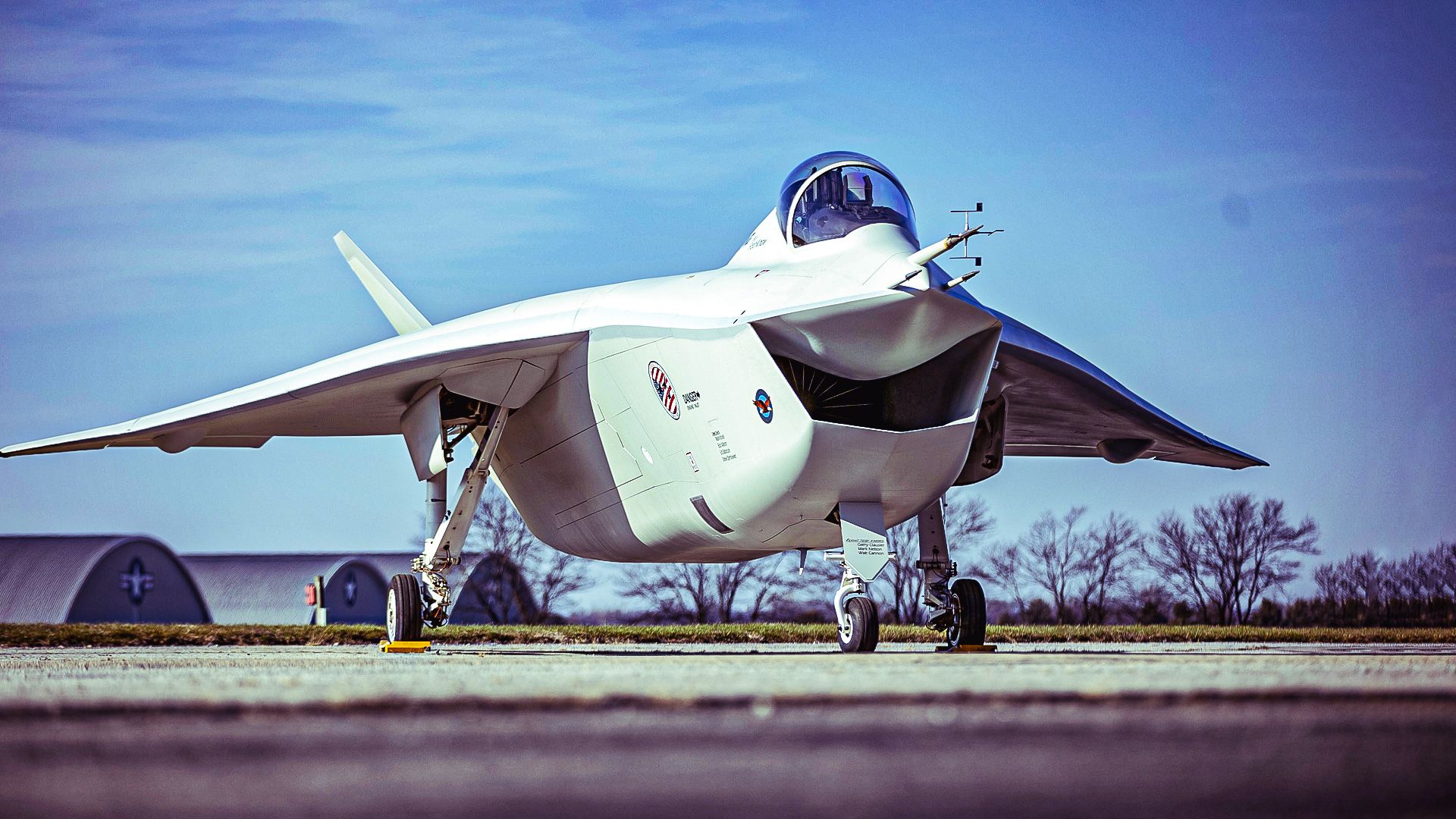
In the early 2000s, the United States military made one of the most consequential decisions in aviation history: it chose Lockheed Martin’s X-35 design, later developed into the F-35 Lightning II, over Boeing’s futuristic X-32, the plane that might have become the F-32. What seemed like a straightforward competition between two stealth fighter prototypes has since grown into a symbol of ambition, failure, and the long-lasting echoes of lost opportunity. The Boeing X-32, despite its odd looks and experimental engineering, represented a radically different vision for the future of American airpower, one that still lingers in the background of every discussion about the F-35 and next-generation fighters.
Today, the “ghost of the X-32” haunts the US military not because the aircraft itself was flawed beyond redemption, but because its story reveals uncomfortable truths about how America builds its most advanced weapons. From the high-risk gamble of the Joint Strike Fighter (JSF) competition to the lessons that still shape procurement today, the X-32’s legacy endures as both a warning and a missed chance. To understand why the military still feels its absence, we must look back at the origins, design philosophy, technical trials, and industrial impact of Boeing’s most ambitious stealth fighter.
The Joint Strike Fighter Program

The JSF program began with the Pentagon’s dream of a single, modular fighter platform that could serve three branches of the military: the Air Force, Navy, and Marine Corps. This “one-size-fits-all” concept promised huge savings and shared technology, but it was an engineering nightmare.  Boeing and Lockheed Martin were chosen to produce competing prototypes, known as the X-32 and X-35, to prove their concepts. Winning meant a contract worth hundreds of billions of dollars and decades of guaranteed production.
Boeing’s proposal emphasized manufacturing simplicity and cost-effective design. Engineers aimed for large, easily produced components, a delta wing for stability, and a single large engine for all three variants. The company believed this approach would translate into lower long-term costs and faster mass production, a compelling promise to the Pentagon at the time. It was an audacious bid to redefine how fighters were built.
But the competition wasn’t just about affordability; it was about confidence, flexibility, and survivability. Lockheed’s X-35 demonstrated technological maturity, while Boeing’s simpler design began to show cracks under scrutiny. The JSF contest became less a technical race and more a referendum on risk management, one that would leave Boeing on the losing side of history.
The STOVL Struggle: Boeing’s Fatal Engineering Gamble

One of the JSF’s most demanding requirements was the Short Take-Off and Vertical Landing (STOVL) capability, critical for the Marine Corps’ operations on amphibious ships and short runways. Boeing opted for a direct-lift approach, redirecting exhaust downward for lift. On paper, it was simple and elegant. In practice, it was an engineering nightmare. The design created immense heat below the aircraft and made it prone to ingesting its own exhaust, threatening engine stability.
During testing, Boeing’s X-32B could hover, but only barely. Engineers had to rework systems to prevent the engine from overheating, and the aircraft struggled to transition smoothly between vertical and forward flight. Lockheed’s competing lift-fan system, though more complex, proved more efficient and stable. The US Marines were impressed by the X-35’s demonstration, which looked seamless compared to Boeing’s strained performance.
In the end, Boeing’s STOVL solution was viewed as too risky and immature for production. The company’s decision to bet its design on a difficult propulsion concept undermined its chances. The lesson still resonates in military aviation circles: innovation without reliability is a gamble few can afford to lose.
Stealth and Shape: When Design Meets Visibility

Stealth was at the heart of the JSF program, but Boeing’s X-32 design came with compromises. Its most distinctive feature, a wide, smiling chin intake, was functional for airflow but problematic for radar visibility. The large, delta-wing airframe also lacked the subtle shaping needed to scatter radar waves effectively. Lockheed’s sleeker, blended-body design was simply better suited to stealth missions in modern combat environments.
Boeing engineers had prioritized ease of manufacturing and aerodynamic simplicity over pure stealth optimization. This philosophy worked well for earlier generations of jets but clashed with the fifth-generation requirements of radar cross-section reduction and infrared suppression. The Air Force evaluators noted that while the X-32 could technically be made stealthier later, Lockheed’s X-35 was already demonstrating superior low-observability.
|
Parameter (Military Factory) |
Specification |
|---|---|
|
Country / Year |
United States / 2000 |
|
Role |
Technology Demonstrator |
|
Length |
45.0 feet (13.72 meters) |
|
Wingspan |
36.0 feet (10.97 meters) |
|
Height |
17.3 feet (5.28 meters) |
|
Max Take-Off Weight |
37,920 lb (17,200 kg) |
|
Maximum Speed |
1,243 mph (2,000 km/h) |
|
Service Ceiling |
50,000 feet (15,240 meters) |
|
Operational Range |
979 miles (1,574 km) |
|
Production Quantity |
2 units |
The haunting truth is that Boeing’s design was, in many ways, ahead of its time, but in the wrong direction. It pursued modularity and cost efficiency before the technology existed to maintain those goals without sacrificing stealth. The result was an aircraft that looked unfinished, a ghost of what stealth could be, trapped between eras of design philosophy.
Confidence Lost: The Redesign That Sealed Its Fate

Midway through the competition, Boeing made a desperate pivot. Engineers realized the original X-32 configuration would not meet the evolving Navy and Air Force specifications, especially regarding agility and payload. The company proposed a major redesign that included a conventional tail and a different wing shape, essentially a new aircraft that existed only on paper when the Pentagon was ready to decide.
This move sent a powerful signal: Boeing didn’t have a production-ready solution. Meanwhile, Lockheed’s X-35 had demonstrated seamless transitions, carrier landings, and a realistic prototype close to the final F-35 configuration. Confidence, always crucial in multi-billion-dollar procurements, shifted decisively toward Lockheed Martin.
The redesign not only cost Boeing the contract but also left a psychological scar within the U.S. military procurement community. It became a lesson taught in acquisition schools: never enter the final phase of competition with a concept still under redefinition. The “ghost” of the X-32 represents every late-stage redesign that shakes trust in a contractor’s vision.
Industrial Consequences: Boeing’s Lost Future in Fighters

The loss of the JSF competition had profound consequences for Boeing’s defense division. The company had long been one of America’s premier fighter manufacturers, with icons like the F-15 and F/A-18 under its belt. Losing the JSF contract effectively ended its path in next-generation stealth fighters, ceding dominance to Lockheed Martin for decades.
This shift also reshaped the American defense industrial base. The Pentagon had become increasingly reliant on a single contractor for the most advanced manned combat aircraft, reducing competition and innovation pressure. Boeing pivoted toward drones, bombers, and commercial aerospace, but its absence from the cutting edge of fighter design still reverberates through the industry.
The haunting aspect of this loss isn’t just corporate, it’s strategic. The US military now faces a future where fewer companies compete for major airpower contracts, concentrating risk in fewer hands. The X-32’s ghost, in this sense, warns of what happens when a single failure reshapes an entire defense ecosystem.
The Ghost in the Hangar: Lessons That Refuse to Fade

Even decades after its loss in the Joint Strike Fighter competition, the Boeing ‘F-32’, or more accurately, the X-32 prototype, continues to cast a long shadow over American military aviation. Its unusual appearance, bold design choices, and eventual rejection by the Pentagon have transformed it into a symbol of what could have been. To military historians and defense analysts alike, the F-32 represents the high cost of innovation when ambition outpaces practicality. Every modern stealth or multirole aircraft that enters testing is judged, in part, against the hard lessons learned from the X-32’s missteps.
For the US military, the ghost of the F-32 is less about a single aircraft and more about a decision that shaped two decades of airpower. The dominance of Lockheed Martin’s F-35, for all its capabilities, also comes with its own set of controversies: budget overruns, maintenance challenges, and political dependence on a single contractor. Had Boeing won, the defense industrial base might look very different today. The X-32’s loss thus serves as a reminder of how one procurement outcome can alter the balance of technological competition, contractor influence, and even foreign policy.
Ultimately, the haunting lies not in the metal of the aircraft, but in the minds of engineers, pilots, and policymakers who wonder whether the United States chose progress or simply convenience. The X-32’s story endures as both a cautionary tale and a quiet inspiration, proof that even failure can fuel the next generation of innovation. In museums and test archives, its delta-winged silhouette stands as a monument to risk, creativity, and the unforgiving nature of defense competition. The Boeing F-32 may never have flown in combat, but in the corridors of the Pentagon, its echo still lingers, a ghost reminding future designers that the line between victory and regret is only a few design choices wide.
source
