

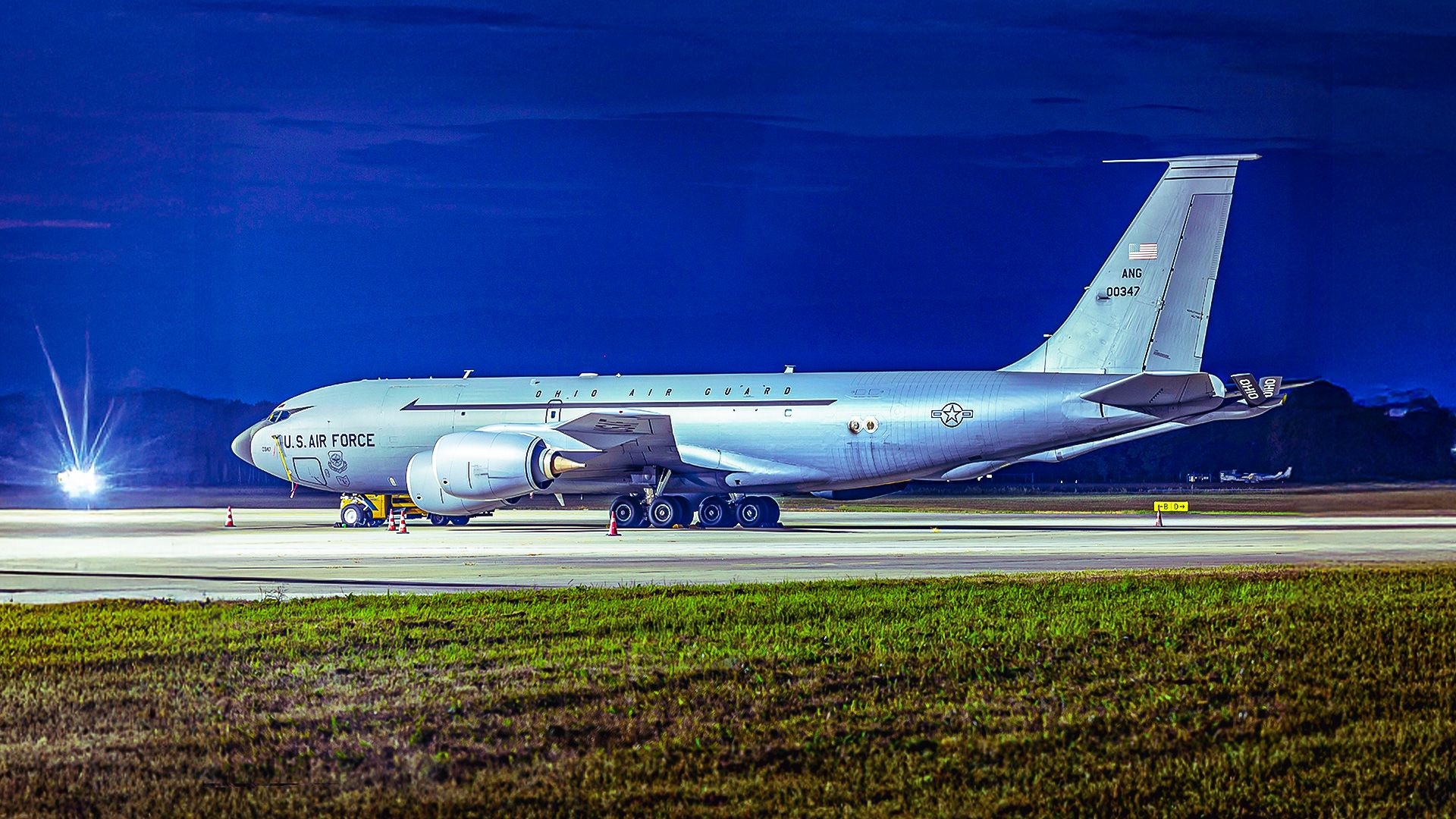
The Boeing 707 was the first widely successful commercial jetliner and served the public to much acclaim for about three decades in mainline service before newer jets like the 737, 747, and 777 came along. The last publicly recorded revenue service flown by an airline-owned 707 touched down in 2013 by Iran’s Saha, according to Jalopnik. However, the hundreds of military variants serving the United States Air Force are still going strong.
The backbone of the USAF’s vast tanker fleet is still the KC-135 Stratotanker, which was developed in parallel with the 707 airliner, and after seven decades, it has no definitive retirement scheduled. Alongside the workhorse Stratotanker are two more specialized jets that have stood the test of time: the E-3 Sentry and the RC-135V/W Rivet Joint.
These aircraft offer a vital capability across three different mission sets that are crucial to the USAF, as well as all the US Armed Forces, and even allied partner militaries that serve alongside them. The big jets were developed to the highest standards and spared no expense, as the arms race of the Cold War was in high gear. That era has faded, leaving little justification to reinvest in all-new platforms, which has given these veteran warbirds an enduring mission.

There is simply no substitute to fill the role of any of the USAF’s legacy 707 platforms. It is true that the KC-46 Pegasus is slowly becoming a larger part of the tanker force, and the E-7 Wedgetail will gradually replace the E-3s, but the enormous cost of each jet means that getting the hundreds of aircraft needed to keep force levels high will take decades. Meanwhile, there is no publicly known program developing a successor to the RC-135 and its electronic surveillance role.
The KC-135 and E-3 do have planned successors, but the ongoing challenge of balancing budgets and working through growing pains has kept the tried-and-true jets in the air. The earliest projected sunset for the E-3 is around 2035, but the KC-135 still has an open-ended timeline. The KC-46 has not yet achieved the full operational capability expected by the Department of Defense (DOD), and investments in other programs, like fifth- and sixth-generation fighters, have tightened the tanker budget, slowing down replacement.
Each of these classic Boeing aircraft still represents powerful elements of the USAF’s strategic capability, and with the upgrades they’ve received over the years, they are even better at their mission than before. The E-7 is a generational leap over the E-3, and the KC-46 brings a simpler, more efficient, and flexible asset to modernize the fleet, but each legacy aircraft is still fulfilling its role well and faithfully.
The wear and tear of decades of service is pushing airframes to the limit of their sustainable lives, driving higher maintenance costs. The older jet engine technology in their powerplants grows less efficient every year compared to modern alternatives as well.
The end of the line is eventually coming for these venerable old jets, but if their cousin, the Boeing B-52 Stratofortress, is any indication, it’s that capability never goes out of style. The “BUFF,” as the B-52 is called, will likely pass a century in service before it retires. We will have to wait and see if the last 707s are there alongside it.
The Fall Of The Soviet Menace

A primary driving factor in why programs like the Next Generation Air-refueling System (NGAS), the USAF’s stealth tanker concept, have yet to come to fruition, is the absence of a near-peer adversary that is perceived as threatening in the eyes of the public and lawmakers. The Soviet Union was a terrible and dangerous foe that demanded ever-improving weapons technology to counter and deter, but with the collapse of that menacing enemy, the US interest in “Star Wars-esque” defense programs also waned.
Today, the naked aggression of Russia as it invaded and continues to occupy and attack Ukraine has reignited a sense of urgency for defense in Europe, especially among allied members of the North Atlantic Treaty Organization (NATO). On the other side of the globe, the People’s Republic of China (PRC) is relentlessly pursuing advanced weapons technology, specifically in stealth technology and advanced missiles. The re-emergence of advanced threats is gradually respooling the momentum of the US defense industry.
In the past decade, significant steps toward modernization have been taken across the US Armed Forces, but the majority of funds have been invested in the new fifth-generation common airframe, the Lockheed Martin family of stealth F-35 Lightning II fighters. That fighter has brought incredible capability to the Air Force, Navy, Marines, and allies of the US around the world. It has also left little room for other advanced platforms to advance.
The Northrop Grumman B-21 Raider will be the world’s first sixth-generation stealth bomber when it enters service in the near future. The US Navy’s first aircraft carrier with a magnetically powered catapult has already been to sea and proven itself, the USS Gerald R. Ford. However, the technology on the E-3 has been eclipsed by the E-7 and even the Navy’s carrier-borne E-2D Hawkeye. Similarly, the KC-135 is a dinosaur compared to the planes it supports, like the F-22 Raptor, F-35, and B-21.
KC-135 Stratotanker

The USAF has been driving to recapitalize the tanker fleet for years, and in large part, it has been successful where it can be. The jets are simply too old to be brought up to speed with an all-new aircraft like the KC-46. At the same time, they still fulfill the core mission of aerial refueling (AR) while the KC-46 has experienced some challenges in certifying to refuel the many different kinds of aircraft that the Stratotanker can support.
The KC-135 may be less efficient and lack the cargo-carrying flexibility of the Pegasus, but it is a proven, reliable platform that gets the job done. The USAF has 376 KC-135s still in active service, compared to just 58 KC-46s. The Pegasus began arriving at Air Force fields in 2018, so going off that rate and ignoring any variables would put a full replacement timeline out another 21 years, roughly.

That means that the Stratotanker will be very nearly a centurion by the time the last sortie launches in 2046. However, there’s no telling how that rate may change with ongoing issues with the Pegasus and funds being pulled from NGAS and KC-135 winglet programs as projects like F-47 Next-Generation Air Dominance (NGAD) move forward.
RC-135V/W Rivet Joint

There are a grand total of just 25 Rivet Joints serving the USAF in the critical roles of electronic warfare (EW) and intelligence, surveillance, and reconnaissance (ISR). These jets are easily identifiable by the large square panels riveted to the forward fuselage, as well as over a dozen antennas along its spine and other spots all over the plane. It is one of the earliest variants of the now-retired C-135 Stratolifter, built at the same time as the 707, and provided the baseline airframe for the other specialized models.
The Rivet Joint’s mission is basically to gather signals intelligence (SIGINT) on adversaries like Russia, the PRC, or even non-state actors like terrorist organizations. It has patrolled the skies since 1961 and kept a close eye on adversarial air forces, ballistic missiles, weapons development programs, and the movements of forces on the battlefield. As the world grows more and more digital, with automation and electronic warfare becoming more important than ever, the RC-135’s job only gets more important.
The intelligence the Rivet Joint collects is used to craft weapons and tactics against emerging enemy systems like new drones, missiles, or stealth fighters. The radio and data messages intercepted and observed by the RC-135 can also create actionable intelligence that informs both battlefield and Pentagon decision-makers. The exponentially more prolific use of drones, stealth technology, and more in warfare makes EW and cyber warfare paramount battlefield domains that can dramatically shift the tide of conflict.
|
Airframe |
Active Number In Service (2025) |
|---|---|
|
KC-135R Stratotanker |
325 |
|
KC-135T Stratotanker |
51 |
|
E-3G Sentry (AWACS) |
16 |
|
RC-135S Cobra Bal |
3 |
|
RC-135U Combat Sent |
2 |
|
RC-135V Rivet Joint |
8 |
|
RC-135W Rivet Joint |
12 |
|
Total USAF Mil-Spec 707’s: |
417 |
The USAF is likely to keep the Rivet Joint flying past 2050, 90 years after entering service. The absence of a planned successor begs the question of what will take over the vital mission it performs, a next-generation replacement or a new strategy altogether using different assets like advanced manned and unmanned aircraft. Only time will tell.
E-3 Sentry

The Sentry came along a little later than its C-135-based counterparts still in service, launching its first missions in the late 1970s. It is also the only one of the three with a clear (relatively) roadmap to retirement. The progress in radar technology, battlefield data networks, and other sensor systems has rendered the E-3 obsolete past the point of modernization. The enormous cost of overhauling a machine as complex as a flying air traffic control (ATC) tower is a Herculean task.
That is where the E-7 Wedgetail comes in, based on the 737, but equipped with a bleeding-edge active electronically scanned array (AESA) radar antenna, the E-7 raises the bar in every category. The radar is made by Northrop Grumman and offers accuracy, range, speed, and features that the E-3’s mechanical array could never achieve. The use of Boeing’s most prolific airliner ever made, as the airframe dramatically improves readiness, efficiency, reliability, and cuts costs on basic maintenance and operation over its lifetime.
The US has yet to take delivery of its first E-7 but plans to acquire 26 of the jets by 2035. It has entered service with South Korea, Turkey, and Australia so far. The program is a critical modernization step for the USAF, but in the meantime, the E-3 continues to serve well. The multi-billion-dollar price tag of the E-7 even has one operator, the Royal Saudi Air Force (RSAF), opting to upgrade its fleet of E-3s and keep them flying instead.
In 2024, the USAF passed over the Army to gain the largest share of the world’s largest defense budget, and that has continued in 2025 with the same expectation for 2026. That hefty bank account has to be shared among a myriad of game-changing, pioneering, breakthrough programs that are pushing the edge of defense technology, like the F-47 and B-21. Sunset is scheduled for 2035, but with no E-7s on the flightline today, we may yet see the Sentry in the skies after 2035.
source
