

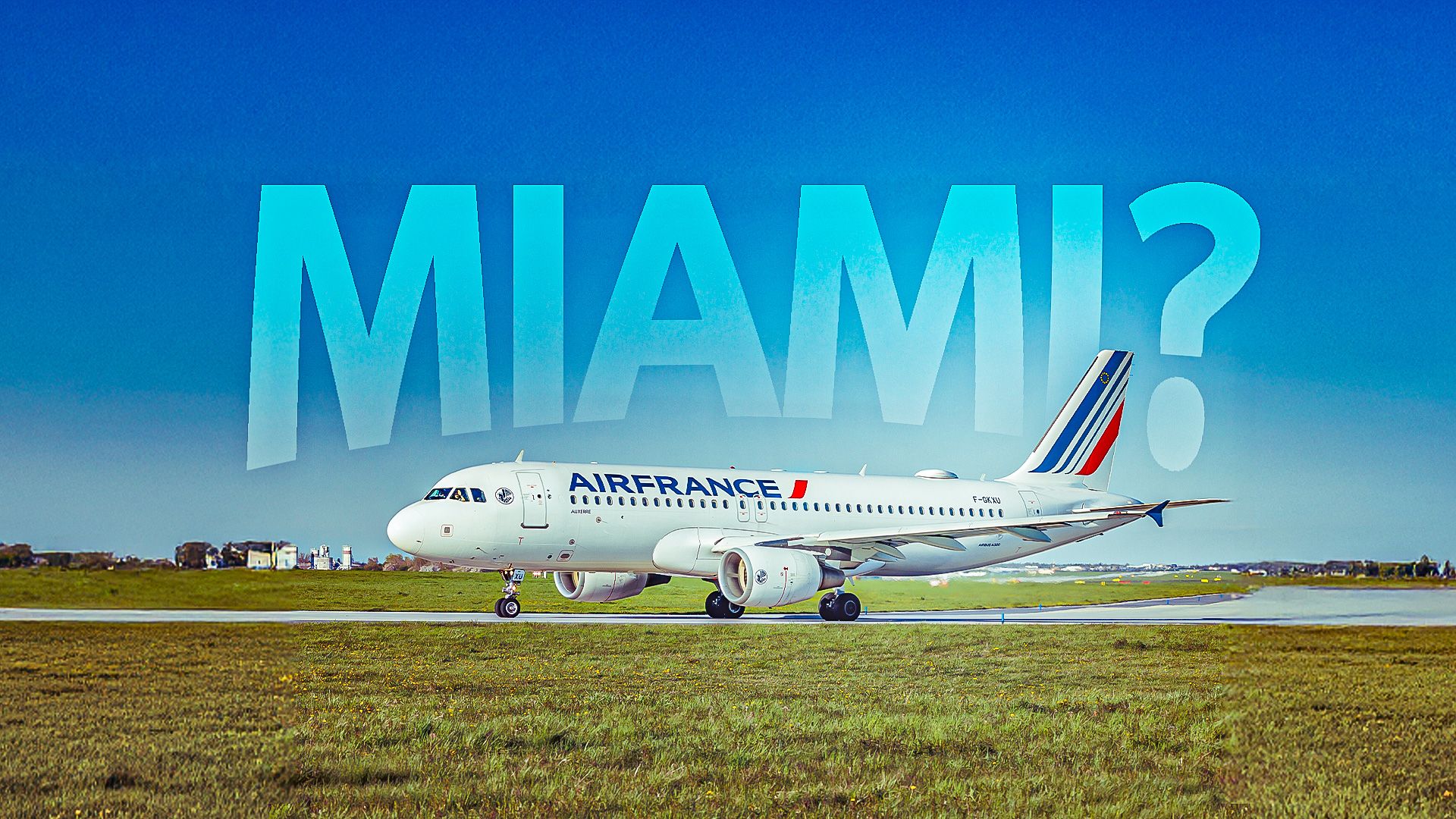
France’s national flag carrier, Air France, operates one of the most unique trans-Caribbean operations you will find. The carrier operates its narrowbody Airbus A320 between  Miami International Airport (MIA) and multiple French overseas departments in the Caribbean and South America. Instead of a single hop to a resort island, this service operates more like a bus or train route in the sky, stopping at multiple destinations, including Pointe-a-Pitre International/Guadeloupe Pole Caraibes Airport (PTP), Martinique Aime Cesaire International Airport (FDF) in Fort-de-France, and ending its journey at Cayenne Airport (CAY) in French Guiana.
For aviation enthusiasts, this is truly a unicorn of a route, and is one of the only such services that exists anywhere in the world. The airline is a European flag carrier actively flying US passengers on an Airbus A320 with a European-style business class cabin (which includes a blocked middle seat and a standard economy seat). For locals, it is far more than a novelty, but rather a dependable link to France’s domestic network and connections onwards. The airline runs this route on a twice-weekly schedule, with northbound morning services and southbound afternoon flights that are designed to dovetail with the carrier’s long-haul banks. This is an unusual blend of practicality and leisure-oriented service, with island-by-island hops stitched together by a single aircraft, crew, and relatively small aircraft.
A Deeper Look At This Island Hopper Service

Air France has a one-of-a-kind operation in which it bases a pair of Airbus A320 jets in the French Caribbean specifically for the purpose of this mission. This pair handles a circuit of routes that links Miami to destinations across the Caribbean and ultimately to South America, a route chain that connects the United States, Guadeloupe, Martinique, and French Guiana, all along the routes already mentioned. Aircraft sequencing can ultimately vary by season, but the overall concept is ultimately consistent, with short legs connecting French territories with a major US gateway hub that sees service from destinations all across the globe.
These aircraft spend their lives in the tropics, serving a mix of local origin and destination traffic, as well as servicing demand from those visiting friends and relatives (VFR), all feeding into Air France’s long-haul route network that flows through Paris, while adding seasonal services to North America that have appeared historically. When onboard, business class service mirrors the standards implemented on intra-European routes, with economy seats being the norm, with a middle seat blocked out. Priority services are offered on the ground to these kinds of passengers, with light upgraded catering on select legs while the rest of the cabin remains in a familiar 3-3 economy-class layout, according to a breakdown of this unique service from Upgraded Points.
From an operational perspective, this route operates as somewhat of a connecting link that would not exist without the geopolitical oddity that is France’s somewhat diversified territorial presence in the Caribbean and Northern South America. Aircraft turnarounds are short by design as crews repeat the takeoff-land-taxi rhythm at multiple different destinations multiple times per day. Those who do not know the context behind this route might be fundamentally surprised to see an Airbus A320 on the ground in the French Caribbean.
A Deeper Look At This Route’s Specifics

There are a handful of specifics that shape the overall passenger experience and operational profile of this route, and they will be discussed now. For starters, the equipment on the route is not only noteworthy but could be the subject of a feature on its own. The Airbus A320 is a core element of Air France’s European fleet, and a small collection of Airbus A320s based out of the Antilles also operate this service, with a European-style business-class cabin and a high-density economy-class cabin.
Airlines will typically serve this route twice per week across hubs that range from Miami International Airport (MIA) to Felix Eboue Airport (CAY) in French Guiana. The total southbound or northbound journeys take roughly eight to ten hours, depending on the amount of time an aircraft may spend on the ground. Because segments cross borders, passengers may encounter immigration or security at intermediate stops, and each leg functions pretty much on its own as a separate short flight.
Individual segments can be priced attractively, and those who are members of Flying Blue, the joint Air France-KLM loyalty program, may be able to get exceptional value through award tickets on these routes. Island weather, air traffic control, and infrastructure constraints can echo throughout a day’s operational pattern, and short stage lengths will often help overall recovery.
What Is Pushing Air France To Operate This Kind Of Service?

The big question that has emerged from our analysis so far is what exactly is driving Air France to operate this kind of service. The answer, at the end of the day, relates directly to the intersection of economics, geography, and sovereignty. Guadeloupe (PTP), Martinique (FDF), and Cayenne (CAY) are all culturally integral parts of France, and, by extension, the European Union. Thus, reliable air links among them, especially to and from Miami International Airport (MIA), help support mobility for residents, public services, and trade.
A narrowbody aircraft like the Airbus A320 is the correct tool for this kind of service. Distances between destinations are moderate, and demand is steady but not uniformly strong to the point that it could support a widebody aircraft. Airport capabilities differ when it comes to the ability to handle a hefty jet like an Airbus A330. Basing Airbus A320s locally allows Air France to tailor its crews, maintenance, and rotations to the region rather than routing every journey through its principal hub in Paris.
This chain also diversifies overall feed, with Miami providing US connectivity and cargo uplift, with the islands crossfeeding each other’s tourism, and Cayenne becoming an alternative for connections to destinations deeper in Latin America. This service is thus a strategic weapon for Air France and for the nation of France as a whole, as it allows the nation’s far reaches to remain connected not just to the outside world and to mainland France, but also to each other.
What Benefits Does This Service Offer For Passengers?

For travelers, the advantages of this kind of service are tangible. The aircraft offers point-to-point access for customers without any awkward backtracking through Miami International or Paris. Passengers can have one single itinerary, which simplifies baggage handling and lowers overall missed connection risks compared to stitching a route together across multiple carriers. Twice-weekly patterns also target peak leisure travel periods, including school breaks, holidays, cruise turns, and other times when demand surges exceptionally.
Individual segments also offer some value and can be priced strongly, with some award charts favoring short-haul award redemptions. Passengers who are used to traveling in Europe will find familiarity in this cabin, with European-style business class cabins offering blocked middle-seat comfort and priority ground handling. Here is a breakdown of cabin capacity on these Airbus A320s:
|
Category |
Capacity |
|---|---|
|
Overall |
174/178 |
|
European Business |
Dependent on bookings/setup |
That’s not to say that traveling economy on this route doesn’t also offer Air France’s award-winning service, something valuable and rare in the Western Hemisphere on legs as short as just an hour. The operational resilience of these aircraft means that delays can sometimes be absorbed later in the day.
What Other Kinds Of Island Hopper Services Are There?

Air France’s island hopper sits among a small set of multi-stop operational runs that are mostly designed around unique geography. One of the closest analogs is likely the Alaska Airlines “Milk Run,” where a single aircraft connects multiple communities in a daily string of stops. In the Atlantic and the Caribbean, regional carriers operate intra-island tags, but few intercontinental brands keep a dedicated narrowbody subfleet overseas exclusively for the purpose.
In the South Pacific, however, there are a few examples of these kinds of flights that are helpful for our discussion. United Airlines operates multiple island-hopping services in the South Pacific, including its famous “Island Hopper” and its less-known “Manila Hopper” services, both legacies of an earlier route network that included continental airlines.
For starters, Air France has also fielded narrowbody services from Guadeloupe to New York and Montreal. These routes also used European-configured Airbus A320s that were fine-tuned to serve local demand without forcing connections in Paris.
What Is Our Bottom Line When It Comes To This Service?

At the end of the day, this unique service brings a lot to the table and demonstrates how geography and politics can shape air transport networks. Services between Miami and destinations all across the Caribbean offer exceptional connectivity for passengers from the Miami area.
Furthermore, it opens up some very interesting connection possibilities in Miami. The airport is served domestically by  Delta Air Lines, an Air France partner airline, allowing for extensive connectivity across the region.
Relatively few operators can say they operate a small narrowbody aircraft an entire ocean away from its principal hub. Well, this unique service is the exception that allows this claim to be accurate for the French flag carrier.
source
