

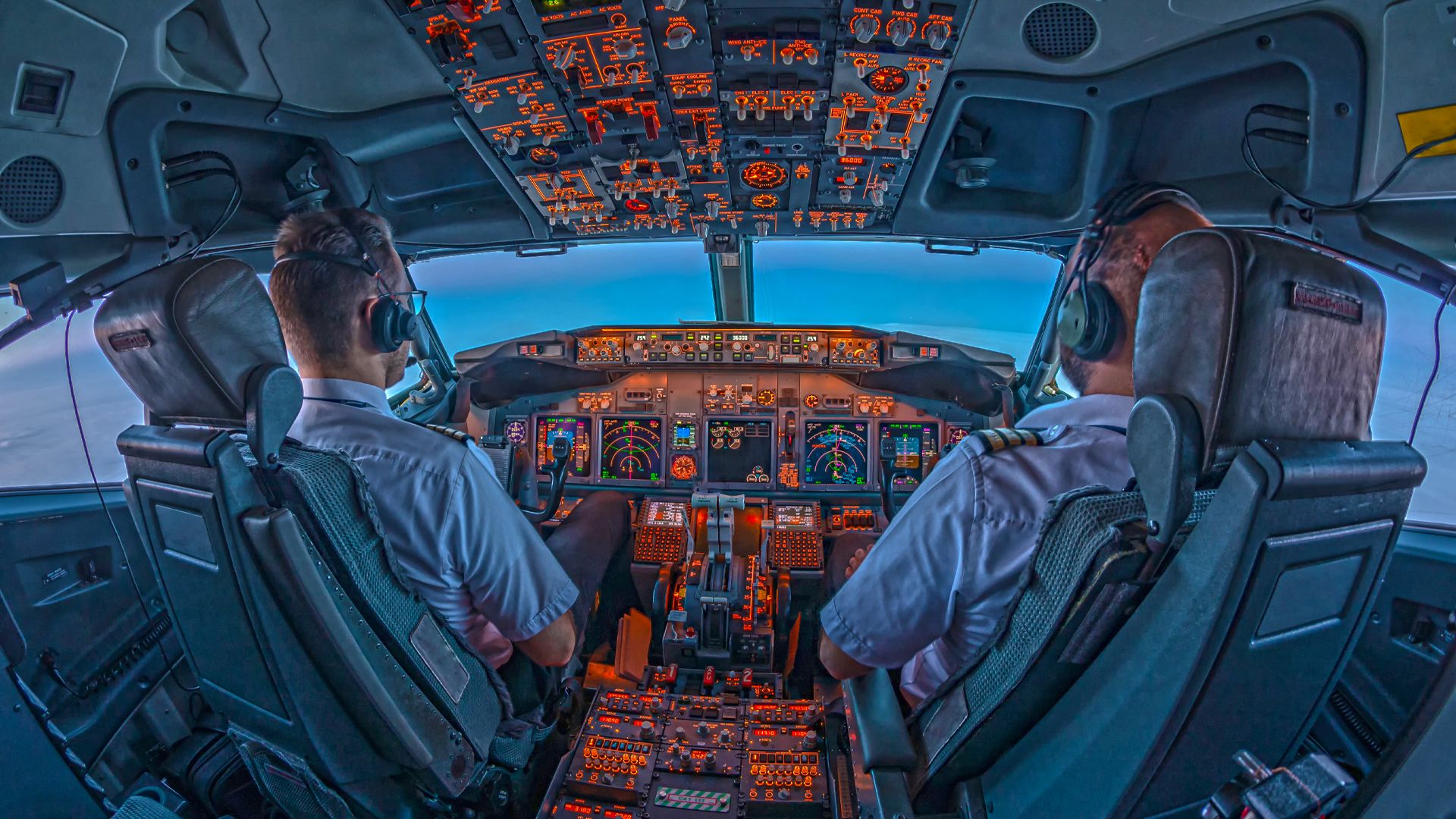
In the flight deck of any commercial airliner, you’ll find at least two pilots. To the right sits the first officer, also known as the copilot or the second in command. On the left is the pilot in command, also known as the captain. While both pilots take turns in flying the plane, as the pilot in command, the captain is legally responsible for the safe operation of the flight and is ultimately the final authority as to the decisions that are made.
In the United States, airline pilots are unionized, and wages are negotiated for years before being written in a contract. While some jurisdictions and airlines place a heavier emphasis on the authority of the captain, US carriers emphasize that the captain and first officer have equal qualifications. However, while the two pilots are meant to be equals inside the cockpit, their paychecks look vastly different. This is how much more a captain makes than a first officer in the US.
Breaking Down The Two Pilots In The Flight Deck

All airliners today require a minimum of two pilots: the captain and the first officer. These are terms that originated from the maritime industry. Despite there being a hierarchy in name, pay, and legal authority, modern Crew Resource Management (CRM) at major airlines worldwide has established that both pilots have an equal say in the operation of the aircraft, and first officers are encouraged to vocalize any concerns or disagreements.
During any flight, pilots split up responsibilities, with one acting as the Pilot Flying (PF) and the other as the Pilot Monitoring (PM). Pilots are scheduled together during a trip, and will typically alternate between being PF and PM. The PF is the pilot tasked with physically flying the aircraft, navigating, and managing the autopilot. The PM is the pilot who handles radio communications, performs checklist tasks, and also cross-checks the PF.
Longer flights require an additional crew member, usually another first officer or a second officer, depending on the airline. Some flights require a fourth pilot, who is usually also a first or second officer, although ultra-long-haul flights operate with a crew of two captains and two first officers. Additionally, captains who are being examined fly with a ‘check pilot,’ who, in the US, is a captain who is certified by the FAA to test and examine other pilots.
Captain Salaries At Regional Airlines

In the United States, pilot salaries are publicly available as these are disclosed in union contracts. After being certified as an Airline Transport Pilot (ATP), newly minted pilots typically work at a regional airline. All airline pilots in the US are hired as first officers, but can typically upgrade to being a captain at a regional airline within a year or two, depending on the aircraft and crew base.
Major US regional airlines include Air Wisconsin, Envoy Air, GoJet Airlines, Mesa Airlines, Piedmont Airlines, Republic Airways, CommuteAir, Endeavor Air, ExpressJet, Horizon Air, and SkyWest Airlines. Pilots are paid hourly, and all three carriers have roughly comparable pay scales. In the case of SkyWest Airlines, the US’s largest regional airline, first-year pilots who are captains are paid $142/hour, while year 20 captains are paid $220/hour, per Airline Pilot Central.
|
Airline |
Operates For |
|---|---|
|
Air Wisconsin |
American Eagle |
|
Envoy Air |
American Eagle |
|
GoJet Airlines |
United Express |
|
Mesa Airlines |
United Express |
|
Piedmont Airlines |
American Eagle |
|
Republic Airways |
American Eagle Delta Connection United Express |
|
CommuteAir |
United Express |
|
Endeavor Air |
Delta Connection |
|
ExpressJet |
United Express |
|
Horizon Air |
Alaska Horizon |
|
SkyWest Airlines |
Alaska Horizon American Eagle Delta Connection United Express |
As a point of comparison, SkyWest first officers are paid $91/hour in their first year, and $107/hour for year seven first officers (the first officer pay scale caps at year seven). At Republic Airways, the US’s second-largest regional airline, first officers are paid $92.73 in their first year and $96.85 in their fourth year, while captains are paid $144.24 in their first year and $222.19 in their 20th year. This is based on the total number of years that a pilot has been with the company.
Captain Salaries At Legacy Carriers

Legacy carriers like American, Delta, and United all have enormous fleets with multiple aircraft types that have different pay scales. The starting rate at  United Airlines for first officers is $120.69/hour on all aircraft types, but rises to $254.99/hour for year 12 on the Airbus A319/A320 and the Boeing 737-700/800/MAX 8. Year 12 first officer pay is $256.33/hour for the 737-900ER/MAX 9, and $265.92/hour for the A321neo, the Boeing 757, and the 767-300ER.
Captain pay in year one is $342.75/hour for the A319/A320 and the 737-700/800/MAX 8, $344.25/hour on the Boeing 737-900ER/MAX 9, and $353.98/hour for the Airbus A321neo, Boeing 757, and Boeing 767-300ER. Depending on the base, upgrade times to captain are typically between two to eight years, but are currently less at the most junior bases (Newark, San Francisco for United) for a narrowbody aircraft.
|
United Airlines Aircraft Categories |
Aircraft |
Domiciles |
|---|---|---|
|
A320 |
A319-100, A320-200, A321neo |
Chicago, Denver, Houston, Los Angeles, Newark, San Francisco, Washington D.C. |
|
B737 |
737-700, 737-800, 737-900, 737-900ER, 737 MAX 8, 737 MAX 9 |
Chicago, Denver, Guam, Houston, Las Vegas, Los Angeles, Newark, Orlando, San Francisco, Washington D.C. |
|
B756 |
757-200, 757-300, 767-300ER, 767-400ER |
Chicago, Denver, Houston, Los Angeles, Newark, San Francisco, Washington D.C. |
|
B777 |
777-200, 777-200ER, 777-300ER |
Houston, Newark, San Francisco, Washington D.C. |
|
B787 |
787-8, 787-9, 787-10 |
Chicago, Denver, Houston, Los Angeles, Newark, San Francisco, Washington D.C. |
The pinnacle of a pilot’s career is widebody flying. At United, the time to move to a widebody first officer is similar to that of a narrowbody captain, and year 12 pay is $317.73/hour for a first officer. For a widebody captain, meanwhile, the hourly rate is $465.13/hour, and, although the pay scale tops out at year 12, it typically takes at least 25 to 30 years to hold this position. United has the largest widebody fleet of any US passenger airline, so upgrade times are slightly lower.
Looking Deeper At Pilot Pay

Pilots do not work the same 40-hour work week as in most other professions. The FAA restricts pilots flying for Part 121 carriers (large airlines) to only 1,000 hours per year, and most pilots rarely come near that limit. At Part 121 carriers, pilots bid on monthly schedules that typically net between 70 and 90 hours. Pilots are also entitled to a minimum guarantee if they fly fewer than a certain number of hours in a month, which is important for reserve pilots.
Additionally, pilots are compensated for trip expenses while on layovers. This is called “per diem,” and pilots are paid the same per diem regardless of their position or aircraft type. Currently, at United Airlines, pilots are paid $2.97/hour on layovers in the Continental US, and $3.54/hour for all other layovers. This is comparable to per diem rates at the other legacy carriers, and current contracts stipulate annual raises in per diem rates.
|
Airline |
Per Diem |
|---|---|
|
American Airlines |
$2.85/hr (domestic) $3.35/hr (international) |
|
Delta Air Lines |
$2.85/hr (domestic) $3.35/hr (international) |
|
United Airlines |
$2.97/hr (CONUS) $3.54/hr (all other) |
Pilots can also pick up extra trips, which can pay one and a half times or even twice as much as a normal trip. These are trips that are typically made available last minute, typically due to callouts, irregular operations, or a lack of staff at a particular base. Due to this variability, pilot pay varies even within the same base, aircraft, and position. However, a common rule of thumb is that multiplying a pilot’s hourly rate by 1,000 gives a close figure to said pilot’s annual salary.
How Airline Seniority Works

For a pilot at a large airline, seniority is everything. This largely determines your schedule, aircraft, base, pay, and position. At a US airline, you have a position on the overall seniority list based on your date of hire (which determines aircraft, base, pay, and position), along with relative seniority in your aircraft/base/position combination. This determines your monthly schedule.
In the US, the only basis for being awarded a particular aircraft/base/position combination is seniority, but some foreign airlines have more structure. Often, you’ll see pilots hired as a narrowbody first officer, then progress to first officer on a widebody. From there, a pilot will move back to a narrowbody as a captain and then upgrade to captain on a widebody. Seniority is still relevant for pay scales and schedule, but it plays less of a factor in deciding your aircraft or position.
Where seniority can become problematic is with airline mergers. Combining two different lists can create issues, as integrating the lists by date of hire can negatively impact the smaller of the two workforces. Meanwhile, integrating by relative seniority can negatively impact the larger pilot group. Currently, the Air Line Pilots Association ( ALPA) favors the second option, although it’s changed its policies numerous times in the past depending on what best suits a situation.
The State Of The Piloting Profession In The US
The US has some of the world’s strictest requirements for becoming an airline pilot, such as the infamous 1,500-hour rule. However, the nation’s largest airlines also have some of the best pay and schedules for pilots out of any airline in the world, and the pilots’ unions are uniquely strong.
One of the major reasons behind the excellent pay and working conditions is the reported pilot shortage. As pilot retirements increase and the nation’s most profitable airlines continue to make money, the unions have leveraged this position of strength to significantly improve pilot pay and working conditions.
In addition, while the 1,500-hour rule has been controversial since its inception, it may have contributed to the improvement of pay and working conditions in the US. The steep requirement limits the supply of pilots, and when the demand for pilots is as high as it currently is, this further strengthens the position of the pilots when negotiating new contracts.
source
