

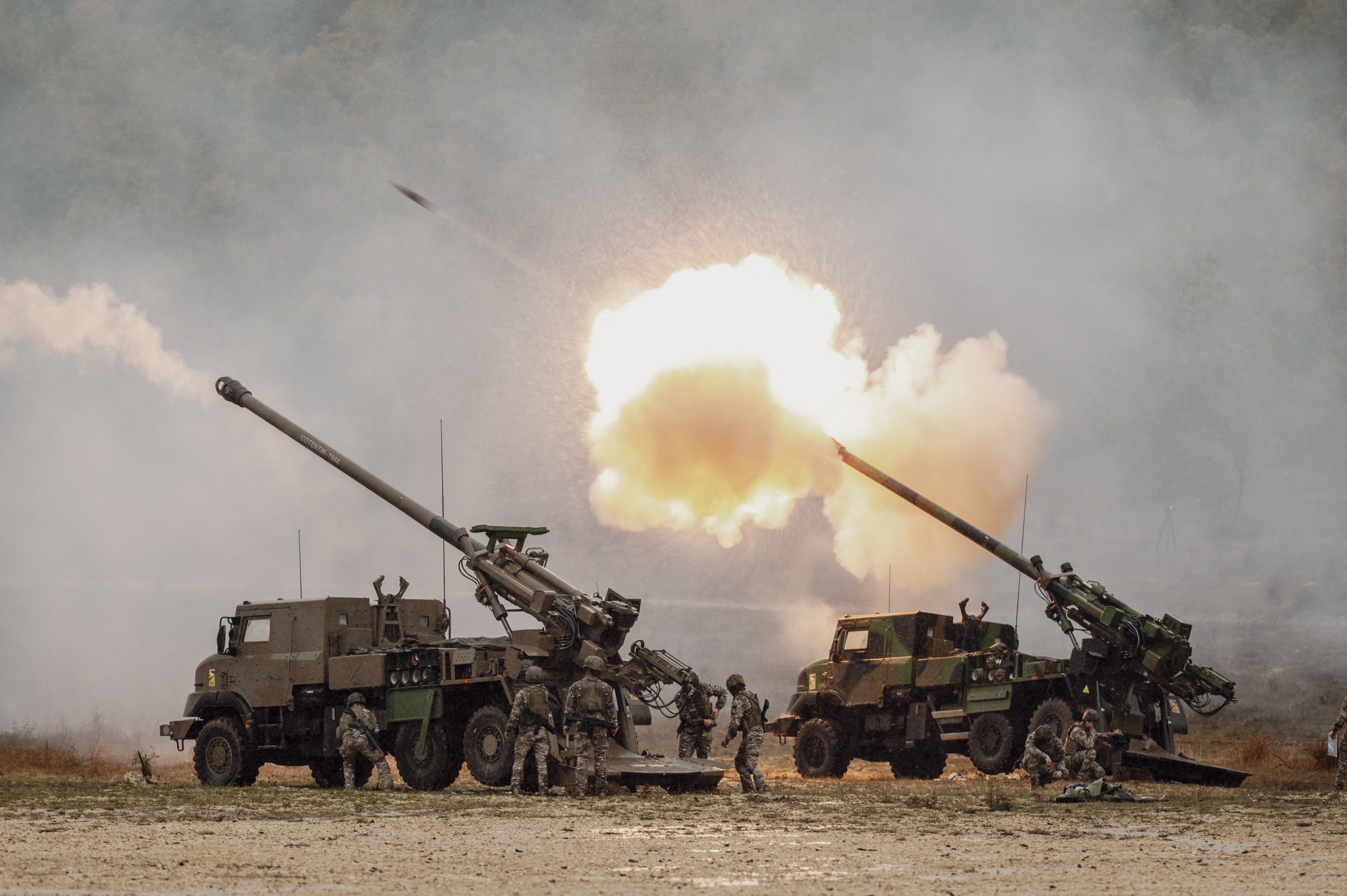
CANJUERS, France — A French Army artillery demonstration in pouring rain in the south-east of the country last week showed the limits of modern warfare: When the weather gets miserable, cannons may still fire, but drones stay grounded.
It’s a lesson already learned in Ukraine, where Russian forces have been timing mechanized assaults with rain and foggy conditions, according to the Institute for the Study of War.
The French Army hadn’t banked on a downpour for last week’s demonstration of unmanned air systems and artillery at Camp de Canjuers, with arms manufacturer KNDS and several foreign military delegations present, after a mostly sunny October at Europe’s largest permanently garrisoned military camp.
The bad weather grounded helicopters, drones and prevented airdrops of equipment and parachutists, while forcing civilian traffic unable to land at nearby Nice airport into a holding pattern over Canjuers that made even artillery fire uncertain.
The demonstration still showed how France’s 35th Parachute Artillery Regiment is trying to adapt to a drone-dominated battlefield, with truck-mounted 20mm cannons, nets, decoys and handheld jammers to protect its howitzer and mortar teams.
For all the attention to drones, feedback from Ukraine shows artillery remains more important than ever, said Lt. Col. Renaud Durbecq, operations and training chief of the regiment, known by its French acronym 35e RAP. The regiment operates the Caesar 155mm howitzer, produced by KNDS, as its main artillery gun.
“Artillery is becoming increasingly important on the battlefield, since our guns are precisely the weapon that allows us to fire at the furthest range – there where, most often, drones cannot go,” Durbecq told reporters at the Canjuers range.
Nevertheless, “dronization” of the 35e RAP is happening at breakneck pace, with five times as many drones in the regiment as a year ago, triple the number of drone pilots and with flight hours doubling, according to the operations and training commander.
The regiment operates the Delair DT46 drone with a range of around 80 kilometers for intelligence gathering and target acquisition, squad-level drones for close-in defense and local reconnaissance, and first-person-view or FPV drones for reconnaissance and strike operations.
One major change for artillery is “acceleration of the intelligence loop,” with DT46 drones directly plugged into fire-control communications, allowing immediate fire upon target detection by the drone, Durbecq said. He said plans are to double regimental DT46 capacity in the coming year, while declining to give drone numbers.
Another change is the arrival of six experimental Proteus anti-drone cannons in the regiment, filling a counter-UAS capacity gap.
The 35e RAP tested Proteus several days before the demonstration, using the 20mm cannon to down two drones immobilized by the Nerod handheld jammer developed by French tech firm MC2 Technologies, as well as to destroy a moving FPV drone.
The regiment is the first French unit to operate the system, cobbled together in four months using a 1970s era 20mm anti-air cannon on a 1980s four-wheel truck, coupled with a thermal camera and fire-control computer.
The army is working on an updated version equipped with artificial intelligence for improved detection, mounted on a more modern Scania truck.
Ukraine’s evolving drone and artillery war has seen other tactical innovations that could be adopted by the French Army, according to Olivier Fort, a former artillery colonel now at KNDS and in charge of selling the Caesar cannon.
He described new tactics that include prepositioning artillery rounds and propellant charges at firing locations rather than carrying ordnance on board the truck-mounted Caesar, avoiding the risk of a secondary explosion in case of drone attack.
“These are things that had not been considered previously, but now the omnipresence of drones is forcing them to do this,” Fort said on the sidelines of the demonstration at Canjuers.
Fort said around 75% of artillery pieces in Ukraine are destroyed by remotely operated munitions such as Russia’s Lancet drone.
Armored tracked howitzers with automated loading systems carry their charge onboard, making them vulnerable to secondary explosions, according to Fort. The Caesar and Ukraine’s domestically developed Bohdana are loaded externally.
“In reality, what will destroy any artillery piece is not the three kilograms of explosives in the Lancet,” Fort said. “If you move without ammunition on board, the three kilos will seriously damage the Caesar, or all the other cannons too, but there won’t be a secondary explosion.”
KNDS says the attrition rate of the 120 Caesar guns operating in Ukraine is 15%, whereas Fort cited a loss rate of more than 50% for some tracked armored guns.
“This is not what we imagined before the war in Ukraine,” Fort said. “People often thought that tracked armored vehicles were necessary, but the destruction rate of tracked armored vehicles in Ukraine is very, very high.”
Another developing tactic is to use artillery to destroy anti-drone nets and wiring that protect trenches and roads to clear the way for loitering munitions, according to Fort.
Both sides increasingly place their artillery guns in dug-in protected positions, as immediate mobility to avoid counterfire has become less important in the war, the KNDS executive said.
Fort argued being mobile remains important for resupply of ammunition and fuel, which he said can be done in minutes on the Caesar, and may take half an hour on some of the tracked armored howitzers.
And with Russian troops now sometimes attacking a single vehicle with ten or twenty drones, anti-drone wire may not be enough. Camouflage, decoys, plenty of anti-drone systems as well as mobility are all important, according to Fort, who pointed to the parachute regiment’s demonstration of those elements in Canjuers.
The war in Ukraine has made clear the need for greater combat mass, and the 35th Parachute Artillery Regiment is bringing reserves into operational readiness, including reservists being trained for artillery expertise, Lt. Col. Durbecq said.
Within the larger 11th Parachute Brigade, the need for mass and firepower meant recreating mortar support teams in infantry regiments, with the 2nd Foreign Parachute Regiment deploying its newly created mortar section at Canjuers for training and certification by the artillery regiment.
The regiment is also turning up the dial on operational preparation for longer engagements, with a six-week training deployment at Canjuers.
As for the Caesar, Durbecq said he’s “very satisfied” with the gun in the current iteration, with its combination of mobility, range and firepower, after taking into account the feedback from Ukraine.
“Each system has its advantages and disadvantages,” Durbecq said, following several salvos in the rain and mud of Canjuers. “But as a user of the regiment, today I believe that I need a system that is reliable, and that must be its greatest quality.”
Rudy Ruitenberg is a Europe correspondent for Defense News. He started his career at Bloomberg News and has experience reporting on technology, commodity markets and politics.
source
