

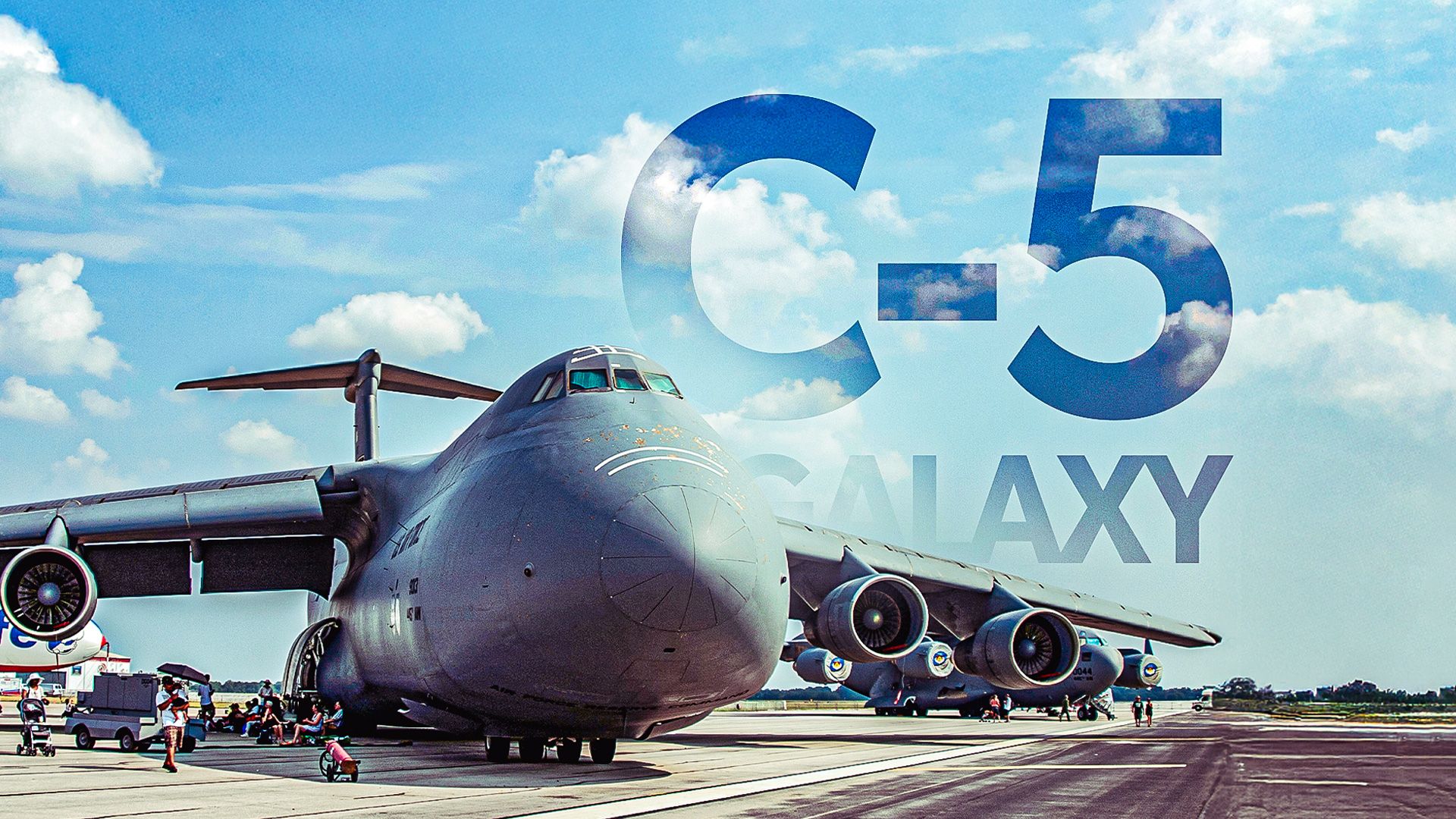
The Lockheed C-5M Super Galaxy is the largest military transport aircraft in the United States Air Force, although not the largest in the world. That title goes to the Antonov An-124 Ruslan, after the destruction of the world’s only An-225 Mriya in 2022. It is also smaller than the Airbus A380 and most Boeing 747 civil airliners. However, as a military aircraft, it is able to ‘kneel,’ conduct aerial refueling, and perform short take-offs.
As with many new aircraft, the plane soon ran into significant development issues after it entered service in the 1970s, the most serious of which were cracks in the wings. After the faulty wings were replaced, the aircraft matured in the 1980s. Since then, the Galaxy, and now the Super Galaxy, has been a workhorse of US strategic transportation.
History & Relation To Boeing 747

In the 1960s, the Air Force identified the need for a large strategic military transport system, and several engine manufacturers and planemakers competed. Lockheed offered a solution with new General Electric turbofans. Boeing’s solution featured Pratt & Whitney’s new turbofans and was considered a strong contender, but the Air Force went with Lockheed’s design. Boeing then took its design and adapted it into the 747 civilian airliner.
Lockheed may have won the initial contract, but in the end, it failed to find any other customers for the Galaxy, and its attempts to make a civilian variant went nowhere. It produced a total of 131 Galaxies for the Air Force in two separate production runs. Boeing went on to sell over 1,500 Boeing 747s to dozens of customers, including the United States Air Force. The final C-5 was delivered to the Air Force in 1989.
Today, the Air Force has a total of 52 C-5s in service, all of which are upgraded C-5M Super Galaxies. One of the most important upgrades was that the aging General Electric TF-39 engines were replaced with General Electric CF6-80C2-L1F commercial engines. These provide a 22% boost in thrust, a 30% shorter take-off roll, and a 58% faster climb rate. The new engines also allow the aircraft to carry higher payloads over greater distances.
The C-5 Is Generally Smaller Than The Boeing 747-8F

One aircraft the C-5M Super Galaxy can be compared with is the Boeing 747-8F, although it should be noted that these aircraft are designed for different roles. Indeed, the Galaxy is designed for military missions, including operating in relatively austere environments, while the much more modern and stretched 747-8F is designed for commercial operations at established airports. With that in mind, the Boeing 747-8F typically outdoes the Galaxy.
The 747-8F is around eight feet longer (250 feet and 2 inches vs 247 feet and 10 inches) and has a wider wingspan (224 feet and seven inches vs 222 feet and nine inches). Its engines provide significantly more thrust (66,500 lbf vs 51,250 lbf per engine), and it offers a larger maximum takeoff weight of 988,000 lbs compared with the Super Galaxy’s 840,000 lbs. This variant also has a marginally larger payload and a faster cruise speed.
|
Specifications |
Boeing 747-8F (per Boeing) |
Lockheed C-5M Super Galaxy (per USAF) |
|---|---|---|
|
Length |
250 feet and 2 inches |
247 feet and 10 inches |
|
Wingspan |
224 feet and seven inches |
222 feet and nine inches |
|
Height |
63 feet and six inches |
65 feet and one inch |
|
Thrust (total) |
266,000 lbf |
205,000 lbf |
|
MTOW |
988,000 lbs |
840,000 lbs |
The Super Galaxy does hold the edge in a couple of areas, as it has a marginally greater wing area and boasts a longer range with a standard payload. Perhaps most notable for a casual observer eyeing the two giants side by side is that the Super Galaxy stands taller. The Super Galaxy is a foot and a half taller, standing 65 feet and one inch, compared with the 747-8F’s 63 feet and six inches.
The Super Galaxy’s Cargo Compartment

The Super Galaxy is designed to serve the strategic logistical needs of the US military. Looking at its cargo compartment, it is able to carry a maximum of 281,000 lbs of cargo and has 36 pallet positions. The compartment measures 13 feet and six inches in height, 19 feet in width, and 143 feet and nine inches in length. This dwarfs the dimensions of its closest USAF counterpart, the C-17 Globemaster III, particularly in length.
The C-17’s cargo compartment is 88 feet long, 18 feet in width, and 12 feet and four inches in height. It should be stressed that being smaller doesn’t make the Globemaster III ‘inferior’ to the Super Galaxy, as these aircraft are simply filling different niches and requirements within the service. The Super Galaxy is overkill for most missions, and the only military transport aircraft that is more or less comparable to the Super Galaxy is the An-124.
The only strategic military transport aircraft in production today are in the Globemaster class of airlifters. Russia has restarted production of its Ilyushin Il-76 strategic airlifter, and the new Xi’an Y-20 is China’s answer to the C-17. The turboprop Airbus A400M Atlas is the largest airlifter in production in Europe, although it’s designed to bridge the gap between the C-17 Globemaster III and the C-130J Super Hercules or Embraer C390 Millennium.
Loading The Super Galaxy

The Super Galaxy can be loaded or unloaded from both the front and the aft, or even both simultaneously. Its nose hinges up while it also has a rear ramp that lowers. Vehicles like trucks, tanks, and MRAPs can be driven on and off using the front and rear ramps. It can carry two M1A1 Abrams main battle tanks or even the fuselage of a disassembled C-130.
In peacetime, Galaxies typically don’t carry maximum loads, as this accelerates the airframe’s wear and tear. In practice, they don’t carry the large numbers of equipment often advertised unless there is a pressing need to do so. One notable feature of the C-5 is that it can ‘kneel.’ Its kneeling landing gear enables the giant aircraft to lower its cargo floor to around that of a truck bed.
Of the 52 Super Galaxies remaining, 50 are later C-5B variant aircraft, and two are original C-5A models. Those two former C-5As are specially modified into Space Cargo Modified C-5Cs that are specifically intended to ferry around cargo like satellites, telescope components, and other cargo for NASA. One notable payload that they have carried was components of the Hubble Space Telescope.
The C-5 May Not Stay The Largest Forever

Radia is designing a new class of ultra-large transport aircraft called the WindRunner. This massive aircraft would be able to ferry massive outsized cargo, like wind turbine blades, to remote locations. The company is also pitching the concept to the US Air Force. Radia notes that defense cargo aircraft run out of room inside the aircraft before they run out of lift capability. It adds that volume is the limiting factor, even for massive jets like the Galaxy.
If ever built for the Air Force, the WindRunner would dwarf the Super Galaxy. It would offer seven times more volume than the C-5M, 12 times more volume than the C-17 Globemaster III, and 20 times more volume than Europe’s largest military transport aircraft, the Airbus A400M Atlas.
|
Specifications |
Radia WindRunner |
Lockheed |
|---|---|---|
|
Volume |
240,000 ft3 |
33,900 ft3 |
|
Pallet positions |
80 |
36 |
|
Payload weight |
160,000 lbs |
280,000 lbs |
The WindRunner would be able to carry complete systems without needing disassembly (including helicopters and fighter jets), while also being able to take off and land on 5,900 feet of an unpaved runway when loaded to maximum payload. It would have a payload volume of around 24,000 cubic feet (6,800 m3) compared with the C-5’s 33,900 cubic feet (960 m3).
The Radia WindRunner would have 80 463L pallet positions compared with the Galaxy’s 36. Its massive volume would have a lower payload. Its payload would stand at around 160,000 lbs (72.6 tonnes) compared with the C-5’s 280,000 lbs (127 tonnes).
More Volume For Outsized Cargo

The largest aircraft flying today are the C-5M Super Galaxy, Boeing 747, Airbus A380, and An-124 Ruslan, but none of these aircraft remain in production. The An-124 fills a similar role, although the Super Galaxy benefits from superior engines and avionics. The Boeing 747 serves both commercial passenger transport and freighter missions, while the Airbus A380 is poorly suited to anything other than ferrying passengers.
As a military aircraft, the C-5M is able to carry out functions that the civil Boeing 747 and A380 are unable to do. These include operating in comparatively austere conditions with short take-off rolls and conducting aerial refueling. One issue faced by cargo aircraft, including the giant Super Galaxy, is the lack of space, not so much limitations from the maximum payload.
Boeing modified 747-400s into the bulging Dreamlifters, while Airbus modified A300s into the Beluga and A330s into the BelugaXL to carry outsized cargo. If Radia has its way, it would build the Air Force a solution that would offer seven times the internal volume of the Super Galaxy, allowing the Air Force to have military analogs to Boeing and Airbus’s specialized outsized cargo freighters.
source
