

Our objective in this piece is to provide a comprehensive comparative breakdown of  United Airlines (NYSE: UAL) and
  Delta Air Lines (NYSE: DAL). We aim to discuss aircraft mix, age, and gauge to reveal where and how each airline chooses to compete. These airlines each have their own maintenance strategy and retrofit cadence, both of which help the carrier exhibit a balance-sheet posture and overall capital discipline. Mapping narrowbody and widebody portfolios by family and subtype will help highlight seating density and premium share, while also allowing us to examine further utilization patterns that convert assets into revenue.
Orders and retirements matter just as much to investors as overall tail counts, so analyzing book-to-fleet pipelines, engine selections, and cabin modifications will help shape our picture of how cost per available seat mile (CASM) and revenue per available seat mile (RASM) differ over time. We will also help position aircraft for various missions, including short-haul bank structures, transcontinental premium traffic, high-gauge leisure traffic, and long-haul airline alliances. We will also address questions of overall resilience, including spare parts coverage, maintenance intervals, fleet commonality, and operational recovery during disruptions. The aim is ultimately not to pick a better fleet but to connect hardware to outcomes, unit economics, schedule flexibility, and overall brand differentiation.
A Brief Overview Of Delta And United’s Business Models

Delta and United are both full-service hub-and-spoke network airlines with capable global reach, and they monetize that reach in a few distinct ways. Delta leans into a premium, reliability-led operating model, featuring a high share of domestic business traffic and heavy investment in premium-branded cabins. These airlines also offer strong corporate contracts and rigorous merchandising that aim to increase the revenue generated per seat. These airlines also incorporate a vertically integrated TechOps division and third-party MRO revenue-generating systems, allowing them to drive high-margin cash flows through multiple verticals.
Internationally, Delta’s joint ventures with Air France-KLM, Virgin Atlantic, and LATAM help channel demand through coastal hubs, thereby protecting yield on core flows. United Airlines, by contrast, is mostly built around long-haul scale and overall gateway dominance. The Star Alliance, with its deep partnerships, particularly those with the Lufthansa Group and ANA, enables the airline to maximize its connectivity across multiple major North American gateway hubs, including Newark, Chicago, Houston, San Francisco, and Denver.
Both airlines utilize loyalty economics as a significant financial asset for their liquidity engine, while cargo, ancillary fees, and a growing premium footprint, driven by Polaris and Premium Plus revenue growth, round out the airlines’ overall mix. In short, Delta Air Lines aims to optimize product and reliability to increase prices, while United Airlines aims to leverage its network breadth and international scale to grow profitably.
A First Look At The Delta Air Lines Fleet

The Delta Air Lines fleet has been carefully designed to enable the airline to serve everything from short hops to long-haul flagship services, with the airline emphasizing comfort, reliability, and fuel efficiency. On the domestic side, the backbone of the airline’s operations is its Airbus narrowbody jets, with Airbus A321/A321neo models mostly handling high-demand routes while Airbus A320s and A319s fill in across its network. The nimbler Airbus A220 serves thinner business and regional markets with a quiet and modern cabin. Delta Air Lines also operates Boeing narrowbodies, particularly the Boeing 737-900ER, and continues to fly the Boeing 717 on some dense, short-haul schedules where quick turns and high-frequency operations are crucial.
When it comes to long-haul international operations, Delta Air Lines leans on two-aisle Airbus family jets with some Boeing models providing supporting coverage. The Airbus A330 family covers transatlantic and select transpacific missions with strong cargo capabilities and efficient operating economics. The long-range flagship Airbus A350-900 pairs lower fuel burn with the airline’s Delta One Suites and Premium Select cabins to compete for high-yield business traffic on the longest individual routes. Here are some additional details for the Delta Air Lines fleet, according to data provided to Simple Flying by aviation industry data provider ch-aviation:
|
Category: |
Delta Fleet Specification: |
|---|---|
|
Total Mainline Fleet Size: |
1050 jets |
|
Average Fleet Age: |
15.5 years |
What ties this entire fleet together is a steady renewal pipeline, featuring more Airbus A321neos and Airbus A330neos, in addition to Airbus A350s, which are being phased in, all of which areon their way from the manufacturer. This strategy will enable the airline to upgauge when demand supports it, provide right-sized jets where necessary, and maintain high reliability with the support of strong in-house maintenance services offered through Delta’s capable TechOps team.
A First Look At The United Airlines Fleet

United Airlines operates one of the world’s most capable global airline fleets, and it is currently well-prepared for a significant period of expansion and growth in its long-haul network depth. In the domestic market, the airline fields multiple different Boeing 737 family variants alongside legacy Airbus A319 and Airbus A320 models, amid a growing subfleet of Airbus A321neo jets. This mix enables United to upgauge busy hubs while also maintaining the right-sized demand on several spoke routes. For long routes, United Airlines leans heavily on widebody jets, with the Boeing 787 family increasingly serving as the backbone of the carrier’s long-haul capabilities.
The Boeing 777-300ER provides a high-gauge lift on many international trunk routes. The carrier also uses some refreshed Boeing 767-300 and 767-400ER models to cover certain kinds of secondary transatlantic missions. This variety provides planners with a significant amount of flexibility, particularly when it comes to matching range, seating, and cargo to meet seasonality and corporate demand. The carrier also has a sizable order book for Airbus A321neo, Boeing 737 MAX, and Boeing 787 jets, all of which underpin the airline’s United Next initiative to add seats and increase its premium share across hubs like Newark, San Francisco, Chicago, Denver, Houston, and Dulles.
|
Category: |
United Fleet Specification: |
|---|---|
|
Total Mainline Fleet Size: |
989 jets |
|
Average Fleet Age: |
16.9 years |
The airline is currently retrofitting its cabins for yield protection on long-haul services. This strategy is straightforward, and it will feed its network with larger, more efficient narrowbody aircraft to maintain high reliability.
Which Airline Operates A Larger Fleet?

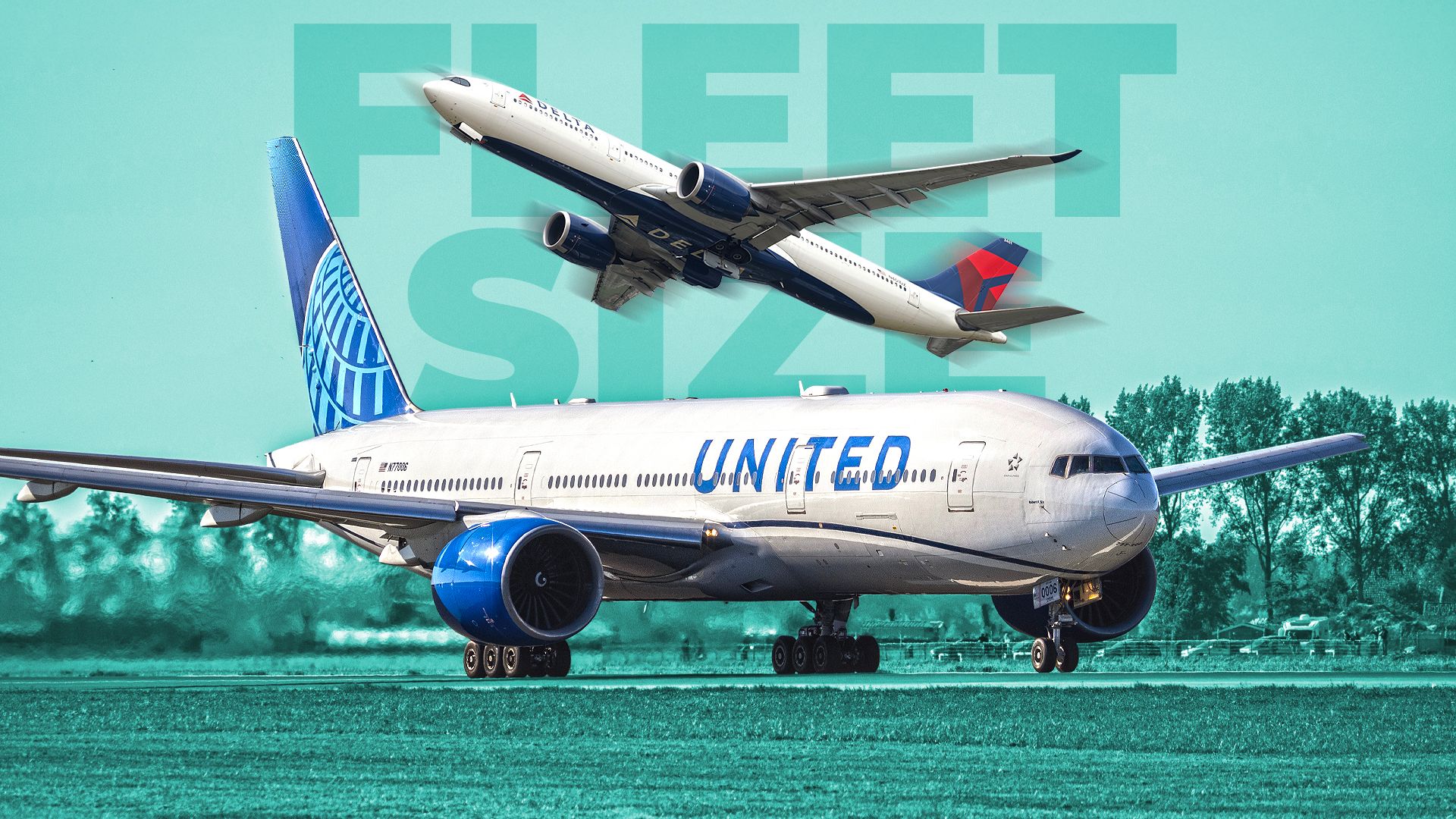
According to all the latest data provided to Simple Flying, United Airlines is currently edging out Delta with its slightly larger mainline fleet, and this is unlikely to change soon. United’s “United Next” plan hinges on an extensive narrowbody order book and an additional wave of arriving Boeing 787s. This will allow the carrier to add capacity at key hubs while expanding long-haul market share.
Even though there are some aircraft retirements in the works, notably those for older Boeing 767 models, Boeing is planning delivery slippage, and the manufacturer’s sheer pipeline should keep United on top in total number of tails. Delta Air Lines is also renewing its fleet, but it is doing so in a steadier fashion with aircraft like the A330-900neo and the Airbus A350-900, while it slowly phases out aircraft like the Boeing 717 and some older Airbus A320 models.
The carrier’s strategy will emphasize its premium share and right-sizing different routes with models like the Airbus A220. The airline is more focused on its operating performance metrics than it is building the largest fleet. In total, Delta will continue to get younger and more efficient, while United will remain larger and increasingly capable of serving long-haul markets.
What Are The Risks Associated With These Fleet Renewal Strategies?

It is essential to note that both carriers are susceptible to classic airline macroeconomic shocks, which could impact their growth and fleet renewal prospects. Both are equally exposed to labor inflation, airport bottlenecks, recessions, and global geopolitical disruptions. Delta’s risk picture centers on its premium and reliability-led model. If corporate demand softens or pricing power begins to fade, the airline will see lower returns on its investment in cabin upgrades.
An aging subfleet of Boeing 717s and older A320s poses some near-term maintenance and retirement risk. However, the airline has effectively hedged this risk through the diversification of its TechOps system. Maintenance demand is also cyclical, and co-branded credit card economics could face regulatory scrutiny, both of which pose risks to the airline’s free cash flow generation picture.
United’s risks mostly skew towards international exposure and overall scale execution. The airline’s strategy relies on large Boeing and Airbus deliveries, with any certification or supply chain delays making CASM targets appear even more optimistic. Congested hubs, especially those operated by United, also increase the airline’s risk picture.
What Is The Bottom Line?

Ultimately, United Airlines and Delta Air Lines are both major operators of North American legacy networks. They have a strong presence in both domestic and international markets.
Few operators are as extensively involved in global corporate travel as these two airlines. As a result, they have invested heavily in the development of their fleets, ensuring that they will be able to serve their core markets for generations to come.
United’s fleet remains larger in terms of actual tail numbers today, and this is unlikely to change anytime soon. Nonetheless, Delta also operates a dynamic fleet, one that primarily focuses on carefully matching capacity with the demand observed in the market at any given point in time.
source
