

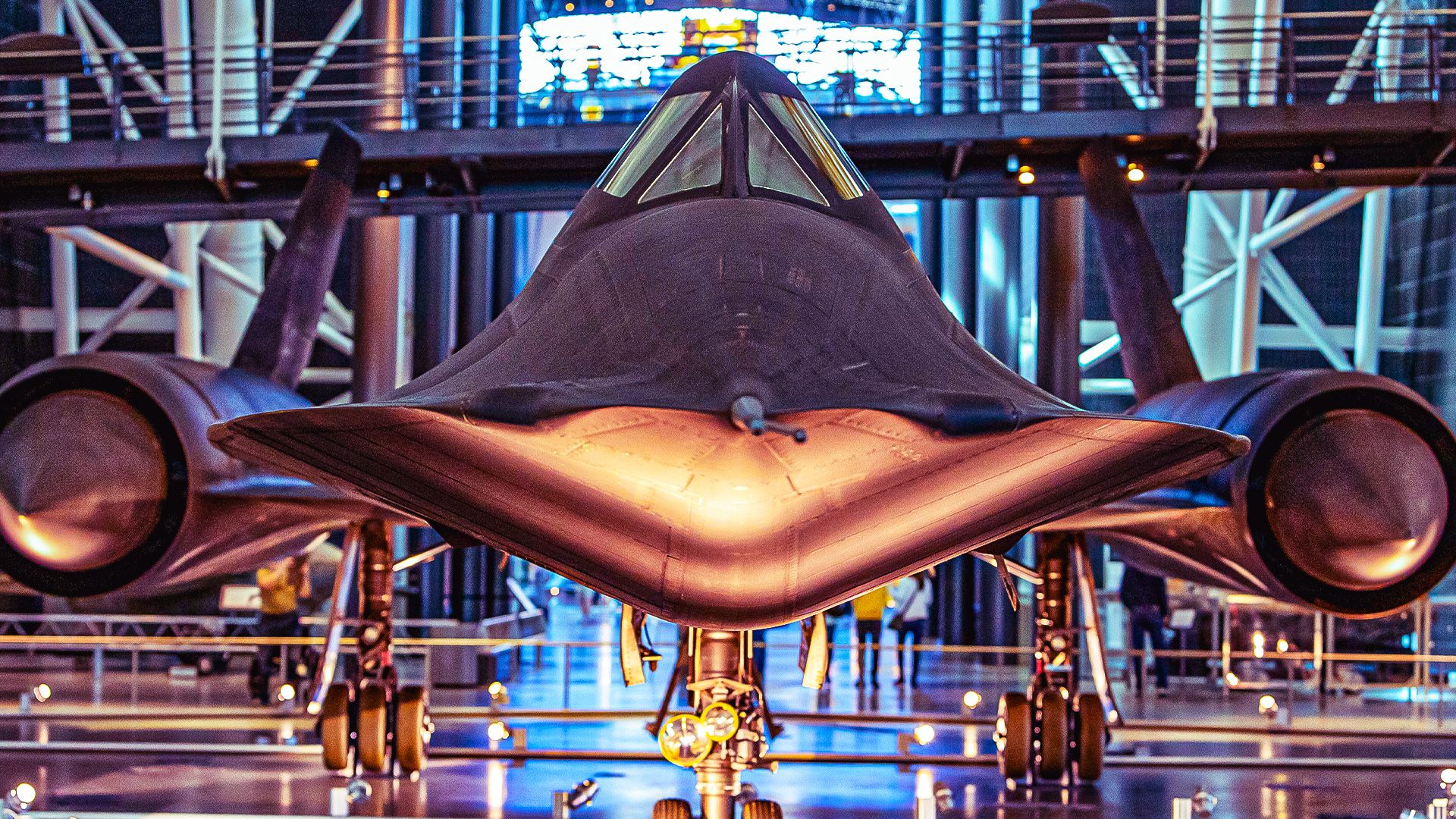
The incredible speed machine SR-71 Blackbird is as famous for outrunning missiles and soaring to the edge of space as it was notorious for spilling fuel on the ground from its titanium skin. The physics-defying jet was made of over 90% titanium by Lockheed Martin’s Skunk Work’s division. The mastermind behind the record-breaking spy plane was none other than the legendary Kelly Johnson who created many iconic planes like the P-38 Lightning, F-104, U-2 Dragon Lady, and others.
It’s exotic alloy construction was designed to withstand the 1000 degree heat generated by screaming through the air at over Mach above 80,000 feet. The titanium skin would only become sealed when it was heated, hence the Blackbird’s leaky reputation. In a classic twist of Cold War espionage, the titanium used to produce SR-71s was sourced from inside the same nation it flew over to spy on, Russia.
Even the best titanium found for the SR-71 was still rejected frequently as the exotic metal is sensitive to corrosion from chemicals and other alloys that most metals were not affected by. Transforming raw titanium ore into a workable metallic material was not cost-effective for Lockheed Martin to make the jet. The Central Intelligence Agency (CIA) went ahead and used shell companies to obtain the alloy, which the Soviet Union was making in far greater quantities than the US at the time.
The Blackbird’s Dire Mission

The SR-71 program began in the 1950s as the CIA’s A-12 reconnaissance plane. The jet was a successor to the U-2 and when Gary Powers was shot down over Russia, its development became dramatically more urgent. The Blackbird was not only designed to be faster and fly higher than the U-2, it was shaped to have a very small radar cross section (RCS) which would make it hard to detect and nearly invulnerable against surface-to-air missiles (SAMs) and interceptor jets.
The CIA flew the small fleet of a dozen A-12s for just a few years over the Soviets as well as North Korea and Vietnam before the SR-71 was delivered to the US Air Force. The USAF would only receive a total of 32 jets before the assembly line was shuttered, and unique tooling destroyed. The SR-71 carried more fuel than the A-12 and two aircrews in a larger fuselage than the A-12. The USAF and CIA development programs were overlapping and helped cover for the clandestine operations conducted by the CIA fleet.

The SR-71 earned a second nickname while based in Okinawa to support the Vietnam War: “Habu,” after the islands’ viper snake. The Black bird fleet performed over 3,500 missions flying reconnaissance over hostile airspace, according to SR-71 Revealed. Despite hundreds of missiles being fired at the jets, not a single one ever hit. Some got close by accident, as pilots reported. Twelve of the 33 SR-71s made were lost due to mechanical failures in over 17,000 sorties during its service, according to the Smithsonian.
SR-71: Hangar Queen

The intensity of the conditions that the Blackbird endured in flight and the complexity of its construction and systems meant that nearly 24 hours notice was necessary to launch a mission, and when they returned, it took about a week to turn around the plane. They required many small parts replacements for the heavy wear and tear on the titanium skin after even uneventful sorties. Then there were the strict inspections of every part and system from nose to tail.
The fleet’s cumulative flight hours exceeded 53,000 by the end of its active career. At its peak in the early 1970s, SR-71 missions were running daily. The jets logged over 2,700 flights at over Mach 3 for a total of more than 11,000 flight hours, over three times the speed of sound. The Blackbird may have been a maintenance monster, but it met the call of duty admirably thanks to dedicated crews on the ground, in the air, and back at the factory.
The CIA chose not to continue operating the A-12, largely due to the cost of the program. The USAF was able to absorb that investment, and even with the rise of space-based reconnaissance platforms, the Blackbird earned its keep. The stunning performance of the jet is still unsurpassed, and while satellites offered a far less expensive and lower risk method of reconnaissance, the Blackbird was far from irrelevant.
The Hit List: Blackbird Records

Over its three decades of service, the SR-71 set many (declassified) records for speed, altitude, and flying time between points. The staggering performance of the jet is still unmatched by any aircraft that has flown to date, as far as we know. Some of those records still stand and unless the fabled SR-72 “Son of Blackbird” is secretly patrolling the air, they aren’t likely to be broken any time soon.
In 1971, right after the jet became operational, Thomas Estes and Dewain Vick, flew over 15,000 miles (24,000 km) in 10 hours and 30 minutes. On September 1, 1974, James Sullivan and Noel Widdifield flew over the starting (radar) line in New York at 80,000 feet and over 2,000 miles per hour. In 1 hour and 54 minutes, they would set a new world speed record from New York to London, England, according to The SR-71 Blackbird.

An SR-71 crew would set a stunning speed record from London to Los Angeles even with speed restrictions in place as they flew over major cities in the US. The jet still averaged just under Mach 3, and when it passed the finish line in LA, there were reports of broken windows from the sonic boom.
|
Record |
Description |
|---|---|
|
1972 Mack Trophy: most meritorious flight of the year |
15,000 miles (24,000 km) in 10 hours and 30 minutes. |
|
1974, Fastest Speed Over Course |
1 hour 54 minutes and 56.4 seconds late from NYC to London. |
|
1974, Distance Speed Record |
3 hours 47 minutes and 39 seconds from London to Los Angeles. |
|
1976, Absolute Speed Record |
World speed record of 1,905.81 knots (2,193.2 mph; 3,529.6 km/h), approximately Mach 3.3. |
|
1976, Absolute Altitude Record |
World record of 85,069 feet (25,929 m). |
|
1990, Four Speed Records In One Flight |
Averaging 2,242.48 mph (3,608.92 kmh): Fastest time from LA to Washington, DC. Fastest time from West Coast to East Coast. Fastest time from Kansas City to DC. Fastest time from St. Louis to Cincinnati. |
The final record-setting flight of the incredible Blackbird lineage was flown by the jet that now resides in the Smithsonian Institution’s Steven F. Udvar-Hazy Center in Chantilly, Virginia. In 1990, Raymond Yeilding and Joseph T. Vida piloted serial number 61-7972 on its final Senior Crown flight and set four records along the way. The fleet wasn’t done yet, but the sortie set the tone for the SR-71s final years.
Spy Planes Give Way To Satellites

As spy satellites became the preferred replacement for aircraft like the SR-71, they were expected to become obsolete. The US Space Force has even split off from the USAF as a result of the ever-growing contest for dominance in the domain of outer space. Satellites offer a more economical means of performing the role that the Blackbird achieved. They do, however, have a flaw because they are readily and easily observable by near-peer adversaries with capable space programs.
Once it was learned that adversaries were tracking satellite orbits and evading observation by concealing activities or assets when they knew the satellites were overhead, the SR-71 found a renewed purpose. The Blackbird could launch on demand outside the hours that satellites were over targets and, because it was difficult to track and detect, the SR-71 could successfully complete reconnaissance that space assets could not.
Today, Boeing’s X-37B might be considered a successor to the SR-71. It is a space plane that resembles a scaled down space shuttle and splits the difference between spy plane and spy satellite. Its missions and activities are extremely secretive, but its longest mission had it in orbit for nearly three years, or 908 days. Officially, it serves scientific and engineering test purposes for USSF.
The Blackbird’s Farewell

The SR-71 served through the highs and lows of the Cold War. Blackbirds flew out of RAF Mildenhall and Diego Garcia, to conduct missions over the Soviet Bloc and Libyan terrorist encampments.
Just before it was grounded for the last time, the SR-71 even enjoyed a brief tenure with the National Aeronautics and Space Administration (NASA). The Blackbird helped NASA test sonic boom noise mitigation and laser air-data sensor tests.
The USAF operated the jet much longer than the CIA, temporarily retiring the Blackbird in 1989 but bringing the fleet back online in 1990 with the final, true sunset happening in 1999. Today, every surviving member of the Blackbird family can be found in museums around the USA and even the United Kingdom’s Imperial War Museum at Duxford.
source
