

In the late 1950s, when everyone expected World War III to go nuclear, the U.S. Army had to contemplate operating on a battlefield sprouting atomic fireballs.
This put Army planners in a dilemma. Military theory said that forces had to be concentrated to overwhelm the enemy and achieve decisive results. Common sense said that massing troops would only present a juicy target for nuclear weapons. The Army ultimately settled on the Pentomic Division, which consisted of self-contained battalions that would assemble for operations and then disperse. Yet the idea proved so unwieldy that the Army soon discarded it.
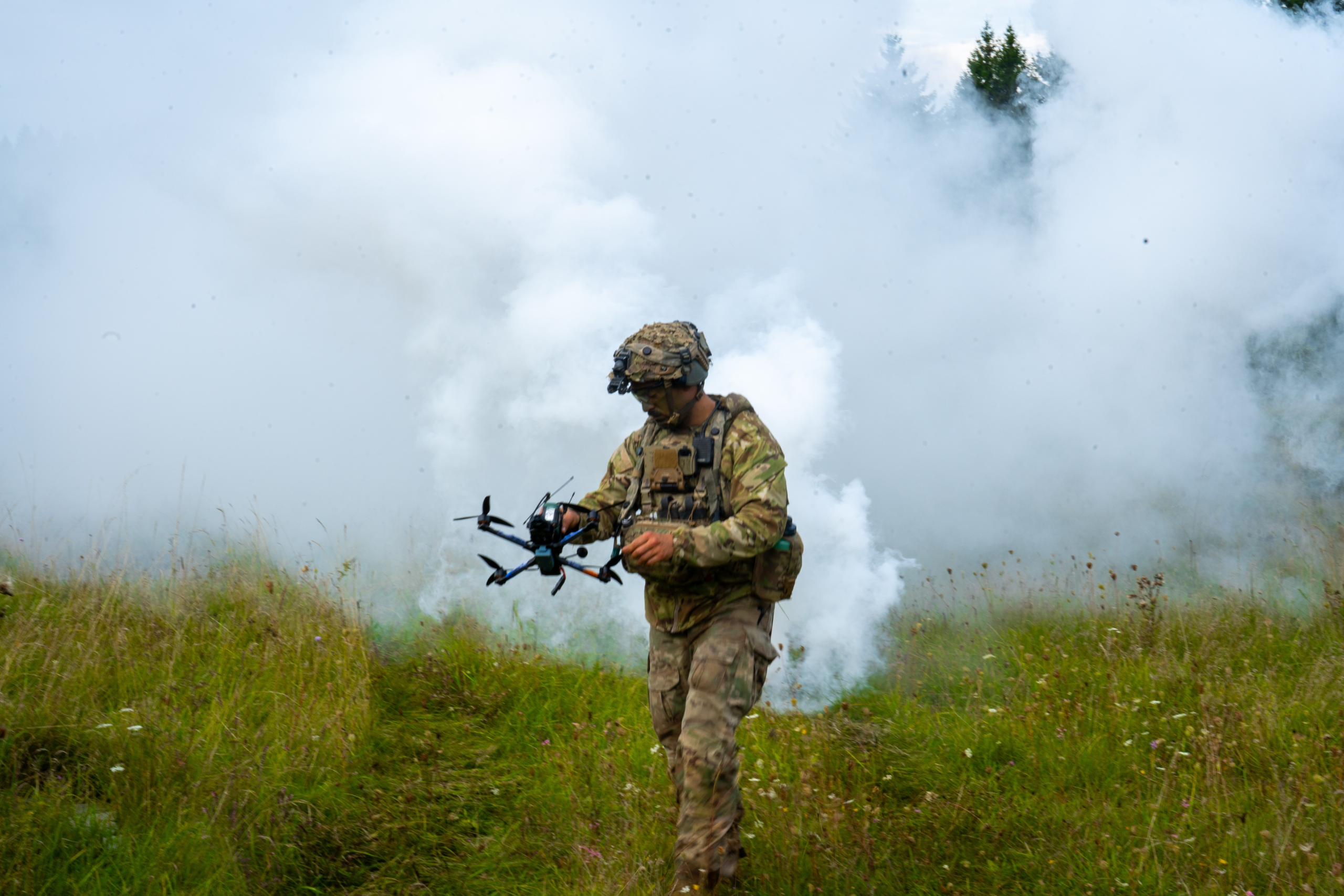
But 70 years later, the Army faces a similar dilemma. Instead of atomic bombs, the threat now comes from drones, as vividly demonstrated in the Ukraine war. To survive, Ukrainian and Russian forces have learned to operate in dispersed groups — sometimes as small as four to six soldiers — for fear of attracting the attention of a drone swarm. But lack of mass foregoes the possibility of decisive maneuver — and victory — and the conflict has degenerated into a grinding war of attrition.
A British expert has a solution: Resurrect the Pentomic concept.
“Something similar to the Pentomic structure may have something to teach in terms an answering the battlefield problems of today,” wrote John Moore, a former British Ministry of Defense official, in a recent essay for the U.S. Army’s Armor Magazine.
The original Pentomic divisions were a response to the “quantitative leap in firepower” from nuclear weapons, Moore told Defense News. With modern armies facing drones, long-range missiles and sensors, the new Pentomic “is posited on a similar response to firepower that in this case is in-depth, ubiquitous, pinpoint in accuracy and available day or night.”
“Massing a larger number of men and materiel takes time,” he said. “You will be spotted and attacked before you even reach the departure or jump-off point.”
The Pentomic concept, which governed U.S. Army infantry and airborne divisions from 1957 to 1963, replaced the triangular divisional structure of three regiments, with a five-sized organization. Pentomic divisions consisted of five battlegroups — equivalent to oversized battalions — with five rifle companies, a headquarters and support company and a mortar battery. But to create self-contained all-arms battlegroups, a plethora of support units were usually attached, including armor, artillery, engineers and air defense.
Given 1950s technology, command and logistics proved overwhelming.
“On the Pentomic battlefield, a CO could easily find himself with at least nine maneuver elements, well beyond the effective span of control for most colonels of the day,” recalled the late U.S. Army Col. David Hackworth in his memoir “About Face.”
Moore envisions the New Pentomic — which he also calls “Pentomic v5″ — as a company-level approach.
“That formation size has enough combat power to achieve local success while having enough resilience to sustain combat for a useful length of time,” he wrote. Battlegroups would be composed of companies that would assemble as needed.
Dispersed, flexible companies would be less likely to be detected and attacked by drones, and could concentrate for attacks.
On the defense, “such a Pentomic structure has sufficient reserve potential to meet a range of attacks and will require increased effort by an attacker to neutralize a defense in depth and use that most precious of assets — time,” Moore wrote. “A dispersed Pentomic defense based on areas of concealment such as villages, towns, wooded and rough terrain can allow for gaps as these can be covered by precision fire at every level and improve unit survivability.”
Moore believes that technology has improved enough since the 1950s that command and control of dispersed maneuver units is feasible.
“Even the smallest unit has, through FPV [first-person-view] drone technology, the means of battlefield reconnaissance and precision strike,” he wrote. “While distributed command systems have great resilience and an ability to jump echelons in terms of targeting.”
Moore also sees the New Pentomic as a relatively inexpensive way that the U.S. — and NATO — can adapt to a changing battlefield.
“It can be done cheaply as it is about structure, training and an attitude of mind,” he told Defense News.
Yet history suggests that a Pentomic 2.0 would face many of the same challenges that doomed its predecessor. In the early years of World War II, the German blitzkrieg achieved remarkable victories, largely due to a doctrine that emphasized flexibility and expected commanders and soldiers to use their initiative. By 1944, heavy losses in experienced officers and NCOs led to increasingly rigid tactics. Similarly, in the early days of the 2022 Russian invasion, outnumbered but agile Ukrainian forces defeated clumsy Russian offensives. But heavy casualties have resulted in Ukrainian commanders reverting to the rigid Soviet-style tactics they were trained in before the war.
“Ultimately, any success will depend on a high level of initiative and a willingness to gamble on success,” Moore wrote. “This will have implications for training and leadership at every level.”
source
