

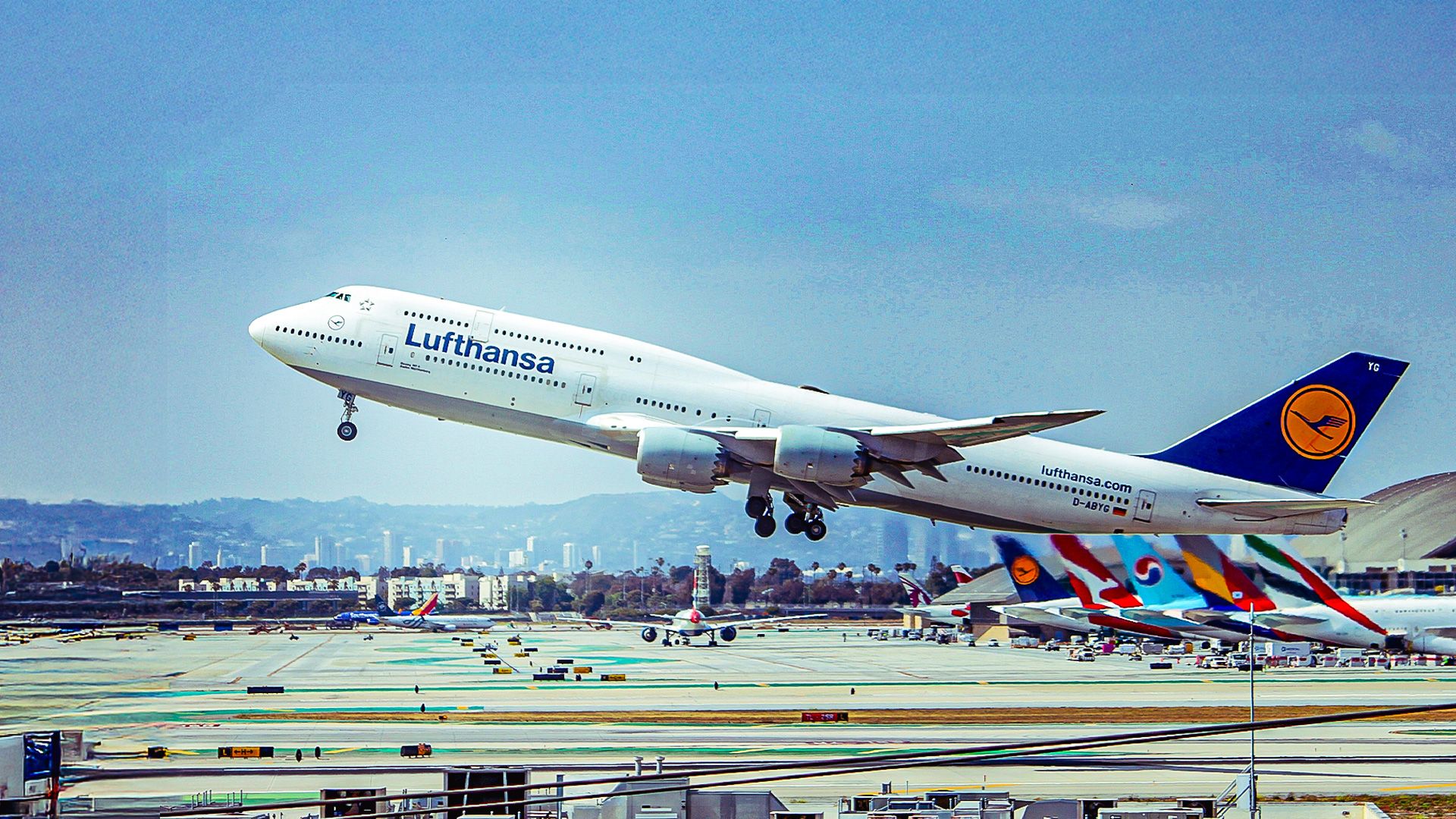
The Boeing 747, also colloquially known as the Queen of the Skies, is a widebody long-range airline that was designed and manufactured by American plane maker Boeing between 1986 and 2003. The aircraft became synonymous with long-haul luxury air travel; however, due to its sheer size and cost to operate, plus changing travel demands, the aircraft was eventually culled from the  Boeing catalog, with the last aircraft rolling off the production line in December 2023.
The decline in popularity for quad-jet airliners has effectively been a result of aircraft technology. Improved aerodynamics and the use of composite materials have made the modern twin-jet much more capable of flying to significantly lower operating costs. Extended twin-engine options, with ETOPS certifications, have made these aircraft more than capable of traversing the oceanic routes that were once only possible with the quadjet.
The History Of The Boeing 747

Following the introduction of the Boeing 707, iconic carrier Pan Am asked for an aircraft that was two and a half times its size, to reduce the overall seat costs by 30%. This saw Joe Sutter leave the 737 programme to work on the 747 design and resulted in the carrier ordering the 747-100 in 1966. Pan Am ordered a total of 25 747-100 airplanes, with Pratt & Whitney developing the JT9D engine for the aircraft.
The first flight of the 747 took place on February 9, 1969, with the plane being officially certified by December of that year. The jumbo jet was officially delivered to Pan Am and entered into commercial service on January 22, 1970. The 747 has continued to operate for 56 years, with additional variants being designed, which include the Boeing 747 Supertanker, Boeing 747-400, Boeing 747-8, Boeing E-4, Boeing VC-25, Boeing Dreamlifter, Boeing 747SP, Boeing YAL-1, and Shuttle Carrier Aircraft.
Competition for the 747 came from smaller trijet widebodies, which included the Lockheed L-1011, McDonnell Douglas DC-10, and later the MD-11 and Airbus A340, A380. The 747 was not just popular with passenger airlines, but became the aircraft of choice for many cargo carriers, such as Atlas Air, which received the last Boeing 747 off the factory floor in January 2023. This airplane remains in active service today.
Design Of The Boeing 747

A factor that contributed to the 747’s overall success was the technology of the high-bypass turbofan engine. This was able to assist in developing twice the power of other turbojets, but consumed up to 33% less fuel. This was pioneered by General Electric and was proven with the engine for the C-5 Galaxy; however, Pratt & Whitney was also working on a similar principle, which saw Boeing, Pan Am, and Pratt & Whitney develop the engine together, which eventually was the JT9D that powered the 747.
Boeing delivered the first 747 to Pan Am in 1969, just 28 months after it took to design and manufacture the aircraft. This was around two-thirds of the usual time from conception to delivery. This earned the 747 the nickname ‘The Incredibles’, given that developing the plane was such a technical and financial challenge. Due to the airplane’s size, Boeing had subcontracted many assembly components, which included the fuselage parts such as engine flaps (developed by Northrop Grumman), tailplane ailerons (Fairchild), and empennage (Ling-Temco-Vought).
For the American plane maker, at the time of the 747’s inception, it did not have an assembly plant big enough to put together the aircraft, so it chose a new location to build the plant. Boeing considered up to 50 destinations across the United States and decided on Paine Field, Everett, Washington. The Boeing factory is now home to the world’s largest building by volume, and the plant is where we see many of Boeing’s aircraft have their final assembly today (in collaboration with its North Carolina plant).
Testing The Boeing 747

Throughout the Queen of the Skies’ development, the plane went through multiple testing scenarios. One of these involved the trial evacuation of the aircraft. This was done by 560 volunteers in a cabin mock-up that included emergency chutes. This full-scale evacuation was meant to meet the maximum 90 seconds, which was mandated by the Federal Aviation Administration, but ended up taking two and a half minutes. This trial also saw several volunteers incur minor injuries. Subsequent trials eventually achieved the 90-second goal, but more injuries were sustained. What was most problematic was the aircraft’s upper deck. This was due to the volunteers not using a conventional slide, instead using a harness attached to a reel.
Other tests included the taxiing of such a large airplane. This led to Boeing building a training device that was known as the ‘Waddells Wagon’, after test pilot Jack Waddell. This consisted of a cockpit mounted on the roof of a truck, allowing pilots to practice taxi maneuvers from the high deck position while the 747 continued to be built.
At the time of the first Boeing 747 production, the program cost was estimated at around $1 billion (today $6.7 billion). The first 747 rolled off the factory floor to be presented to the world’s media and 26 airlines, which at the time had ordered the aircraft. The first flight took place on February 9, 1969, with Jack Waddell and Brien Wygle. Despite minor problems (flaps), the aircraft handled the testing very well.
Entrance Into Commercial Service

The first Boeing 747, for Pan Am, was christened by the then First Lady of the United States, Pat Nixon, on January 15, 1970. The aircraft was in the presence of the Pan Am chairman, Najeed Halaby, at Washington Dulles International Airport (IAD). The aircraft, instead of being sprayed with champagne, was doused with white, red, and blue water, recognizing the colors of the flag of the United States. The aircraft had a fairly uneventful introduction into commercial service and began revenue flights on January 22, 1970, between New York and London.
Other airlines started to follow suit with the Boeing 747, with even the Australian carrier Qantas becoming the first airline in the world to operate a full Boeing 747 fleet. This included 17 of the aircraft, which helped fuel the carrier’s long-haul ambitions and operate the iconic ‘ Kangaroo Route‘ connecting Australia to the United Kingdom. A list of memorable 747 operators below (this list is not exhaustive):
|
Operator |
|---|
|
Air Canada |
|
Alitalia |
|
British Airways |
|
Delta Air Lines |
|
Lufthansa |
|
Iberia |
|
Pan American World Airlines |
|
Qatar Airways |
|
Royal Air Maroc |
|
Scandinavian Airlines |
|
United Airlines |
Atlanta-based  Delta Air Lines became the last US operator for the 747, retiring the final Boeing 747 from its fleet in December 2017. The 747 in history has operated for every major US carrier since its introduction in 1970. Delta flew its 747 in a farewell tour in 2017, visiting cities such as Seattle-Tacoma, Atlanta, Los Angeles, and Minneapolis/St Paul.
Variants Of The Boeing 747

Throughout the aircraft’s tenure, there were several different variants that looked to improve on the first model of the 747-100. While the -100 was able to revolutionize long-haul travel due to its large capacity, airlines were looking for additional improvements, such as more power and longer range. This saw the introduction of the 747-200, in February 1971, to KLM.
Other variants included the 747-SP, a special performance aircraft that was designed with a shorter overall fuselage but a longer range. This was designed specifically for ultra-long-haul flights, such as London to Johannesburg or Washington to Tokyo. 747-300 was a stretched aircraft that had a larger upper deck, known as the ‘hump, that would allow increased passenger capacity on the second level.
The 747-400 became the most successful variant of all Boeing 747s, and had improved winglets that resulted in improved fuel efficiency, and a state-of-the-art (at the time) modern cockpit. The last variant to be developed of the 747 was the Boeing 747-8, the largest version of all. This had modern engines and improved fuel efficiency when compared to the previous generation aircraft. The 747-8 is around 18 feet (5.6 meters) longer when compared to the 747-400.
Where To Find The 747 Today

Several airlines continue to operate the Boeing 747 and believe the aircraft’s versatility, capacity, and range are well-suited to their commercial long-haul operations. European carrier Lufthansa is among the last few airlines to fly the passenger 747, while Korean Air and Air China dominate the 747 operations in Asia. Rossiya also flies the Boeing 747 primarily for domestic routes across Russia’s vast terrain. Cargo airlines are where the 747 really shines, and remain integral to the operations for Atlas Air, Cargolux, and UPS Airlines with their freighter versions.
On the ground, several 747s have been retired and are now on display at museums around the world. Such examples of these include the 747-121 (registration N7470), named the City of Everett. This is on display at the Museum of Flight in Seattle, and is the first 747 and prototype ever built. The 747-230B (registration D-ABYM) remains on display at the Technik Museum Speyer, in Germany, and wows visitors with the aircraft being positioned on a pedestal (picture above).
The Boeing 747 revolutionized air travel and was the world’s first widebody airplane. This enabled airlines and their passengers to fly further and faster than ever before. The 747 led to the democratization of air travel, drastically increasing passenger capacity on airplanes, making air travel financially possible for the middle class, and facilitating new long-stop long-haul flights. The 747 has become a cultural icon symbolizing global connection, and has helped spawn new industries such as the rapid worldwide delivery of cargo.
While the 747 continues to operate in limited passenger services, and for cargo options, the dominance of the twin-engine aircraft, such as the Airbus A330, A350, and Boeing 777 or 787, has been made possible by better efficiency, sustainability, and the move away from hub and spoke and towards point-to-point travel.
source
