

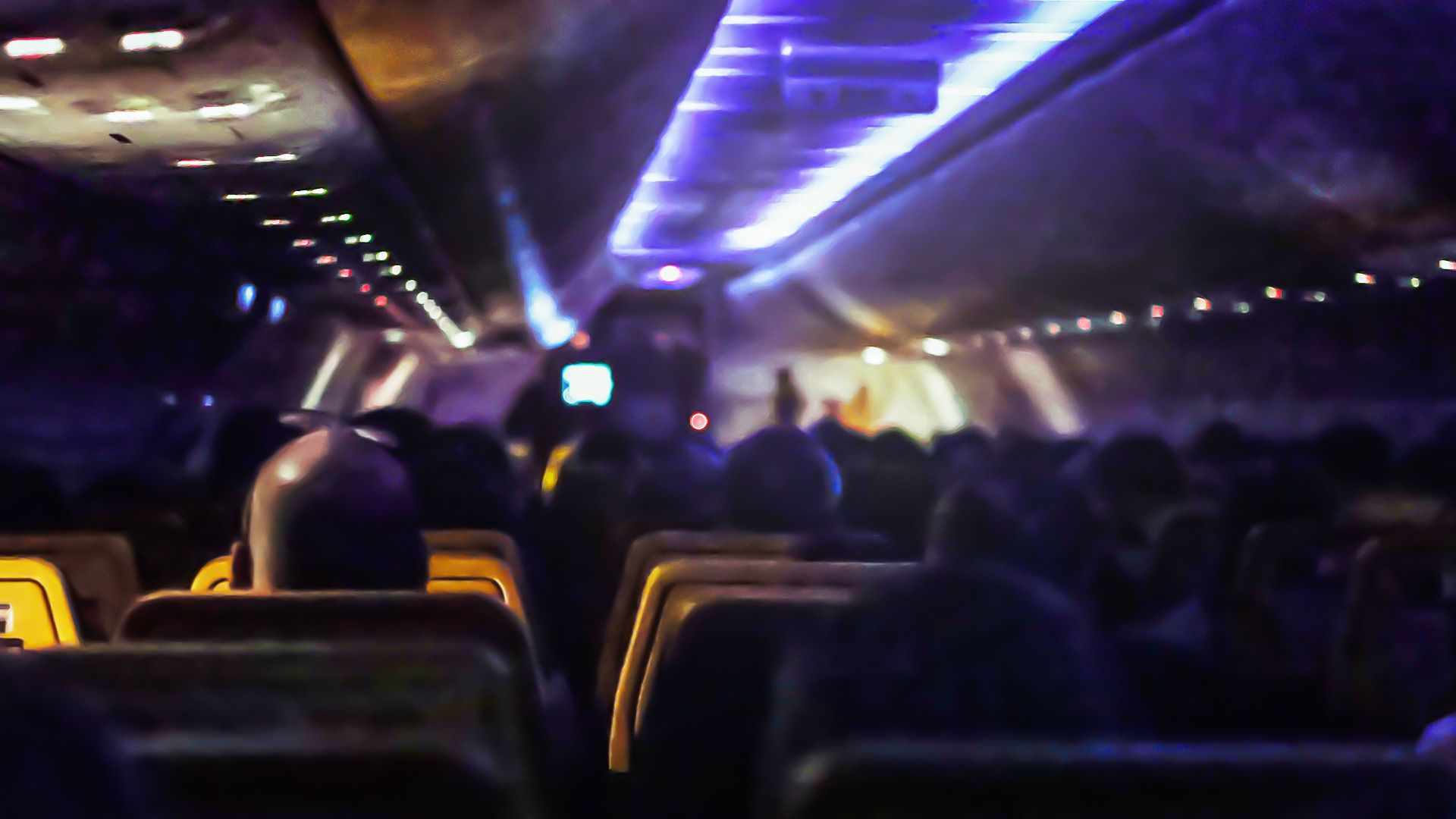
As a passenger on a flight, you may notice that before takeoff and landing, the cabin lights are dimmed. Some people believe that it is purely to help passengers sleep on their flight, but there is a much more important reason behind it. This guide looks at the real reason that the cabin goes dark after pushback.
Behind every procedure that takes place in the aircraft cabin, there is a safety reason. The dimming of the cabin lights is no different and takes place before takeoff and landing on most flights. During the day, it is not as noticeable and may not be necessary, depending on the conditions outside. It is a subtle change but a very important one.
Why Is It Significant?

The Senior Cabin Crew Member (SCCM), Purser, or Inflight Manager (depending on the airline) will dim the cabin lights, depending on the light outside, usually at nighttime, dusk, and dawn before takeoff and landing. This takes place once the safety checks are completed by the cabin crew, to ensure the cabin is ready for takeoff and landing.
These safety checks include checking that passengers are wearing their seatbelts, that all baggage and items are secured in the cabin, aisles, and floor are clear, and window blinds are open. They are also checking that seatbacks are upright, and tray tables are stowed, so as not to impede any passenger’s egress in an emergency. Once the cabin crew reports that checks are complete and the cabin is secure, the lights are dimmed.
Dimming the lights allows the passengers’ and crew’s eyes to adjust to the light outside the cabin, in case there is an emergency evacuation. It can take between five and ten minutes for the eyes to adjust sufficiently from bright light to dark, according to RD.com. With a dim cabin, the eyes have already acclimatized to the light outside and lower visibility in the cabin and in an emergency evacuation, every second counts.
Facts And Figures

Every year,  Boeing compiles a log of commercial airline incidents/accidents and fatalities and notes the phases of flight in which they occur. This data for the year 2024, which was published in April this year, can be found on their website. Commonly, takeoff and landing are the most dangerous parts of the flight, although in 2024, there were increased accidents/incidents during the taxi phase.
The study was based on the worldwide commercial fleet of all aircraft and accidents in 2024. They noted that 21% of incidents or accidents took place during takeoff and the initial climb, and 46% of fatal accidents took place during the final descent and landing. Therefore, these are considered the most critical phases in flight. Procedures are in place to make these as safe as possible.
Worldwide Commercial Fleet 2024
|
Phase of Flight: |
Number of Accidents: |
|---|---|
|
Landing |
22 |
|
Taxi |
7 |
|
Cruise |
6 |
|
Parked |
5 |
|
Climb |
1 |
|
Tow |
1 |
|
Final Approach |
1 |
|
Total: |
47 |
Data: Boeing
Fortunately, aircraft accidents are incredibly rare, and the International Air Transport Association (IATA) says that the risk of fatality due to an aircraft accident is low. They estimate that a person would have to fly every day for 25,214 years to experience a 100% fatal accident. In 2024, the all-accident rate was 1.13 million flights, or one accident per 880,000 flights. There were seven fatal accidents among 40.6 million flights, higher than the previous year.
The Importance Of This Safety Procedure

Dimming the cabin lights during long flights at night is, of course, conducive to passengers getting some rest. However, when taking off and landing, and the lights are dimmed, it is wise to be awake and aware. According to the Flight Safety Foundation, passengers can lose up to 83% of their wayfinding ability when there is smoke or fumes in the cabin.
When the lights are dimmed, passengers maintain orientation as it prepares the eyes for low-light conditions inside and outside the aircraft. This ensures better vision if an emergency evacuation were to occur. In a dark and smoky cabin, the ability to see the emergency exit signs and pathway markings is critical. Being able to see outside in low-light conditions helps the sense of direction and gives us a better ability to spot hazards.
Research has shown that passengers rely on vision to find their way out of an aircraft, but usually, vision is the first sense to be impaired by smoke or fumes. However, visibility beneath the smoke layer is not typically impaired; hence, pathway markings and low-level lighting may be seen and are specifically designed for evacuation guidance.
Important Safety Features

Once the lights have been dimmed in the cabin, it is easier to see the emergency exit door lights and the floor-level pathway marking. The US Federal Aviation Administration (FAA) and the European Union Aviation Safety Agency (EASA) require that the pathway markings be bright enough to be clearly visible in darkness. These are usually made with photoluminescent materials, which cause them to glow in the dark; therefore, they will still function if there is no power.
When the lights are dimmed in the cabin, it also helps the pilots to see more clearly outside. The exterior lights of the aircraft are switched on during takeoff and landing, so that they are visible to other aircraft and the runway is illuminated. Landing lights are turned on when descending below 10,000 feet and fully activated on the final approach, so that the pilots can clearly see the runway and be seen by other pilots.
The use of exterior aircraft lights:
- Takeoff: Lights are switched on after takeoff clearance is received.
- Climb: Lights are left on until climbing through 10,000 feet and then switched off to reduce drag.
- Descent: Lights are turned on when descending through 10,000 feet or when entering airspace with potential Visual Flight Rules (VFR) traffic.
- Approach: When the landing gear is extended, the lights are switched on and fully activated.
- Landing: Lights are switched off once the aircraft has vacated the runway.
If a window blind is closed, the cabin crew may well ask a passenger to open it for take-off and landing. This is so the crew can assess outside conditions and see if it is safe to evacuate, should evacuation be necessary. In an emergency, it is likely to be dark in the cabin, and only the battery-operated emergency lights will illuminate. They are tested before every flight.
In An Evacuation

Every second is precious during an evacuation; it is important to follow the crew’s instructions, leave everything behind, and get out of the aircraft as quickly as possible. According to FAA and European aviation regulations, a passenger aircraft is required to be evacuated in less than 90 seconds with half the emergency exits blocked. This is because, after an accident, a post-crash fire can flashover within 90 seconds, therefore making a fast evacuation crucial.
Watching the safety demonstration and knowing where your nearest emergency exit is is crucial to survival if an emergency evacuation happens. Knowing how to use the oxygen mask correctly and the life vest could also save your life. It is also a good idea to count the number of seat rows towards the nearest exit, which may also be behind you. This would be useful in a dark or smoky cabin when vision is impeded.
Research has also shown that passengers do not follow directional clues unless instructed to do so, instead heading towards the door through which they entered the aircraft cabin. When instructions were given, passengers made fewer mistakes in turning in the wrong direction, therefore speeding up the evacuation, instead of impeding it.
Safety In A Nutshell

Dimming the cabin lights is part of safety procedures and ensuring the best chance of survival should an emergency evacuation take place. There is safety and logic behind any procedure in the cabin, and the cabin crew are there primarily for your safety. If they instruct a passenger to do something, it is because of safety protocol and procedures. It is also illegal not to follow crew instructions, and not doing so can result in fines, civil penalties, or being banned from flying.
This year alone, with a number of emergency evacuations taking place, it is clear to see that passengers do not pay attention to safety instructions and impede evacuations by taking their baggage with them or filming the evacuation on their phone. These potentially put the lives of other passengers and the crew at risk and stop the aircraft from being evacuated in 90 seconds.
The Flight Safety Foundation says that passenger knowledge is crucial in how quickly and safely passengers evacuate an aircraft. A passenger who has planned an exit route will handle an evacuation better than one who has not and is relying on wayfinding systems onboard the aircraft instead. They also suggest that Virtual Reality or Augmented Reality technology has the potential to overcome the challenge of passenger apathy and promote passenger safety awareness.
source
