

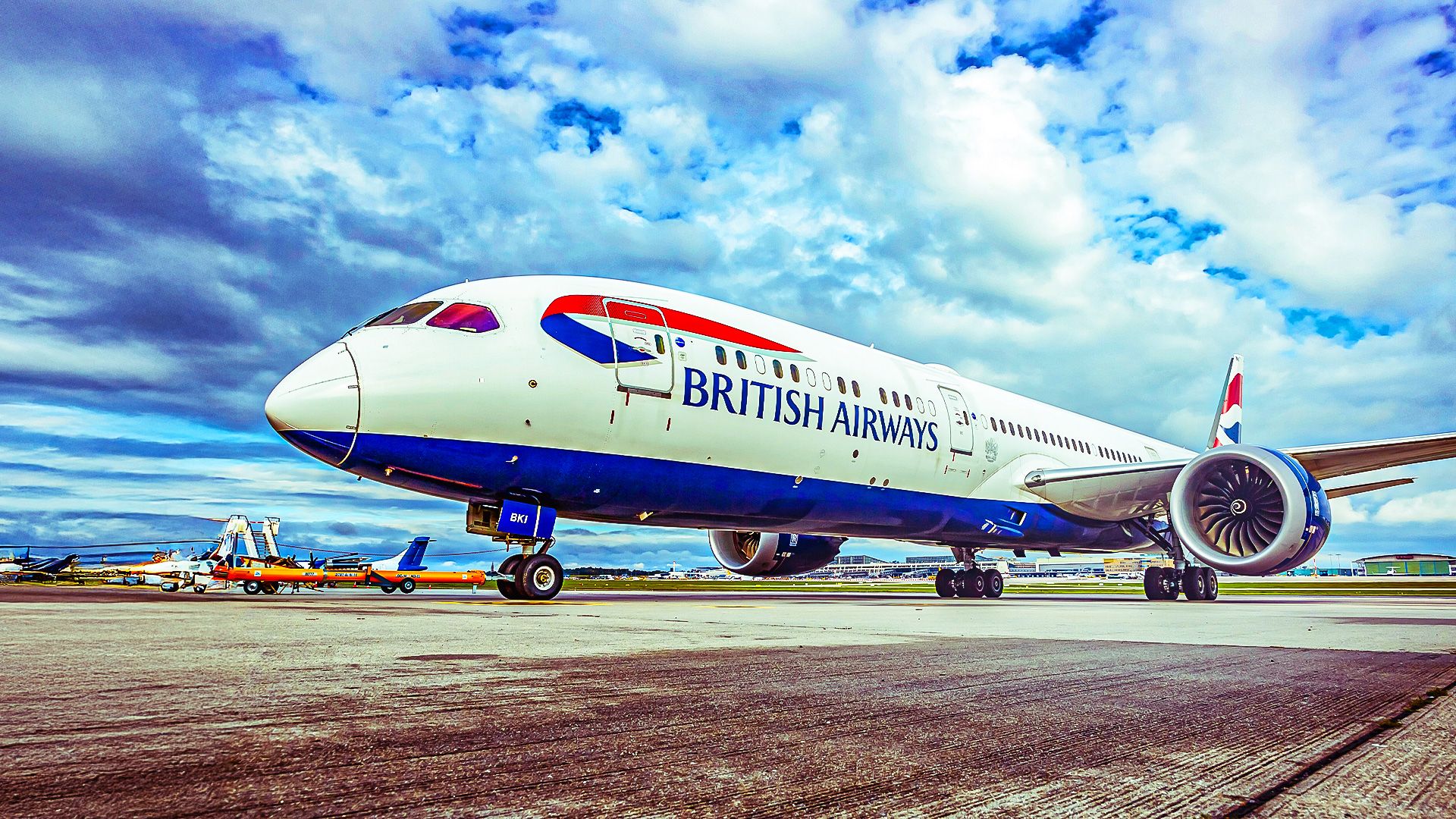
The flag carrier of the United Kingdom,  British Airways, enjoys the benefits of being the largest carrier at one of the world’s most congested airports, London Heathrow. From here, it operates a robust network of domestic and international services with its range of aircraft. One of the aircraft that has filled the gap between the Boeing 767 and Boeing 777 is the 787 Dreamliner.
British Airways has a fleet of 253 active aircraft in October 2025, with another 77 on order, according to ch-aviation. The airline operates a fleet of all Airbus narrow-body aircraft, in addition to the Airbus A350-100 and Airbus A380-800, while the rest of the widebody fleet is made up of the Boeing 777 (777-200ER and 777-300ER) and all three of the 787 family. BA is also expecting up to 24 of the 777X (777-9), once these are eventually certified.
The 787 At British Airways

BA first flirted with the idea of acquiring the 787 back in 2007, ordering 36 new long-haul aircraft, which were a mix of the A380 (12) and 787 (24), with the Dreamliner to be powered by the Rolls-Royce Trent 1000 engines. The 787s were expected to replace the airline’s aging Boeing 767 fleet. The first delivery of the 787 to BA was on June 26, 2013, and the airline put the aircraft into service on September 1.
The carrier’s revenue flight with the game-changing aircraft was between  London Heathrow Airport (LHR) and
  Toronto Pearson International Airport (YYZ), serving the largest city in Canada (Toronto). The airline gradually introduced the airplane on other key routes, such as
  Newark Liberty International Airport, on October 1, later that year.
BA currently operates all three types of the 787, with data from ch-aviation identifying the airline has 12 Boeing 787-8, in two configurations for between 204 to 214 passengers (one with retrofitted Club Suites, the other with the older style seating), and 18 Boeing 787-9 (all fitted with the older style seating). The 787-9 can carry up to 216 passengers across multiple classes. The Boeing 787-10, the largest of the Dreamliner family, has 12 in operation with BA, with another 38 on order. All of the -10 are fitted to carry up to 256 passengers.
Today, the aircraft is an integral part of the airline’s wider global operations and is deployed on routes across the carrier’s network. Using data from Cirium, an online aviation analytics company, Simple Flying will look into the longest routes operated by the British Airways 787 from London Heathrow:
Santiago Arturo Merino Benítez International Airport

The longest route with the 787 in the British Airways network is its direct non-stop flight to Santiago Comodoro Arturo Merino Benítez International Airport (SCL), serving the city of Santiago, Chile. The airline’s sole Chilean connection operates multiple flights per week, connecting the UK to Chile and beyond.
With 172 flights recorded by Cirium for 2025, this is the airline’s longest route with the 787-9 aircraft, reaching 7,227 miles (11,563 km). This route was first launched non-stop in 2017; however, the airline had previously served Santiago with ‘add-on’ flights from Buenos Aires between 1993 and 2000.
|
Equipment |
Boeing 787-9 |
|---|---|
|
Distance (miles) |
7,227 |
|
Distance (kms) |
11,563 |
|
Flights In 2025 |
172 |
|
Seats In 2025 |
37,152 |
|
Available Seat Miles (ASMs) In 2025 |
268,497,504 |
SCL is the largest and busiest airport in all of Chile, and British Airways is the sole operator offering direct flights to and from the United Kingdom. Additional European services are offered by Air France (Paris), Iberia (Madrid), KLM (Amsterdam via Buenos Aires), LATAM Chile (Madrid), and Level (Barcelona), and  Turkish Airlines (Istanbul via São Paolo).
Singapore Changi International Airport

This year, Singapore will see a total of 258 Boeing 787-9 services will be operated by British Airways from London Heathrow. The route, which covers a distance of 6,764 miles (10,822 km), is the second longest with this aircraft type for the carrier.
 Singapore Changi Airport (SIN) is one of the most highly regarded airports in all of Asia, and even the world. The airport is not only a destination in itself with a myriad of gardens, waterfalls, fishponds, and other natural attractions, but also has an extensive network of international operations, thanks to all the airlines that serve the airport. Singapore is a bustling financial hub, and this sees a high demand for business travelers to the region.
|
Equipment |
Boeing 787-9 |
|---|---|
|
Distance (miles) |
6,764 |
|
Distance (kms) |
10,822 |
|
Flights In 2025 |
258 |
|
Seats In 2025 |
55,728 |
|
Available Seat Miles (ASMs) In 2025 |
376,994,192 |
British Airways not only operates the 787 to Singapore, but also uses the same aircraft to continue to its sole Australian gateway, Sydney Kingsford Smith International Airport. Additionally, BA schedules the Airbus A380-800 on other direct flights to Singapore. Competition on this route is also offered by Singapore Airlines (with multiple daily services), alongside Qantas, which retains its flagship route to London from Sydney via the airport.
Kuala Lumpur International Airport

Malaysia’s capital, Kuala Lumpur, is just a short hop from neighbouring Singapore, and is another hot contender for the longest Boeing 787 flights operated by British Airways. At a distance of 6,593 miles (10,548 km), this is the third-longest route operated by the 787-9.
 Kuala Lumpur International Airport (KUL) is located just outside the city of KL, and is also the home of AirAsia and Malaysia Airlines. British Airways had served the Malaysian capital up until 2001; however, after a pause of 14 years, the airline returned to KUL in 2015.
|
Equipment |
Boeing 787-9 |
|---|---|
|
Distance (miles) |
6,593 |
|
Distance (kms) |
10,548 |
|
Flights In 2025 |
306 |
|
Seats In 2025 |
66,096 |
|
Available Seat Miles (ASMs) In 2025 |
435,770,928 |
Two airlines serve the London to Kuala Lumpur route with non-stop flights, including British Airways and the Malaysian flag carrier, Malaysia Airlines. Both airlines maintain daily services; however, BA does operate this route with a mix of the 787-9 and other aircraft.
Hong Kong International Airport

Direct flights to  Hong Kong International Airport (HKG) are usually offered by the British Airways Airbus A350-1000 and a mix of the 787 family of aircraft. However, this year the London-based carrier has 58 non-stop services to the Asian city with the 787-9 specifically. These will provide a comfortable 12,000 seats to cover the nearly 13-hour journey.
Covering a distance of 5,995 miles (9,592 km), Hong Kong is not only a strong economic partner, but traces its roots back to being a crown colony of the UK between 1841 and 1981. This became a dependent territory from 1981 to 1997, until the handover of Hong Kong to China in July 1997. Today, Hong Kong is a Special Administrative Region of China (SAR).
|
Equipment |
Boeing 787-9 |
|---|---|
|
Distance (miles) |
5,995 |
|
Distance (kms) |
9,592 |
|
Flights In 2025 |
58 |
|
Seats In 2025 |
12,528 |
|
Available Seat Miles (ASMs) In 2025 |
75,105,360 |
British Airways faces direct competition on the route from oneworld alliance partner, Cathay Pacific, which offers multiple daily flights to the UK, including London Heathrow and Manchester. Virgin Atlantic also used to operate on the route until the carrier withdrew its services in 2022, a move that saw the airline cut 50 jobs, and stop serving the city after 30 years of dedicated service.
Other Far Flung Destinations With The 787

Additional long-haul routes with the Boeing 787 for British Airways that are worth a notable mention include the airline’s direct services to Cape Town International Airport (CPT), South Africa. The airline serves this route with not just the Boeing 787, but also other widebody aircraft, resulting in just 45 return trips scheduled with the 787-9. These flights specifically represent a total of 9,720 seats and 58,261,680 available seat miles. The route covers a total of 5994 miles (9,590 km), just marginally shorter than Hong Kong. British Airways maintains year-round flights to Cape Town, but also additional seasonal services from London Gatwick (LGW).
Next up is London to  Tokyo Haneda Airport (HND), which covers a distance of 5,974 miles (9,558 km), with an estimated flight time of 13 hours, 50 minutes. The link to Tokyo’s closest airport to downtown sees it being a popular choice for business and leisure travelers. British Airways first started flying the direct route in 2011, in addition to its other Tokyo Narita services. In 2025, BA will offer a total of 385 non-stop flights to HND, representing a total of 83,160 available seats, and 496,797,840 available seat miles. This is the most popular route by number of flights offered in this analysis.
The 5,775-mile (9,208 km) flight to  Shanghai Pudong International Airport (PVG) is operated by British Airways 787-9 a total of 236 times in 2025, which equates to a modest 50,976 seats across 293,336,880 available seat miles. BA has served Shanghai for more than 20 years, since it first introduced flights back in 2005. Direct competition on this route is provided by the hometown airline, China Eastern Airlines.
Aeropuerto Internacional Benito Juárez, or more commonly known as  Mexico City International Airport (MEX), rounds out the list of the longest Boeing 787 services for British Airways in 2025. The direct flight to the Mexican capital will see a total of 319 services offered onboard the 787-9, which represents a total of 68,904 seats, across 381,797,064. The route covers a total distance of 5,541 miles (8,865 km), and Aeromexico, which also flies the route with its own Boeing 787 aircraft.
source
