

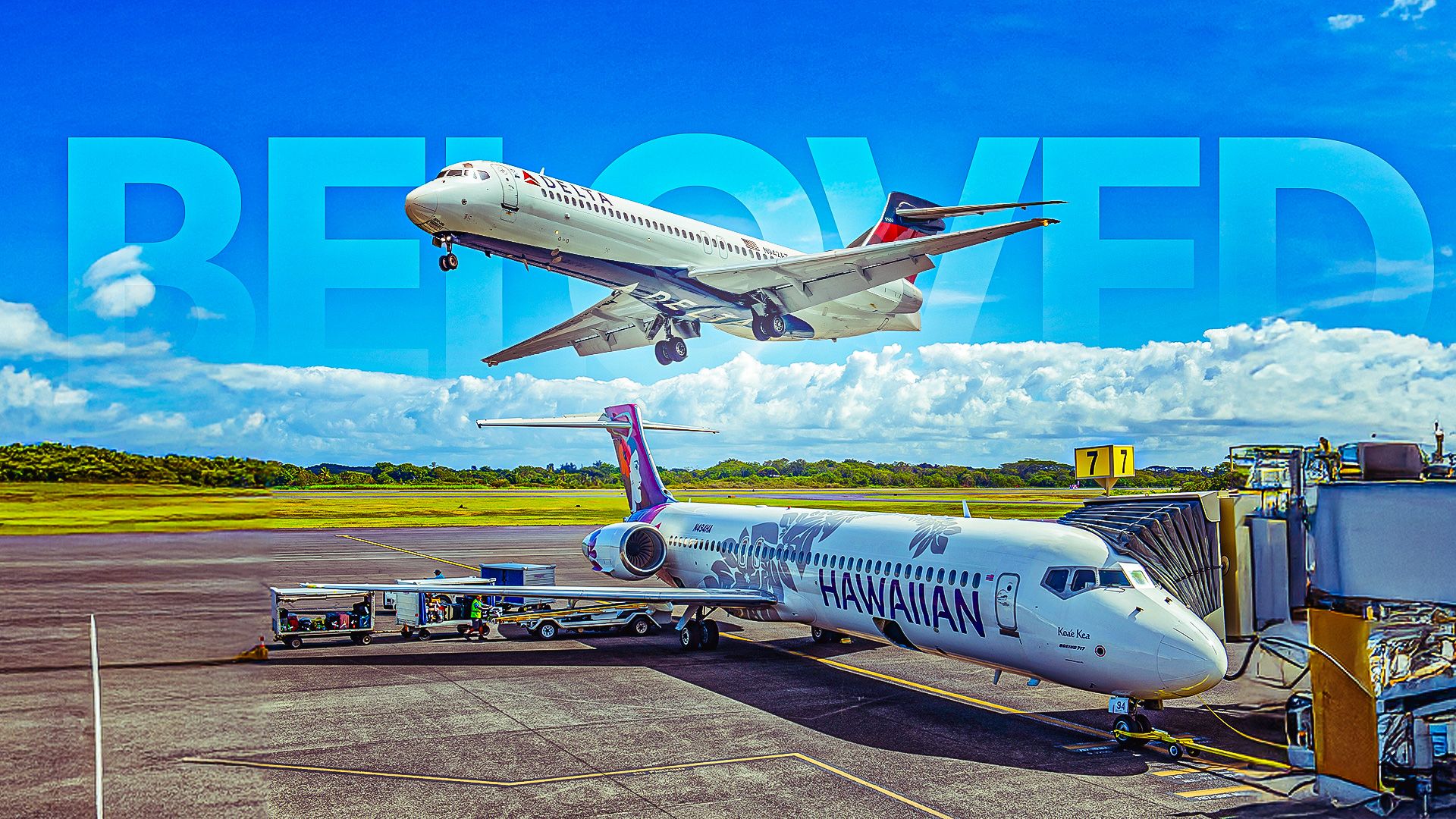
The Boeing 717 was once a popular five-abreast narrow-body aircraft that was initially marketed by McDonnell Douglas. In the early 1990s, the McDonnell Douglas MD-95 was the aircraft’s initial name, before the company’s merger with Boeing in 1997. The aircraft was a derivative of the successful MD-80, and more broadly the DC-9 family.
The Boeing 717 can seat approximately 134 passengers in the five-abreast configuration, and is powered by two Rolls-Royce BR715 turbofan engines. Both these engines are mounted near the rear end of the fuselage. With a range of up to 2,060 nautical miles (3,820 km), these aircraft are apt for short to medium regional routes.
MD-95 & Boeing 717 History

Under the McDonnell Douglas umbrella, the history of MD-95 dates back to 1983, when the airplane manufacturer commenced a study that was named the DC-9-90. In the early 1980s, as the DC-9 family moved away from the smaller ‘Series 30’, McDonnell Douglas suggested developing a smaller version of the DC-9. This was initially dubbed the DC-9-90, and in February 1983, it was revealed to be 25 feet, 4 inches (7.72 m) smaller than the DC-9-81. This airplane design was to seat up to 117 passengers; however, the recession in the 80s postponed the airplane’s development.
By 1991, McDonnell Douglas announced it once again would consider developing a 100-seat version of the MD-80. This was to be eight feet (2.4 m) shorter when compared to the MD-87. McDonnell Douglas, Pratt & Whitney, and the China National Aero-Technology Import Export Agency signed a memorandum of understanding to collaborate on the development of a 105-seater, named the MD-95. The first time the MD-95 was put to market was in 1994.
McDonnell Douglas was purchased by Boeing in August 1997. This saw many industry observers claim that this would see the end of the MD-95; however, Boeing kept the version alive and renamed it the Boeing 717. Early operators of the 717 were pleased with the airplane’s reliability and appeal. At one stage, Boeing did consider stretching the 717, dubbed the 717-300; however, it eventually axed the plans, fearing that it could cannibalize the 737-700 model of aircraft.
Early Operators Of The Boeing 717

Australian regional airline Impulse leased five Boeing 717s in early 2000, with plans to utilize these aircraft to expand on mainline routes. This decision eventually led to the demise of the Australian carrier, with the airline eventually selling out to flag carrier Qantas in May 2001. Qantas found success with the aircraft’s abilities, and with the airplane being faster than its BAe-146 airplanes. Paired with low maintenance costs, the Australian airline purchased more of the aircraft as a replacement for the 146 fleet.
In 2001, Boeing implemented a moving assembly line for the 717, which substantially reduced the airplane’s production time. However, economic downturns following the September 11 terrorist attacks saw Boeing review its future. While sales slumped, Boeing continued to push the aircraft, with the 100th 717 being delivered to AirTran Airways in 2002. In 2000, just 19 worldwide sales were recorded, with a sluggish six in 2001. In 2005, on January 14, Boeing announced it would plan to end production of the 717 once it completes all outstanding orders.
|
Total Orders |
155 |
|---|---|
|
Total Deliveries |
155 |
The last 717 rolled off the assembly line floor in 2006. This marked the 156th delivery of the type and was destined for AirTran Airways. This was iconic, as not only was AirTran the last customer, but also the launch customer. This aircraft variant was the last commercial airplane to ever be produced at Boeing’s California, Long Beach facility.
Characteristics Of The Boeing 717-200

The Boeing 717 requires a crew of two pilots, and can carry up to 134 passengers in a single class configuration, or 106 when offering both business/first and economy. The belly of the airplane can also hold 935 cubic feet (26.5 m3) of cargo onboard. The airplane’s performance ensures a cruising speed of up to 504 miles per hour (811 kmph), while a maximum speed can be reached of Mach 0.82 (566 miles per hour / 911 kmph).
At 124 feet in length (37.80 m), and a wingspan of 93 feet, four inches (28.45 m), the aircraft sits empty at 67,5000 pounds (30,617 kg), and at a height of 29 feet, eight inches (9.04 meters). Both the airplane’s engines, Rolls-Royce BR715-A1-30 turbofans, provide up to 18,920 pounds of thrust (84.2 kN) per engine.
Data from ch-aviation identifies that as of September 2025, just 86 Boeing 717 remain active, with two operators, only in North America, being Atlanta-based Delta Airlines, and Honolulu-based Hawaiian Airlines. Delta uses these aircraft for regional flights, and Hawaiian relies on these airplanes to provide frequent island-hopping services between the Hawaiian islands.
The 717 At Delta Air Lines

 SkyTeam Alliance partner, Delta Air Lines, operates 68 Boeing 717-200 aircraft, which were initially all leased from AirTran Airways in 2012, after Southwest Airlines acquired AirTran, but opted to keep a single type 737 fleet. This move enabled Delta to replace its aging DC-9, MD-8, and MD-90 aircraft while utilizing these aircraft for short-haul operations. The 717 shared type ratings and similar systems to other existing aircraft in the airline’s fleet. Southwest’s decision not to integrate these into its wider fleet was a win for Delta, as they were able to quickly obtain these aircraft and replace its other aging airplanes.
In 2012, Delta signed a strategic lease for all 88 of the AirTran Airways 717, at a cost that included Southwest refitting them all for the Atlanta-based carrier. This move was a cost-effective fleet modernization plan, which allowed Delta to upgrade its fleet without needing the funds to obtain new aircraft and requiring pilot retraining and maintenance overhauls. Delta remains the largest operator of the 717, and these aircraft can be seen on domestic routes from its major hubs.
|
Aircraft Type |
Total Seats |
|---|---|
|
Boeing 717-200 |
110 |
|
Airbus A220-100 |
109 |
|
Airbus A220-300 |
130 |
While Delta is now gradually retiring its Boeing 717s, these are being replaced with the Airbus A220, another aircraft type of which Delta is the largest operator. Final retirement of the 717 is expected by the end of 2026. Delta operates two types of the A220, also in a five-abreast configuration, with 45 A220-100 and 34 A220-300. The airline has another 66 of the A220-300 on order. These two aircraft variants can seat between 109 and 130 passengers in a multi-class configuration.
The 717 At Hawaiian Airlines

Honolulu-based Hawaiian Airlines, now part of Alaska Air Group Alaska Air Group, operates 18 Boeing 717-200. These aircraft are deployed on their interisland flights, and are praised by the airline for their reliability and ability to operate quick turnarounds. They are configured to carry up to 128 passengers and are nearing an average age of 25 years. The airline must closely monitor them due to their operations in hot and humid conditions.
Hawaiian introduced the Boeing 717 in 2001 and expanded its fleet after acquiring aircraft from the defunct Aloha Airlines. Hawaiian has always been one of the jet’s primary users and has been understandably loyal to the aircraft type. While Hawaiian Airlines has kept quiet on what could be a suitable replacement for these aircraft, it could likely be the Boeing 737 MAX, Airbus A220, or Embraer E195-E2.

Hawaiian Airlines is the tenth largest commercial airline in the United States, when considering the number of passengers carried, and operates its primary hub from Daniel K. Inouye International Airport in Honolulu (HNL). The airline maintains a secondary hub at Kahului Airport in Maui. Its widebody operations are made up of the Boeing 787 and Airbus A330, with international services to Australia, Canada, Japan, New Zealand, and South Korea, alongside other widebody operations to the mainland United States.
No Direct Replacement

While  Boeing has no direct replacement for the 717, there are plenty of other options out there that airlines can consider, such as the 737, Airbus A220, and Embraer E195. The 717 was perfect for some airline fleets, due to its superior fuel efficiency and modern technology at the time. However, a quarter of a century later, these are starting to wear, and airlines are looking for their exit strategy.
Qantas, which recently retired the last of its 717s, used the aircraft as a lifeline to regional outback communities and heavily supported the mining operations in Western Australia. However, more recently, the carrier has welcomed a shiny new fleet of Airbus A220, which are already put to work on domestic flights, and will soon provide an international link between Brisbane and New Zealand’s capital, Wellington. This will be the first time Qantas has slotted this aircraft for international operations.
The Boeing 717 has been used the world over to provide convenient, regional flights, with big-name airlines like American Airlines, Qantas, Jetstar, MexicanaClick, Midwest Airlines, Olympic Airlines, Spanair, Trans World Airlines, Blue1, German Wings, Volotea, Bangkok Airways, and Turkmenistan Airways all having once operated the iconic aircraft type.
source
