

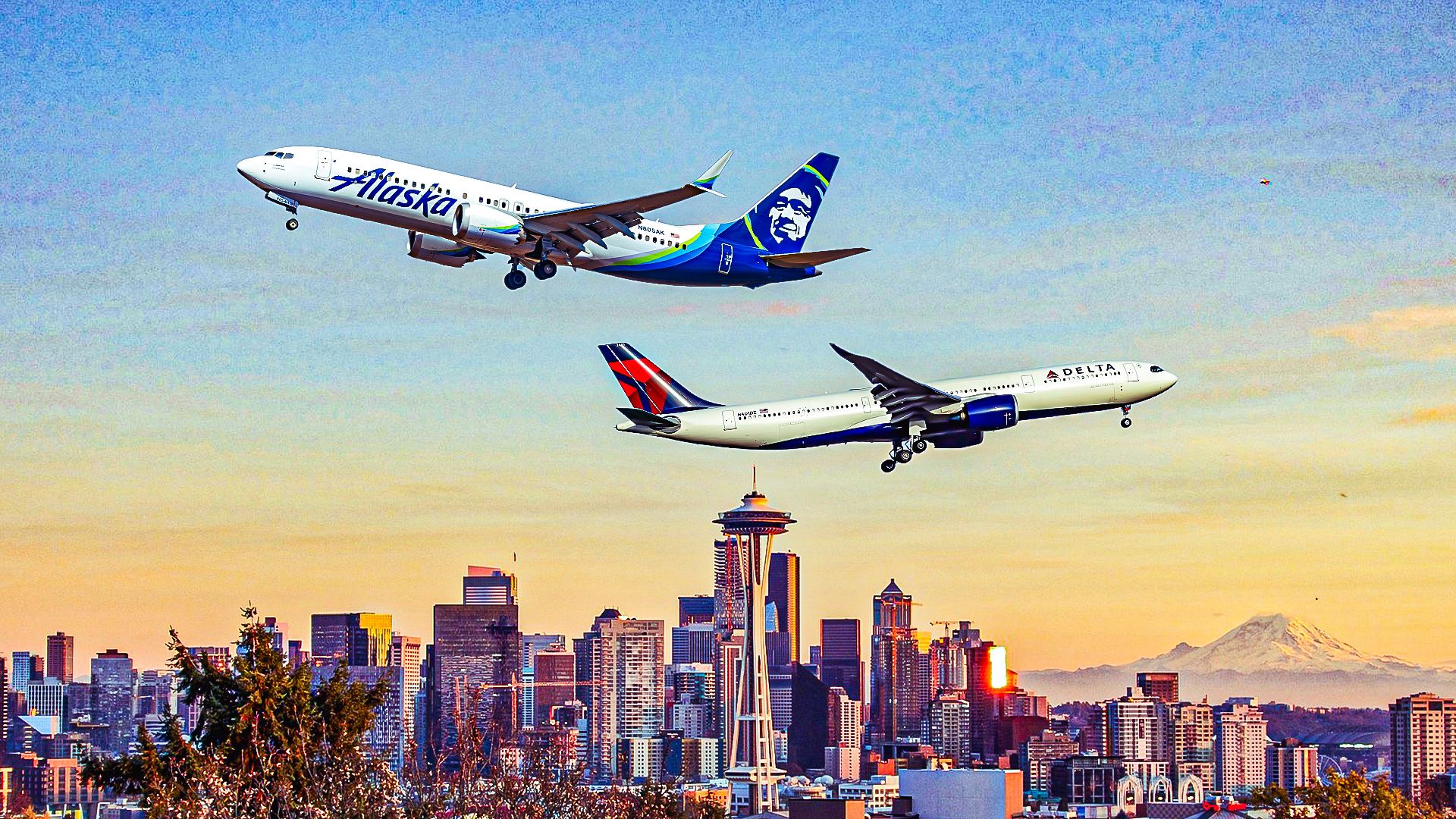
In the misty Pacific Northwest, a fierce battle is unfolding, not on the ground, but in the skies above  Seattle-Tacoma International Airport (SEA). For over a decade,
  Alaska Airlines, the hometown carrier deeply rooted in the region’s aviation history, has been locked in a high-stakes rivalry with
  Delta Air Lines, the Atlanta-based giant that has aggressively expanded its presence in the Emerald City. What began as a strategic partnership has evolved into a full-blown turf war, with both airlines vying for dominance in one of the fastest-growing US aviation markets.
The competition shows no signs of abating. Alaska Airlines, bolstered by its recent merger with Hawaiian Airlines, is pushing into long-haul international routes, challenging Delta’s stronghold on transoceanic flights from Seattle. Delta is countering with new European destinations, fleet upgrades, and premium lounge expansions. The stakes are enormous: Seattle’s airport handled over 52 million passengers in 2024, with projections for strong future growth driven by its tech industry and growing tourism to the Pacific Northwest.
From Allies To Adversaries

Rewind a couple of decades, and Alaska and Delta used to be the best of friends. Back in 2004, they announced a codeshare, which included reciprocal frequent flyer benefits. The partnership was a genuine win-win: Delta was primarily an East Coast airline, and Alaska gave it a significant West Coast footprint, while for Alaska, partnering with Delta gave its passengers easier access to global destinations.
But following its merger with Northwest Airlines in 2008, Delta sought to challenge  United Airlines‘ dominance in San Francisco and
  American Airlines‘ strength in Los Angeles by establishing a strong West Coast hub. Seattle emerged as the perfect candidate: underutilized compared to other hubs, with a growing tech economy demanding more international connectivity.
In 2014, Delta announced that it was building a fully fledged hub in Seattle, pouring resources into gate expansions and marketing itself as “Seattle’s global carrier”. Over the next two years, it more than doubled its number of flights at SEA, spurred on by the threat it perceived due to Alaska’s acquisition of Virgin America and increasing closeness with the  oneworld alliance. Tensions boiled over at the end of 2016, and both airlines announced the termination of their partnership, and the turf war began in earnest.
What’s At Stake? The Value of Seattle

Operated by the Port of Seattle, SEA supports tens of thousands of jobs and produces $22 billion in economic activity in the Pacific Northwest. It is currently served by 37 airlines, with 94 domestic and 35 international destinations. It has a 4-Star Skytrax Rating and has been awarded “Best Airport in North America” three years in a row (2022-24). But Alaska and Delta have traditionally had very different views of their value to their respective networks.
|
Seattle-Tacoma International Airport: Key Statistics (2024 data) |
|
|
Annual Passengers: |
52.6 million |
|
Domestic Passengers: |
46.0 million |
|
International Passengers: |
6.6 million |
|
US Rank By Passenger Numbers: |
11 |
|
Total Airlines: |
37 |
|
Total Domestic Destinations: |
94 |
|
Total International Destinations: |
35 |
|
Runways: |
3 |
Seattle’s value to Alaska Airlines was always as a natural hub, being the logical point to connect The Last Frontier with the lower 48 states. The airline built up its operations there throughout the 1960s and 1970s, and officially designated it as its “central hub” in 1985. As other airlines focused on larger cities, Alaska established deep loyalty within the market and has consistently controlled more than half the market share. It’s an investment that has paid off, as an economic boom has transformed greater Seattle into a city of more than 4 million people, with a 21% population increase over the past decade.
That growth is what drew in Delta. Post-merger, it wanted a West Coast hub of its own to drive transpacific expansion. LAX was already too splintered, SFO was taken, and SAN and PDX just weren’t really viable. But SEA was ideal with its fast-growing economy and population, spurred on by a tech boom, and being even closer to the major Asian markets of China, Japan, and South Korea. It knew it would be an uphill battle competing with Alaska domestically, so for Delta, the greatest value of Seattle has always been international growth opportunities.
Alaska Airlines Has Hometown Advantage

As the turf war heats up, Alaska has the massive advantage of dominant market share and an almost unnatural level of loyalty in Seattle. As the largest carrier at SEA, Alaska commands a 52% overall market share compared to Delta’s 24%, serving roughly double the number of destinations. This translates to stronger gate control and scheduling flexibility, allowing Alaska to optimize connections for its passengers.
|
Market Share At SEA |
|||
|
(Data: Port of Seattle) |
Domestic |
International |
Total |
|
Alaska Airlines |
58% |
16% |
52% |
|
Delta Air Lines |
24% |
26% |
24% |
Alaska plays to this strength. Branding itself as “Seattle’s Hometown Airline,” it is the official airline sponsor of the Seattle Seahawks, Mariners, and Sounders FC, using custom liveries and even naming local hero Russell Wilson “Chief Football Officer.” Community ties are reinforced through extensive sponsorship of Seattle Pride events, local nonprofits, and environmental programs, presenting the airline as embedded in the city’s culture. And there are multiple collaborations with local companies, like Starbucks and Tom Douglas restaurants.
Tellingly, if you’ve ever spent time with Seattleites, you’ll know that the majority have an Alaska Mileage Plan credit card. The loyalty scheme is widely regarded as superior to Delta’s SkyMiles, offering better redemption rates and partner perks through the oneworld alliance. The result? Even as Delta has quadrupled its market share since declaring SEA a hub (6% to 24%), Alaska’s control of more than half the market hasn’t budged. Delta’s growth has come at the expense of other airlines (most notably United and  Southwest Airlines), but not Alaska. Such is the level of loyalty to Alaska in the Coffee Capital.
The Hawaiian Airlines Acquisition Changes Everything

However, Alaska Airlines has had one area of obvious weakness in its turf war with Delta. It has just a paltry 16% share of international traffic, and the bulk of that is short hops to Canada. With no widebody aircraft, it wasn’t able to offer its loyal base flights to far-flung destinations in Asia or Europe, and this is where Delta was able to make some of its biggest inroads.
But that has all changed. The $1.9 billion acquisition of Hawaiian Airlines provides Alaska with access to the Hawaiian widebody fleet, which includes 24 Airbus A330-200s and (currently) four Boeing 787-9s. The airline has added to the 787 order, so it now expects to have 17 of the type by the end of the decade. While the A330s will remain in the Hawaiian Airlines fleet for international long-haul and continental US flying to and from Honolulu, the 787s will be based in Seattle for Alaska’s new long-haul routes, where it will go head-to-head with Delta for the first time.
As a result, Alaska has been rapidly announcing new international routes from SEA, and earlier this month, showcased the new livery that will adorn the 787s that will fly them. The airline already has five intercontinental routes on the schedule:
- Tokyo (Active)
- Seoul (September 2025)
- Rome (Spring 2026)
- London (Spring 2026)
- Reykjavík (Spring 2026)
Ben Minicucci, CEO of Alaska Airlines, said that the two latest routes announced (London and Reykjavík) are the fourth and fifth of at least 12 intercontinental destinations that the airline plans to serve from Seattle by the end of the decade:
“With these bold moves, we are accelerating our vision to connect our guests to the world. We are seizing this moment to redefine the international experience and level up. And we’re doing it with the same relentless focus on safety, care and performance that’s always defined us. I’m so proud of how our people continue to step up and deliver as we push ahead on these initiatives, with even more to come.”
Delta Fights Back With Premium

For Delta, the events of the past year have certainly altered the competitive landscape, but it’s not the first time that the carrier has had to adapt and compete. It also has its own advantages. As one of the world’s largest and most profitable airlines, Delta is the size of six Alaska Airlines in both revenue and profit, and even once Alaska has all its 787s, Delta will have more than ten times as many widebodies. In terms of pure brute force, Delta has far more resources that it can bring to the fight.
Moreover, it won’t be a simple fight. Don’t expect to see price wars or Delta flooding the market with capacity to drown out Alaska and try to grab market share. Rather, Delta will use the same tactics that already work so well against its traditional foes: offering a premium-heavy product that attracts the most lucrative travelers, especially international passengers, ensuring that it maximizes revenue-per-seat-mile. Delta isn’t in the fight to see who can carry the most passengers from Seattle to Spokane. It’s focused on filling premium seats from Seattle to Seoul.
You can already see the Delta strategy in effect:
- Global network: Delta is targeting business and high-value leisure travelers with messaging that emphasizes its massive global network, something that even Alaska described as “a worldwide network of destinations that is second to none” when they formed their original codeshare. This is particularly effective with large Seattle-based companies like Amazon, Starbucks, or Microsoft.
- Upgauging to A350s: It is establishing a base at SEA for its A350s and their pilots, effectively upgauging its routes to Asia and Europe to larger aircraft with 20% more capacity compared to the A330s that have traditionally operated the routes. The A350s also offer a higher proportion of premium seating, including up to 40 Delta One suites.
-
Expansion of lounges: Delta has added a new dual-level lounge complex (in addition to the existing Sky Club), with a refreshed Sky Club on the lower level and a brand-new Delta One lounge on the upper level. This is open almost exclusively to those who are flying on long-haul business or first class itineraries with Delta and its
 SkyTeam
partners. - Raising the stakes: When Alaska announced the launch of a new route to Rome next spring, Delta responded immediately by announcing that it would also launch the same route, plus add a new route to Barcelona at the same time.
So beware the debate that suggests that “winning” in Seattle is all about market share. Delta’s view of winning will come down to profitability rather than just the number of passengers it carries versus Alaska.
What To Expect In The Months Ahead

In many respects, it is too simple a question to ask “Who will win in Seattle?” The reality is that neither carrier is going to win outright, but also, neither is going to lose. Delta is not going to back down from a resurgent Alaska, but equally, Alaska is not about to lose substantial market share to its larger competitor.
On domestic routes, which make up 87% of the traffic at SEA, we can expect the situation to remain largely static. Alaska has roughly double the number of routes, so Delta may choose to add some new domestic routes similar to earlier this year with Washington DC and its new longest Airbus A321neo route to Miami. But Delta will also have to balance the value of adding domestic routes to Seattle versus at its more dominant hubs like Atlanta, or its high-growth focus cities in Austin and Raleigh-Durham.
It is on international routes where the battle will be hottest, and with good reason. While making up just 13% of SEA traffic currently, international passengers are growing at 14% year-over-year (vs 2% for domestic) and are the highest value segment. But there are a lot of obvious untouched markets (e.g., Hong Kong, India, Australia, all of South America), and the majority (58%) of international passengers still arrive and depart at SEA via international carriers. So there is also a lot of room for both carriers to grow internationally without being in huge conflict with each other at every step.
What will certainly happen is that Delta will compete as the premium, global choice, which will push Alaska to deliver a high-quality service with its new 787 routes. We can see the airline responding already with its new livery and promise of interior enhancements. If both carriers are able to grow in a strongly competitive but profitable environment, as is feasible, then there is one clear winner of the turf war: the Seattle traveler.


- IATA Code
-
SEA
- City
-
Seattle
- State/Province/Region
-
Washington
source
