


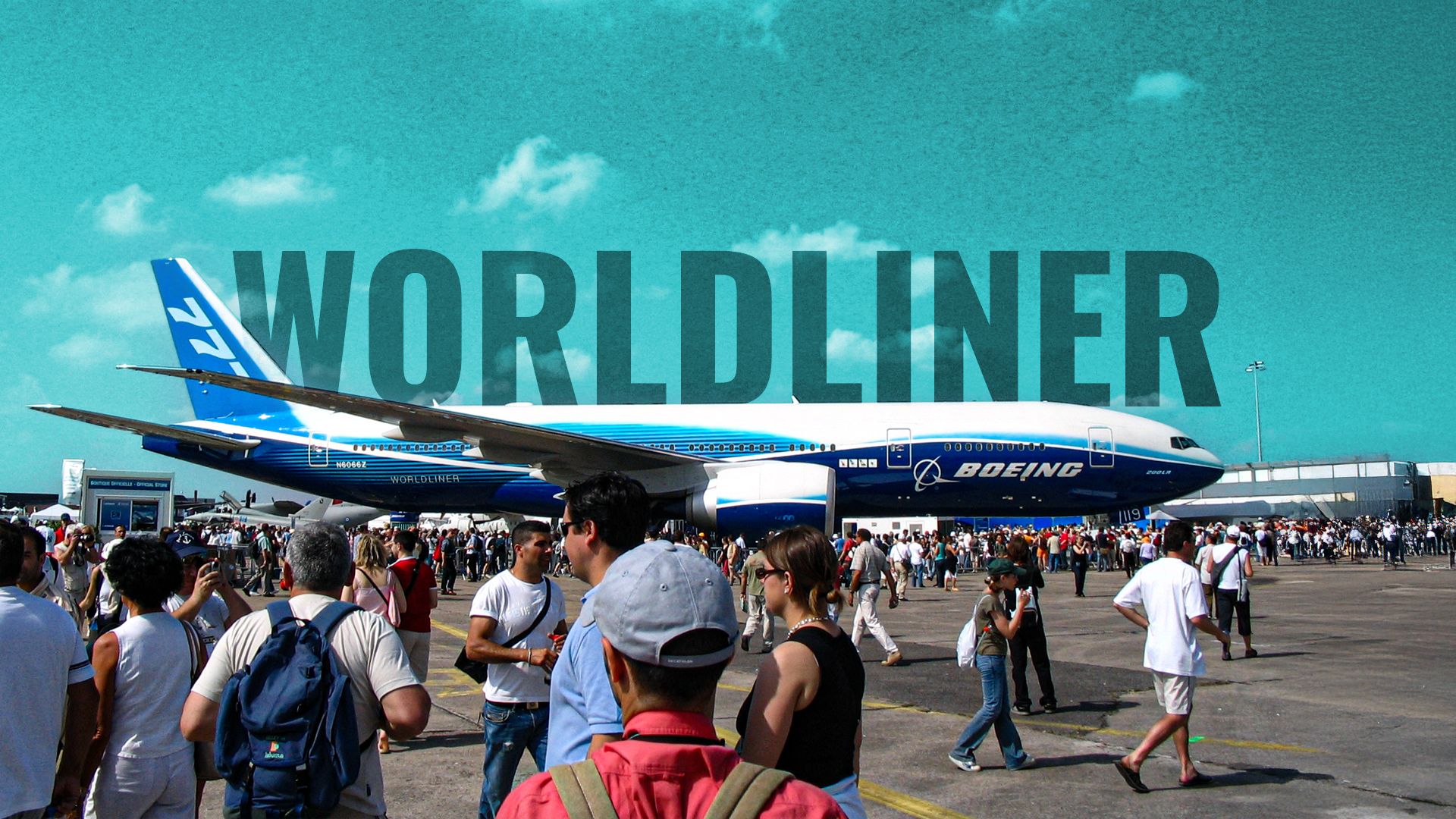
On November 10, 2005, a Boeing 777-200LR landed at  London Heathrow Airport (LHR) after flying more than halfway around the world without stopping to refuel. The “longer range” triple seven departed from Hong Kong airport (HKG) on November 9 for its 22-hour, 42-minute trek halfway around the globe. The jet was recorded by the Guinness Book of World Records as flying 11,664 nautical miles (21,601 km or 13,422 miles).
Boeing’s lead test pilot for the 777, Captain Suzanna Darcy-Henneman, would have the honor of piloting aircraft N6066Z from the shores of the Pacific Ocean to the islands of the United Kingdom in the Atlantic Ocean. She was also the first female production test pilot in Boeing’s history, according to This Day In Aviation.
The “Worldliner,” as Boeing dubbed the new model, was powered by two General Electric GE90-115B engines, which were the most powerful commercial turbofan engines on any airliner in the world until recently being surpassed by the new GE9X. The model would be the fifth variant of the 777 family, and capable of connecting virtually any two cities on Earth.
Boeing Makes History Again

The route of the Worldliner took it from Hong Kong eastbound over the Pacific Ocean, crossing the International Date Line (IDL), before it reached the shores of North America. The plane then continued over the mid-North Atlantic Ocean until it reached London.
Lars Andersen, vice president and program manager, 777 Program, Boeing Commercial Airplanes, gave the following remarks in the company’s press release after the record-setting flight:
“The 777 has been a leader in its market ever since it first went into service. The 777-200LR Worldliner continues that market leadership by offering unmatched capability that allows airlines to offer passengers nonstop routes to their destinations.”
This Day In Aviation records that the 777 averaged 981 kilometers per hour (609 miles per hour) from Los Angeles to New York, and 910 kilometers per hour (565 miles per hour) from New York to London.
In 2008, Captain Darcy-Hanneman became Chief Pilot, Boeing Commercial Airplane Services, and was later inducted into the Women in Aviation Pioneer Hall of Fame in 2010. She was the first woman to earn a captain’s rating on the 747-400, and earned ratings on the 737, 757, 767, and 777 series jets during her career.
She gave this statement after the historic flight of the Worldliner, 777-200LR:
“The performance of the 777-200LR during the record flight was exceptional. It took the support of a great team of people to make this historic flight a success. I’m proud to be a part of that team.”
The 777-200LR beat the previous distance record set by a 747-400 in 1989, which flew 9,200 nautical miles (17,039 km) nonstop from London to Sydney. It also beat the 777-200ER (Extended Range) that flew 10,823 nautical miles (20,044 km) from Seattle to Kuala Lumpur in 1997, despite being a heavier jet than the -200ER.
Worldliner By The Numbers

The first production models were delivered in 2006 with a 301-seat capacity and a normal service range of 9,420 nautical miles (17,445 kilometers). Ultimately, only 61 of the aircraft would be produced due to the extremely niche market. The highly specific purpose of flying ultra-long-haul routes would only provide a very limited pool of potential customers and itineraries that required the aircraft’s capabilities.
The aircraft’s design prioritized a high maximum fuel capacity for takeoff, which meant it sacrificed payload for more fuel capacity in order to attain its extraordinary range. On the majority of routes where its entire range wasn’t required, this hindered its economic desirability. There were three fuel tanks installed in the cargo area in order to keep the plane in the air.
|
Specification |
Boeing 777-200LR |
|---|---|
|
Seats (2-class) |
317 |
|
Range |
8,555 nautical miles (15,843 kilometers) |
|
Length |
63.7 meters (209 feet 1 inch) |
|
Wingspan |
64.8 meters (212 feet 7 inches) |
|
Height |
18.6 meters (61 feet 1 inch) |
|
Engine |
GE90-115B |
The 777-200LR has become a very successful freight aircraft that is still in production even as its more popular counterpart, the -300ER has stopped being built. The weight-to-volume characteristics of the aircraft make it ideal for freight, and some earlier passenger -200LRs are also being converted into freighters.
The 777-200LR airframe has been successful in the cargo market despite the termination of passenger production. The -200LR airframe serves as the foundation for the Boeing 777 Freighter (777F). It uses the -200LR’s fuselage length but the -300ER’s large gross weight and wings.
Boeing Embodying American Ingenuity

The Boeing 777, known as the “triple seven,” family was instrumental in the advancement of safety and engineering progress that has given rise to large, long-range twinjets replacing legacy quadjet aircraft on international routes. The four-engined, iconic 747 jumbo jet and Airbus A380 super jumbo have been progressively falling to the wayside as airlines favor modern two-engined widebodies.
The baseline 777-200 was the first aircraft type to obtain ETOPS-180 certification when it first entered service in 1995, which was the most notable watershed contribution the triple seven family made. In 2011, the -200LR and -300ER types helped achieve type-design approval for ETOPS up to 330 minutes.
Captain Darcy Henneman was also the pilot who took the -200LR into the sky for the very first time. She said this after its successful maiden flight:
“The 777-200LR’s ability to connect the world is amazing. Flying the first flight is an honor and a rare opportunity.”
The triple-seven brought about a revolution in nonstop commercial air service. The longest range models made ideal, straight-line routes possible between almost any two cities in the world. The jets also allowed airlines to fly through zones that were once restricted to twinjets over areas like the South Pacific and Southern Indian Oceans.
Worldliner Paving The Way

The 777-200LR and the 777-300ER (extended range) were developed concurrently as part of the Worldliner program and share a strong engineering commonality. Both aircraft were equipped with the same GE90 engines, which allowed for their incredible payload and range.
The higher maximum takeoff weight (MTOW) required for both aircraft was first achieved on the world liner with its reinforced landing gear and strengthened wings. The supercritical airfoil and raked wingtips that both the -300ER and -200LR feature were first tested on flights by the Worldliner.
The legacy of the triple seven family directly contributed to the 777X, 787 Dreamliner, and other modern jetliners, with major progress in the use of Computer-Aided Design (CAD) software (CATIA). The 777 jets were the first commercial aircraft designed entirely with CAD.
The method proved that a complex aircraft could be designed and assembled virtually. A process that became standard practice afterward and was refined for the 787 program, allowing for even greater precision and reducing the need for costly physical mock-ups.
The 777’s advanced fly-by-wire system and integrated avionics laid the groundwork for the even more advanced, electric-heavy architecture of the 787. The -200LR proved the viability of ultra-long-haul routes with twinjets, a capability the 787 and 777X continue to improve upon. The 77X aims for even greater fuel efficiency and range, incorporating 787 cabin features like larger windows, LED lighting, new cabin styling, and better humidity control.
The use of raked wingtips on the -200LR was a precursor to the 777X’s advanced, longer carbon-fiber composite wing that is equipped with industry-first folding wingtips. The expertise gained from operating the powerful GE90 engines on the -200LR and -300ER directly led to the development of the next-generation GE9X engines for the 777X.
Boeing’s Rare Bird

Seeing a 777-200LR in “the wild” is a plane spotters’ delight, as it is one of the rarest commercial airplanes still in service today. The aircraft is only seen at select international hubs in India, Canada, the Middle East, and South America. Routes include a couple of large hubs in the United States, dispersed between the East Coast and the West Coast.
Just a handful of airlines currently keep the aircraft in their inventory. According to Planespotters.net, the list includes:
|
Boeing 777-200LR Operators |
|---|
|
Air Canada |
|
Air India |
|
Emirates |
|
Ethiopian Airlines |
|
Qatar Airways |
|
Turkmenistan Airlines |
|
Pakistan International Airlines (PIA) |
|
Azerbaijan Airlines (AZAL) |
|
Iraqi Airways (aircraft is currently stored) |
The operators that put the Worldliner to the greatest use are Air India, Air Canada, and Qatar Airways. These airlines found the aircraft’s incredible range exceptionally useful as their nonstop routes all run over the 7,000 nautical mile threshold.
At 8,691 nautical miles, Air India’s Bengaluru–San Francisco route continues to be the farthest scheduled 777-200LR trip. Air Canada’s Vancouver–Sydney flight is 7,755 NM long, and Qatar Airways’ Doha–São Paulo flight is 7,368 NM long.
Each airline concentrates its capacity on a few high-value destinations. The traffic data shows strong demand for these carefully selected destinations. In April 2025, there were a total of 440 flights and 124,556 seats accumulated by all the -200LR routes, according to data from Cirium.
