


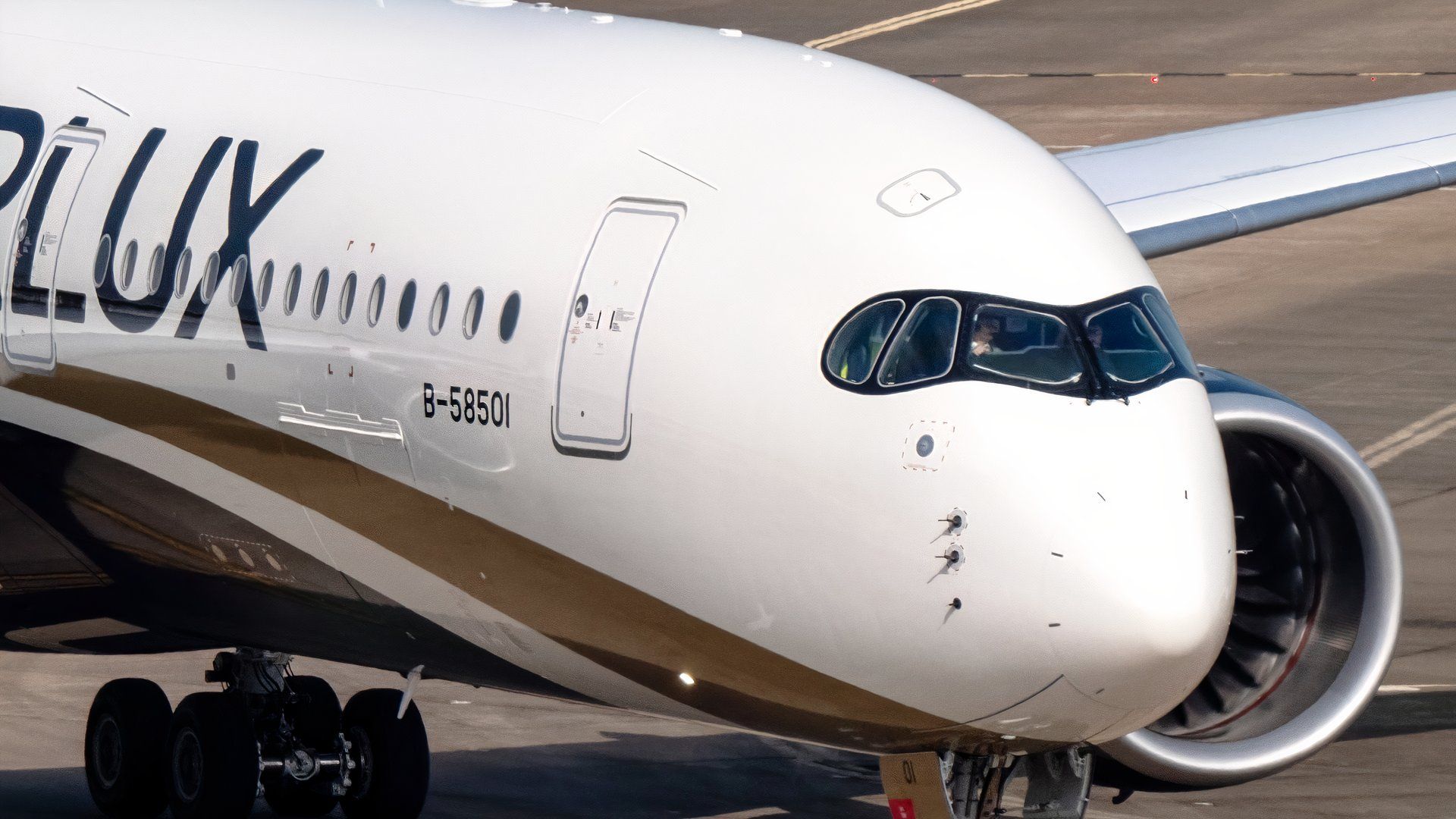
In 2024, Ontario International Airport welcomed just over seven million round-trip passengers. It was the first time traffic had exceeded seven million in 17 years. Compared to before the pandemic in 2019, throughput increased by more than a quarter. This growth was particularly driven by incumbents Delta Air Lines, United Airlines, and Volaris. However, the arrival of Avianca in 2021, followed by Avelo in 2024 (although it has since exited). STARLUX launched in 2025.
Against this background, Ontario’s management attended Routes World in Hong Kong. Among a huge number of heavily branded pop-ups by airports, tourism bodies, countries, etc., from all across the world, its offering was among the most eye-catching.
Ontario’s Offering To The World

Having been to lots of Routes events, credit must be given to Ontario’s management for its creativity, which extends well beyond the example photo shown above. Like all the others, its stand was designed for people—whether at airlines or journalists, etc.—to pop by and chat. Spending tens of thousands of dollars attending such events is about growing awareness, relationships, and hopefully—sooner or later—more business.
Its promotional material was vivid and littered with to-the-point statements. “More than nine million people live closer to ONT than LAX,” “Introducing Southern California’s fastest and easiest airport,” “ONT is the fastest-growing of the ten largest airports in California,” “ONT is open 24/7; you won’t find slots or curfews here!” and so on. Of course, the latter point about accessibility is particularly well-utilized by Ontario’s many freighters.
Ontario Is Served By 11 Passenger Airlines

According to Cirium Diio data for October 2025 to January 2026, Ontario’s passenger departures have risen by over 2% year-on-year. It has an average of 76 daily takeoffs, but as many as 90. As Avelo pulled out in March 2025, 11 airlines (mainline and regional) operate them.
Unsurprisingly, the airport is massively about  Southwest (42% of the departures), followed by American (14%) and Delta (11%). Alaska Airlines, Avianca, China Airlines, Frontier, JetBlue, STARLUX, United, and Volaris provide the remaining third of services. STARLUX arrived in June 2025 and provides the second link to Taipei.
|
Long-Haul Passenger Operator |
Route |
October Operations |
|---|---|---|
|
China Airlines |
Taipei-Ontario |
Daily 777-300ER/A350-900 |
|
STARLUX |
Taipei-Ontario |
In the same four months, Ontario’s passenger network encompasses 30 airports, of which 24 are domestic and six are international. It has international flights to Guadalajara, Leon/Guanajuato, Los Cabos, Morelia, San Salvador, and Taipei.
Its domestic map sees flights to Atlanta, Austin, Baltimore, Boise (starts January 7), Charlotte, Chicago Midway, Chicago O’Hare, Dallas/Fort Worth, Dallas Love, Denver, Honolulu, Houston Hobby, Houston Intercontinental, Las Vegas, Nashville, New York JFK, Oakland, Phoenix, Portland, Sacramento, Salt Lake City, San Francisco, San Jose, and Seattle.
Ontario’s 10 Largest Unserved Domestic Routes

According to the US Department of Transportation data, Orlando is the largest unserved market. It has 106 passengers daily each way (PDEW). Southwest has 40% of the market, followed by American (23%) and Frontier (19%). More people connect in Denver than anywhere else. As always with such things, traffic figures are before markets grow from nonstop flights and promotions.
New York LaGuardia is next (90 PDEW), followed by Washington Reagan (77). Of course, perimeter restrictions mean these airports won’t be served. Philadelphia is fourth (72), and then Spokane (66), San Antonio (64), Indianapolis (61), St. Louis (61), Kansas City (59), and Boston (55).
More meaningfully, if cities of no more than 1,000 miles are considered, Spokane is first (66), followed by El Paso (41), Albuquerque (38), and Reno (33). All four cities have been served before, including by ExpressJet. Will any of them have nonstop flights again?
