


The YFQ-44A CCA switched between Shield AI’s Hivemind and Anduril’s Lattice AIs during the same flight, completing tasks with both.
Anduril Industries’ YFQ-44A Fury Collaborative Combat Aircraft (CCA) flew with Shield AI’s Hivemind and Anduril’s own Lattice autonomous flight programs, both companies announced on Feb. 26, 2026. Notably, the drone also switched between software mid-flight, completing a range of combat-representative test points with both.
This allowed to demonstrate the software’s and hardware’s technical maturity, while being in harmony with the broad CCA development path envisioned by the U.S. Air Force. The new development came within two days of the drone flying with an AIM-120 Advanced Medium-Range Air-to-Air Missile (AMRAAM).
Hivemind just flew @anduriltech‘s YFQ-44A.
Hivemind completed its first flight test aboard Anduril’s YFQ-44A aircraft for the @usairforce’s Collaborative Combat Aircraft (CCA) program. During the flight test over the Mojave Desert, Hivemind passed all required test points,… pic.twitter.com/q3GTCesciH
— Shield AI (@shieldaitech) February 26, 2026
Prior to that, in mid-February, the other CCA selected as a part of the Increment 1 phase, the YFQ-42A Dark Merlin, flew with Collins Aerospace’s Sidekick mission autonomy software. Shield AI at the time had announced its selection as the autonomy software provider for the CCA program, saying Hivemind was then in the process of being implemented on Anduril’s YFQ-44A Fury.
This has now led to its actual flight with the Hivemind code, which Anduril’s senior vice-president of engineering Jason Levin said was made possible by the “early implementation” of the Autonomous-Government Reference Architecture (A-GRA) on both the YFQ-44A and the mission autonomy software stack.

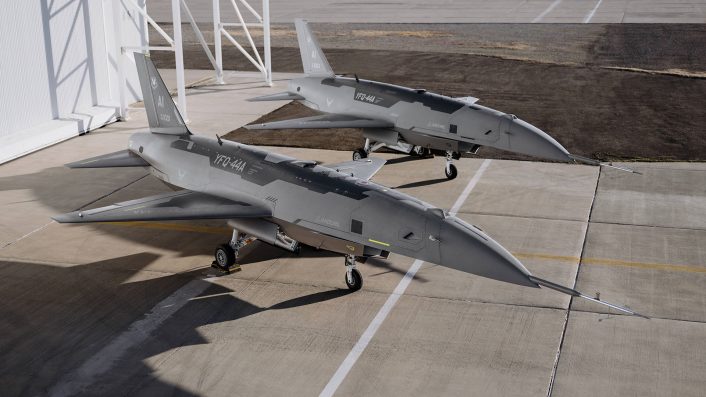
Shield AI meanwhile revealed that the flight took place over the Mojave desert and stressed upon a “software first approach” dictating the future of airpower and CCA development. Both companies are now looking forwards towards an expanded testing campaign with detailed Concept of Operations (CONOPS).
YFQ-44A flies with Hivemind
A statement from Anduril’s senior VP of engineering Jason Levin said: “The aircraft took off and autonomously approached a designated point where Shield AI’s mission autonomy software stack, Hivemind, was activated to complete a series of test cards. Following completion of Hivemind tests, Anduril was able to seamlessly switch to Anduril’s Lattice for Mission Autonomy stack to complete the same test points, before returning safely to land.”
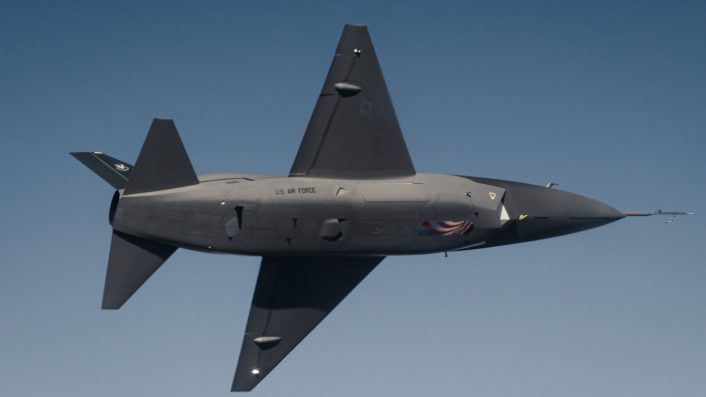
Switching between Hivemind and another unspecified A-GRA-compliant, government-owned program was also tested with GA-ASI’s MQ-20 Avenger, which feeds into the broader CCA program along with the company’s XQ-67A Off-Board Sensing Station (OBSS). Levin added the integration of a separately-developed autonomy stack is a “significant technical endeavor,” however it was rapidly achieved because of the “early implementation of A-GRA on both the YFQ-44A and the mission autonomy software stack.”
“The integration of mission autonomy software unlocks the next critical phase of testing, including detailed mission CONOPs, weapons integration, multi-ship flights, integration with crewed fighters, and more,” Levin added. Anduril’s and Shield AI’s engineers integrated Hivemind with YFQ-44A’s flight control software through countless “software-in-the-loop simulations and milestone hardware-in-the-loop test events,” validating the autonomy stack’s performance.
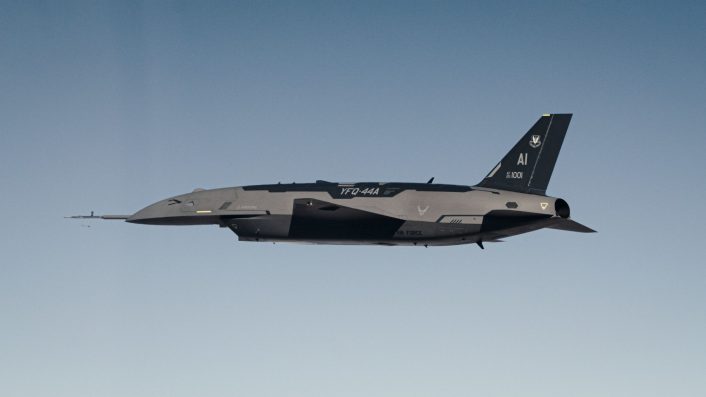
Shield AI meanwhile said Hivemind “successfully completed all test points” such as “handling mid-mission updates and initial operational behaviors.” The company added that this “opens the door to expanded testing of mission autonomy behaviors with Hivemind and YFQ-44A in support of the CCA program.”
‘Software is the future’
Hivemind Solutions’ vice president Christian Gutierrez said the software’s flight with the YFQ-44A “showcases the potential of airpower built on mission autonomy,” adding that the “software is central to the future of airpower.”
The U.S. Air Force just made autonomy software as important as the aircraft.
The @usairforce selected Hivemind for the Collaborative Combat Aircraft (CCA) program, the first time mission autonomy software has been decoupled from the aircraft. Hivemind has successfully… pic.twitter.com/jq08TtR4Xs
— Shield AI (@shieldaitech) February 13, 2026
Shield AI’s statement further added: “By independently selecting mission autonomy software and aircraft for the first time, the Air Force’s selection of Hivemind marks a historic shift in defense acquisition towards software-led autonomy. The program also seeks to establish a universal standard for mission autonomy through implementing the A-GRA, a modular, open-systems approach, to prioritize [a] software-first mindset.”
The platform-agnostic A-GRA compliant Hivemind, “unlike traditional autopilots that simply follow preplanned routes […] can reroute around or engage dynamic obstacles, execute collaborative tactics with peer systems and piloted aircraft, respond to unexpected conditions […] as part of a human-machine team.”
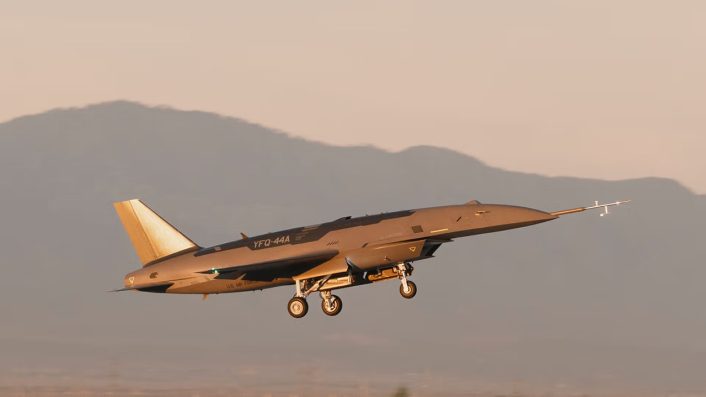
Hivemind flights with U.S. military and other platforms
The Hivemind autonomous flight software has previously flown the U.S. Navy’s BQM-177A and Airbus’ DT25 target drones, the Airbus MQ-72C Lakota unmanned rotary-wing platform, and at least two flights with GA-ASI’s MQ-20 Avenger in February 2025 and June 2025. During the latter, the UCAV achieved its first simulated air-to-air kill while, in the earlier February 2025 trial, it primarily validated the Hivemind and Autonomy-Government Reference Architecture (A-GRA) interfaces.
Later, in November 2025 and February 2026, an F-22 Raptor took control of the MQ-20 Avenger. During the former this was done through a tablet-based Pilot Vehicle Interface (PVI), and enabled by the Government Reference Architecture Compute Environment (GRACE) module.
We are moving with urgency & purpose to deliver game-changing capabilities to our warfighters. CCA inert captive carry testing is a deliberate step in our plan to build a more lethal & integrated @usairforce.https://t.co/S1zR1jMO1f pic.twitter.com/2OQDKd9A2n
— General Ken Wilsbach (@OfficialCSAF) February 24, 2026
Then, in mid-February, the U.S. Air Force announced a new milestone in its CCA program, demonstrating the successful integration of A-GRA with mission autonomy software like Collins Aerospace’s Sidekick and the Hivemind from Shield AI. While GA-ASI’s YFQ-42A Dark Merlin flew with Collins’ Sidekick, Shield AI confirmed its selection as a mission autonomy provider following a competitive Technology Maturity and Risk Reduction (TMRR) evaluation.
The Hivemind autonomy software at the time was integrated onto Anduril’s YFQ-44A Fury through A-GRA and was then undergoing system-level testing.
The Air Force explained that testing different autonomy software from various developers is meant to avoid dependence on a single vendor, called a “vendor lock”. Allowing hardware to easily shift between various programs, through a Modular Open Systems Architecture (MOSA) as per mission need, underpins a new air force technical, engineering and logistical doctrine.
Fight Unfair. https://t.co/y4ZGSjVxaG pic.twitter.com/Jnzk6i3W1m
— Anduril Industries (@anduriltech) February 23, 2026
As we reported here at The Aviationist, Levin said in a statement “Working in very close collaboration with Shield AI for the last several months [we] look forward to flying YFQ-44A with their software onboard very soon.” Then on Feb. 24, we reported about the U.S. Air Force releasing the first photo of an YFQ-44A Fury carrying an AIM-120 Advanced Medium-Range Air-to-Air Missile (AMRAAM) during an undated captive carry trial.
At least two prototypes of the Fury have been photographed, while the YFQ-42A Dark Merlin has three confirmed airframes.
source