


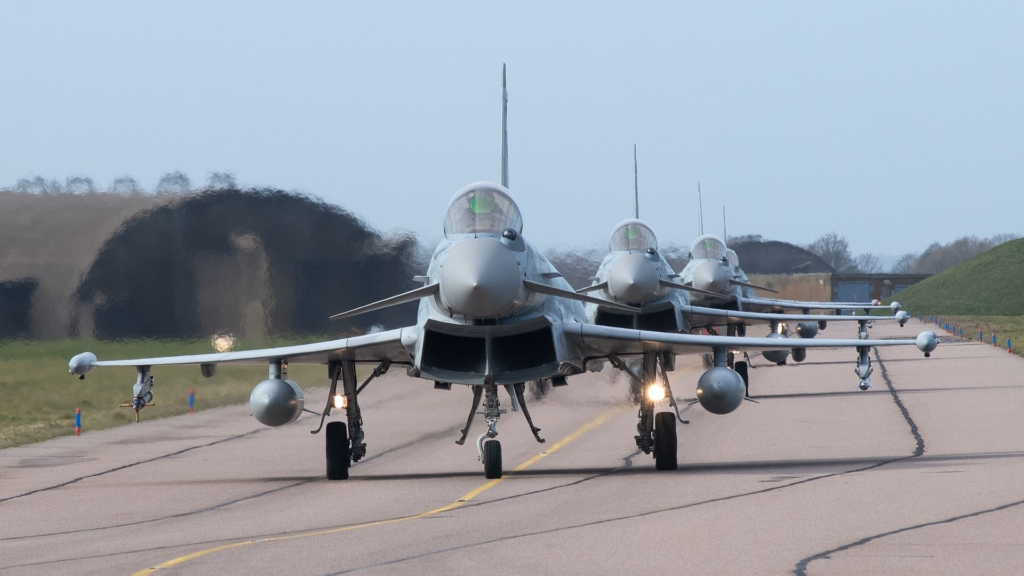
The Eurofighter Typhoon has been lauded for much of the last two decades as one of the most agile and capable multirole combat aircraft in the world. The rise of stealth fighters in recent years has made it grow more outdated in the face of a changing paradigm in air warfare. A growing number of analysts, and even some of its operators, have started to see it as obsolete, like the National Security Journal recently wrote. Some envision a future where the Typhoon is limited to low-end duties, freeing up valuable airframe hours for more costly stealth aircraft.
The question has changed from whether the Typhoon can still dominate an air-to-air dogfights. Now it is whether it can win a fight characterized by sensor fusion, networking, electronic warfare (EW) saturation, and, most importantly, stealth enemies. Its canard-delta shaping reflects radar brightly to enemy sensors. Its exposed engine faces and all external pylons exacerbate the issue. Its primary advantages are speed and maneuverability, so changing its aerodynamics and adding systems would compromise those, leaving no realistic way to “stealthify” the jet and produce a worthwhile platform.
The End Of The Eurofighter’s Reign

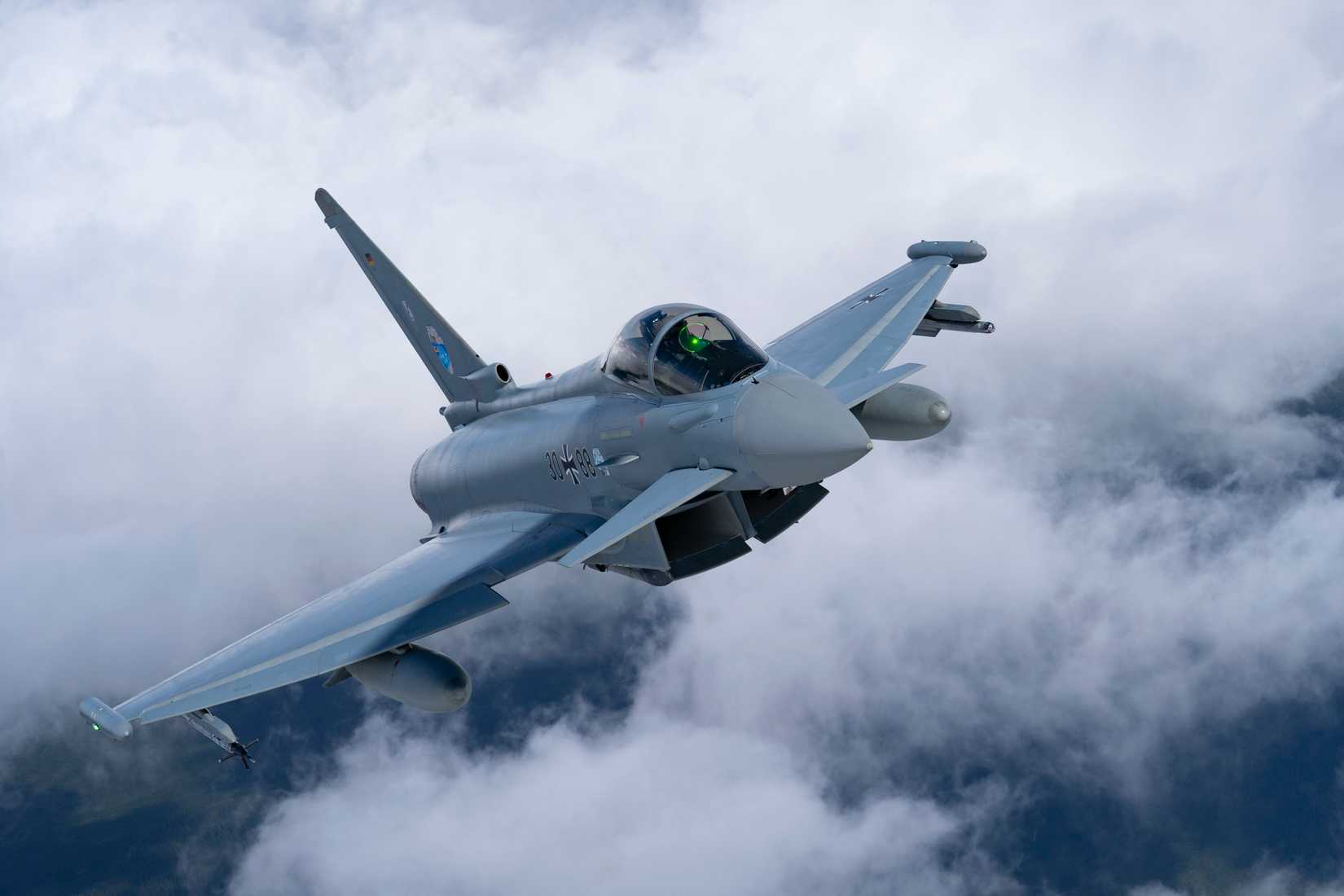
Fifth-generation aircraft, like the F-35, J-20, or Su-57, lessen their radar cross section (RCS) with radar absorbent material (RAM), serpentine engine intakes, and internal weapon bays that keep their external profiles clean. Because it lacks these features, the Typhoon is forced to operate at standoff distances. That also means it must carry larger and bulkier long-range missiles, which both increase its RCS footprint and undermine the very performance advantage for which the aircraft was designed.
When facing surface-to-air missiles (SAM) like the Chinese HQ-9B or the Russian S-400, the Typhoon’s traditional strategy of racing in at high altitude and speed, launching its payload, and then turning for home is no longer guaranteed to work. The growing accuracy and range of SAMs are steadily nullifying the effectiveness of performance and countermeasures, with stealth left as the only sure-fire protection.
It is helpful to revisit the technological and political context of the Eurofighter’s creation to lend context for why it is now showing signs of obsolescence. Western Europe’s air forces were expected to encounter massive Soviet strike formations in the Central European theater at short range in the opening salvos of a Cold War that had turned hot. Air forces did not plan to spot and strike enemies hundreds of miles away, deep inside hostile air defense networks. The strategy of the time relied on a jet that could launch fast, climb hard, and turn inside the enemy.
|
Spec |
Eurofighter Typhoon |
|---|---|
|
Wingspan |
35 feet, 11 inches (10.95 meters) |
|
Length |
52 feet, 4 inches (15.96 meters) |
|
Height |
17 feet, 4 inches (5.28 meters) |
|
Wing Area |
551.1 feet² (51.2 meters²) |
|
Empty Weight |
24,250 lbs (11,000 kgs) |
|
Max Takeoff Weight |
51,809 lbs (23,500 kgs) |
|
Max Payload |
16,535 lbs (7,500 kgs) |
|
Pylons |
13 Hardpoints |
|
Max Fuel |
11,020 lbs (5,000 kgs) |
|
Max G’s |
Pos 9 to Neg 3 G |
|
Engines |
Two Eurojet EJ200 reheated turbofans |
As a result, the Typhoon was first designed for high-altitude supersonic performance and within-visual-range agility rather than for deep penetration or all-aspect stealth. Engineers opted for a delta canard layout, which produces large control-surface power but also produces multiple radar-reflecting features. The design provides amazing instantaneous turn rates, rapid pitch response, and high lift at dogfight speeds. Unfortunately, it makes stealth shaping nearly impossible without a complete redesign.
The environment of air warfare has rapidly changed in the years since the fall of the Soviet Union. These days, an integrated air defense system connects airborne early-warning aircraft, over-the-horizon radars, passive radio frequency arrays, and long-range infrared monitoring instead of relying solely on surface-to-air missiles and ground radars. Long before traditional fighters can deploy their own weaponry, these sensors can be combined to identify and apprehend them from hundreds of kilometers away.
How The Typhoon Could Be Stealthier


Though it would help slightly, achieving absolute stealth requires more than just covering an existing airframe with RAM paint. It also demands burying engines deep inside serpentine intakes and shielding compressor faces. Then there’s aligning surface edges so that radar waves reflect away from a threat receiver, minimizing external gaps and cavities, and designing the exhaust plume for a low infrared signature.
The Typhoon’s characteristic square intakes produce a strong radar return. These expose a significant portion of the compressor face area to any radar signal that comes from a head-on bearing. Together with the leading edge of the wing and the canard foreplanes, which move independently for control, these surfaces provide constantly moving reflectors. Reflections are multiplied by external hardpoints with armaments hanging off the wings. Engineers would still have to deal with the fin-and-canard geometry issue even if they removed the pylons and fitted conformal weapon bays along the fuselage.
The forward fuselage and intake structure would have to be removed entirely for retrofits to conceal the engine face behind an S-shaped duct. This would be extremely expensive and probably not feasible given the design constraints. Typhoon’s internal architecture and aerodynamic signature were crafted in the early 1990s, before stealth had been considered for European defense.
The Typhoon would also have significant challenges with software and sensor integration, even if a partial reduction in radar cross section were possible. To compile radar, infrared, electronic support measures, and off-board data in fifth-generation jets, they rely on enormous amounts of processing capacity aboard. The Typhoon is a small, lightweight jet by comparison, and adding hundreds or even thousands of pounds of new equipment would quickly hurt its performance numbers, if it even fit inside.
Can Performance Overcome Tech?


There are still hold-outs that argue that the Typhoon’s incredible kinematic performance can make up for its lack of low observability qualities. This argument significantly downplays the evolution of missile warfare over time. Recent long-range air-to-air missiles, like the American AIM-260, Chinese PL-15, or Russian R-37M, are far more difficult to evade at the terminal than their predecessors thanks to throttable motors, datalink course corrections, and advanced seeker sensors.
In the homing phase, missiles can now pull 60 G’s or more, but a crewed fighter hardly ever survives more than 9 G’s, including the Typhoon. Though still vital, the typhoon’s speed and agility are no longer enough to ensure victory, or even survival, on its own.
The relevance of the Typhoon is also dubious from the perspective of electronic warfare (EW). Stealth aircraft are built to work in tandem with strong escort jamming platforms or to carry internal jammers. They require a lot less jamming power to disguise because their initial radar cross-section is substantially lower. It becomes a beacon for passive RF sensors if the Typhoon, with its larger signature, adopts the same strategy, as it must emit more signals.
The Typhoon would need structural changes again for greater EW systems to include more cooling capacity and electrical generation reserves. Installing the required transmitters and auxiliary systems would increase weight or drag, or both. Even yet, its own emissions would make it vulnerable to detection and anti-radiation weaponry.
The Royal Air Force (RAF) of the United Kingdom recently retired some of its earliest models, the Tranche 1 jets. Those aircraft could have been a boost to the beleaguered Ukrainian Air Force, which was defending itself against the Russian invaders. Still, instead, they were sent to the scrapyard, according to The National Interest. That decision in itself is a strong reflection of the Typhoon’s current position in the spectrum of air warfare, clearly showing how performance is no longer as valuable as onboard technology.
Making The Eurofighter Fourth-Gen-Plus


Investing in or collaborating on a brand-new fifth generation fighter design makes more sense given the expense and degree of complexity that a “stealthified” Typhoon would require. This reasoning helps to explain why several European countries are currently investing in the Tempest and Future Combat Air System (FCAS) programs instead of continuing to produce Eurofighters indefinitely.
Absolescence is a relative term; however, the Typhoon is still in use and will remain so until the 2040s. The latest Tranche 5 jets include upgraded radar, the SPEAR-3 standoff missile, potentially conformal fuel tanks, enhanced countermeasures, passive sensors, more EW features, and more. These enhancements will maintain its lethality against peer-level threats.
|
Eurofighter Typhoon (ECRS) Radar |
|---|
|
Repositionable AESA array for a wide field of regard |
|
Electronic warfare and jamming features |
|
Passive detection via Pirate Infrared Sensor |
|
Automated defensive aids (DASS) for threat response |
|
Modular design allowing ongoing hardware and software updates |
The Eurofighter Typhoon remains a highly capable fourth-generation jet, and Tranche 5 will be a fourth-generation plus (4.5) level fighter. It is becoming outdated in the specific, harsh environment of breaching peer-level air defenses that are defended by networked sensors and stealth platforms. The Typhoon will work as a missile truck similar to the F-15EX Eagle II, as a defensive counter-air platform, or a stand-off weapons carrier outside the highest risk bubbles. It can provide a high-value capability even on the fifth-gen battlefield. The Typhoon’s future is not as a stealth fighter but rather as a high-performance workhorse supporting a new generation of stealth aircraft in the most challenging missions.
source