


Since the early days of aviation, with the Wright Brothers’ historic flight in 1903, aviation has come a very long way. More so than ever, we can fly further and faster than ever before. We are time-poor and need to travel to places as quickly as possible. What is the world’s fastest commercial jet, and why would Boeing be worried about it? Let’s find out more.
The rivalry between manufacturers Boeing and Airbus is legendary as they compete to bring the newest and largest aircraft to the world. Of course, speed is also important, although fuel efficiency has become more important in recent years. Boeing and Airbus worked on one project together to build the largest commercial jet, but only Airbus continued with it. Could it be that this was also the fastest commercial jet?
The Boeing 747 Vs. the Airbus A380

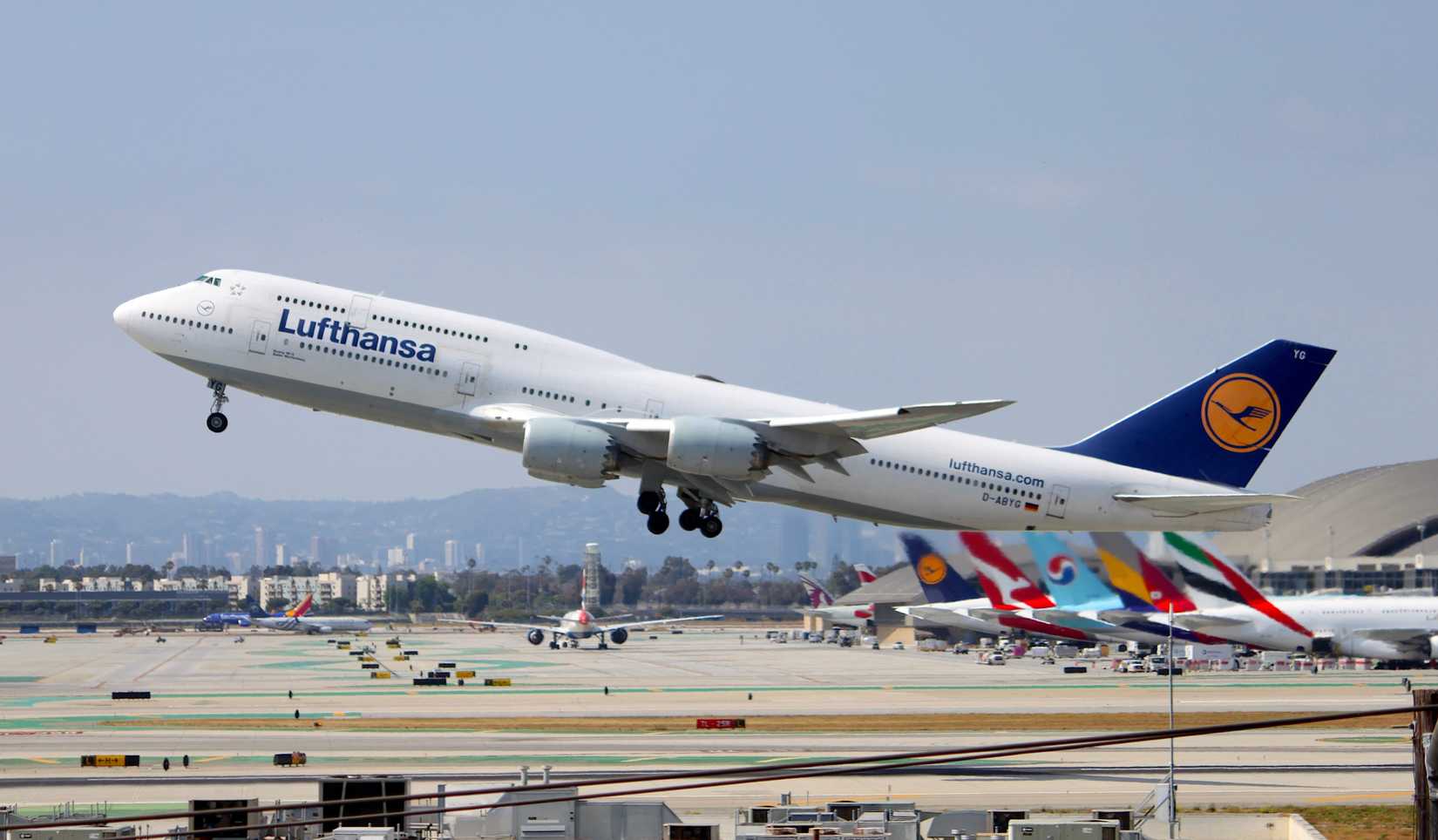
For years, Boeing had dominated the long-haul wide-body market, especially with the Boeing 747 jumbo jet. In the late 1980s, Airbus recognized the need to develop a new aircraft to compete with it. In 1993, Airbus collaborated with Boeing on a project called the Very Large Commercial Transport (VLCT), but two years later, Boeing withdrew from the project as they didn’t think that the $15 billion development costs could be recouped through aircraft sales. Instead, Boeing worked on a stretched version of the 747, which would become the Boeing 747-800.
Airbus continued work on the ‘A3XX’ and designed it to feature two A340 fuselages side by side. Not only did they want to build the largest commercial jet, but also to reduce operating costs. In December 2000, Airbus introduced the A380, a double-decker aircraft that truly caught the attention of the aviation world and the public alike. Although it should have been named the A350, as the successor to the A340, the ‘8’ was used to symbolize the double-deck but also because it was a lucky number in Asia, where they hoped the aircraft would be a success. Singapore Airlines would become the launch customer for the A380.
The widebody Boeing 747 was one of the fastest aircraft in service, with a speed of 580 mph (933 km/h), as well as the largest at the time. The new Airbus A380 was its nearest rival with a top speed of 634 mph (1,020 km/h) and a range of 8,300 nautical miles (15,410 kilometers), just beating that of the Boeing 747, which was 7,670 nautical miles (14,205 kilometers). So Airbus had completed an impossible feat: producing a double-decker aircraft that was also the largest and fastest commercial airliner.
A Closer Look At The Airbus A380


The Airbus A380 is the world’s only widebody double-deck airliner and is the fastest commercial aircraft in service. It was the first of its kind and was 40% larger than its closest rival, the Boeing 747-800. It has a range of 8,300 nautical miles or 15,410 kilometers, meaning it could fly nonstop from New York to Hong Kong. It has a maximum operating speed of 0.89 Mach, a top speed of 634 mph (1020 km/h), and a long-range cruise speed of 0.85 Mach.
The Airbus A380 is equipped with either Rolls-Royce Trent 900 engines or the General Electric/Pratt, and Whitney Engine Alliance GP7200 engines. These four engines produce 70,000 pounds of thrust, equivalent to that of 3500 cars. The GP7200 engine had taken over a decade of engineering before being added to the A380. They needed to develop an engine that could cope with the aircraft’s size and aerodynamics. It had to have the power to lift the aircraft while being quiet. The fuel burn is a small percentage of efficiency, but can save millions in terms of operating costs.
Aircraft specifications: Airbus A380
|
Length |
72.73 m |
|
Wingspan |
79.80 m |
|
Height |
24.10 m |
|
Cruising Speed |
910 km/h |
|
Max. altitude |
13,100 m |
|
Max. takeoff weight |
560,000 kg |
|
Max. landing weight |
391,000 kg |
|
Range |
12,400 km |
|
Cabin width (MainDeck / Upper Deck) |
6.6 m / 5.9 m |
|
Seats |
509 |
|
First/Business/Premium/Economy (max.) |
8/78/52/371 |
Data: Lufthansa
According to the Aircraft Performance Database by Eurocontrol, takeoff speed at V2 Indicated Air Speed (IAS) is 150 knots, initial climb is (IAS) 190 knots, through FL150 at 320 knots or Mach 0.83. The cruise speed is True Air Speed (TAS) 520 knots and Mach 0.85, which decreases to Mach 0.83 at initial descent and 300 knots. The speed on approach is (IAS) 250 knots, followed by a landing speed of Vat (Airspeed at Threshold) (IAS) of 140 knots.
What Have Airlines Said About The Airbus A380?

The airlines have very mixed views on the Airbus A380, with many retiring the jet due to high operating costs and its fuel consumption. To make money, the aircraft has to fly to full capacity. During the pandemic very few people were traveling, so it made sense to retire or store the A380. Some of the A380s were scrapped entirely or bought by airlines for their spare parts.
Lufthansa returned six A380s to Airbus and stored the rest of the fleet. This was useful for them as when travel returned to peak capacity, they could use the aircraft on high-demand routes to the US and Asia. Emirates and Singapore Airlines continue to see value in their A380s, partly because of the luxury experience the aircraft offers, but also for the ability to serve on busy, high-demand routes. Some of the airlines plan to keep the aircraft in service well into the 2030s. Airlines like Emirates operate the A380 to maintain their market share on high-density routes and use the existing airport infrastructure.
Operators of the Airbus A380 in 2025:
|
Airline |
A340s active |
A340s parked |
A340s retired |
|
All Nippon Airways |
3 |
||
|
Asiana Airlines |
6 |
||
|
British Airways |
12 |
||
|
Emirates |
116 |
21 |
7 |
|
Etihad Airways |
9 |
1 |
|
|
Korean Airlines |
7 |
3 |
|
|
Lufthansa |
8 |
6 |
|
|
Qantas |
10 |
2 |
|
|
Qatar Airways |
8 |
2 |
|
|
Singapore Airlines |
12 |
3 |
12 |
Data: Airbus
Air France, China Southern Airlines, Malaysia Airlines, and Thai Airways all decided to retire their A380 fleets during the pandemic. Recently, charter and ACMI operator Hi-Fly owned one A380, which was leased to Global Airlines. Unfortunately, after just two transatlantic flights with the airline, the A380 was parked and resold to another operator, as reported by AeroTime.
The Fastest Commercial Jets: A Comparison


Another iconic aircraft, the Concorde, still remains unmatched in terms of speed. The supersonic jet was the fastest commercial airliner built, with a speed of 1,354 mph (2,179 km/h). It entered service in 1976 and was developed by British and French engineers, hence becoming a flagship for both British Airways and Air France. The aircraft famously flew from London to New York in just over three hours, under half the time of a commercial airliner, until its retirement in 2003. Concorde flew at Mach 2.04, twice the speed of sound. It had a takeoff speed of 220 knots (250 mph, 400 km/h), a cruise speed of 1,350 mph (2160 km/h), and a landing speed of 187 mph (300 km/h), according to British Airways.
The Boeing 747-8 Intercontinental widebody aircraft was one of the fastest commercial airliners with a cruise speed of Mach 0.855 (570 mph, 915 km/h). It could carry 467 passengers and had a range of 7,730 nautical miles (8,900 miles, 14,320 km). It has a top speed of 706 mph or 917 km/h. It had limited success as airlines sought more economical aircraft like the Boeing 777, the Boeing 787 Dreamliner and the Airbus A350. In comparison, the new Boeing 777X has a cruise speed of Mach 0.85 or 644 mph (905 km/h), but is not focused on speed but fuel efficiency.
Other notable top-speed commercial jets of the past include the Tupolev Tu-144 and the Convair 990 Coronado. The Tu-144 was nicknamed the ‘Konkordski’ and was a supersonic jet built in the Soviet Union in the 1960s. It was the first commercial airliner to reach supersonic speeds, just months before Concorde arrived on the scene. It had a cruising speed of 1,510 mph (2,430 km/h) but was retired in 1985 after 102 flights, due to safety concerns and recurring technical issues. The Convair 990 Coronado was in service between 1961 and 1973, boasting a cruise speed of 610 mph (980 km/h) and was one of the fastest aircraft of its time.
Success Or Failure?

The aircraft’s strength was its ability to move large amounts of people at a relatively low cost, saving 4% on fuel burn and a per-seat savings on overhead costs of 13%, according to Modern Airliners. Airbus said that the average seat configuration chosen by the airlines was 497, but could be 575 in the Airbus A380 Plus. With an all-economy configuration, it could have 853 seats. They also planned for a shortened variant, the A380-700, and a stretched variant, the A380-900.
Emirates was the largest A380 customer and still operates the largest A380 fleet, with over half of the total A380s. They wanted a NEO (New Engine Option) version of the A380, but Airbus was not keen to commit to the project due to low aircraft sales. During the pandemic, the airlines needed to cut costs, and some stopped operating the A380 entirely. Some airlines, like Virgin Atlantic and Qantas, canceled their orders. Airbus was reliant on Emirates orders for the A380, but the airline reduced its order from 162 aircraft to 123 aircraft, and Airbus could not secure any additional orders.
|
Total orders: |
251 |
|
Total deliveries: |
251 |
|
In operation (Sept.2025) |
186 |
|
Stored A380s: |
36 |
|
Scrapped A380s |
24 |
Data: Airbus
The Airbus A380 was initially a huge success with its high performance, lower operating costs, and fuel efficiency. However, this dwindled over time as it was not as fuel-efficient as once thought, and operating such a large aircraft had many complexities. In February 2019, Airbus announced that it had ceased production of the aircraft. When it was launched, Airbus had anticipated that 1,200 A380s would be built. However, less than a quarter of that were ordered and built.
What Might Lie Ahead

Although Boeing had led the game in long-haul aircraft like the Boeing 747, Airbus made the double-decker aircraft possible and built the largest passenger aircraft in the world, and it was also the fastest commercial jet. It fell out of favor with the airlines but remained popular with passengers, and Airbus ceased production in 2021.
There will always be an element of rivalry between Airbus and Boeing, but it is no longer about the largest or fastest aircraft. Today’s focus for aircraft manufacturers is on efficiency and sustainability. Aircraft need to be more fuel-efficient, have lower operating costs, and be more aerodynamic, as well as quieter and produce less carbon emissions. Airlines are now looking at twin-engined aircraft such as the Airbus A350 and the Boeing 787. Another competitor is the Airbus A321XLR, which entered service in November 2024. Boeing is said to be working on a B797, in response, but it is not likely to enter service until the early 2030s.
The aviation world has witnessed so many improvements in speed and efficiency. Indeed, Concorde, the Airbus A380, and the Boeing 747 have been extremely significant in the history of commercial aviation. Although these have all ceased production, the Boeing 747 and the Airbus A380 continue to fly, but in a smaller capacity than their heyday, and a supersonic aircraft is under production. So, who knows what we will see next in the future of aviation? One thing we know for sure is that nothing is impossible.
source