


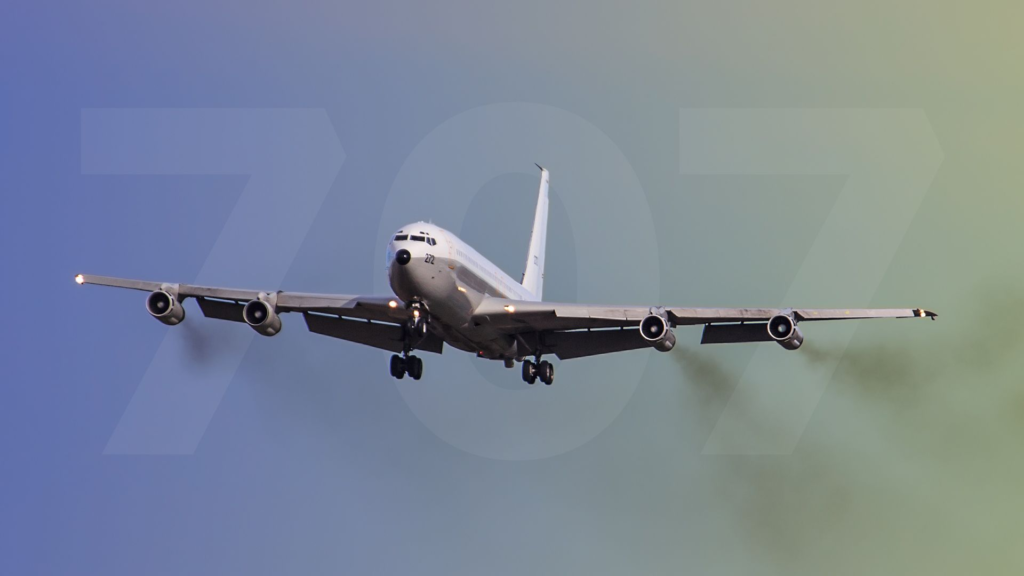
Boeing is one of the largest commercial aircraft manufacturers in the world. Currently, the commercial aviation business segment employs nearly 50,000 employees around the world. This includes those located at its major manufacturing facilities in Everett, Washington, and Charleston, South Carolina. 



- Launch Customer(s)
-
Pan American World Airways
- First Delivery
-
October 26, 1958
Boeing has grown to immense success due to its dominance in the commercial aviation industry. The company is responsible for producing one of the most popular narrowbody airliner series of all time, the Boeing 737 family. This includes the 737 Classic, 737 Next Generation (NG), and the 737 MAX series. Overall, over 12,000 Boeing 737s have been delivered since its introduction in the 1960s. However, prior to the 1960s, Boeing saw significant success with another narrowbody aircraft, the Boeing 707. This aircraft laid the groundwork in the commercial industry for years to come. Let’s take a closer look at the Boeing 707, as well as some of its unique features, such as its four engines.
Why Did The Boeing 707 Utilize Four Engines?

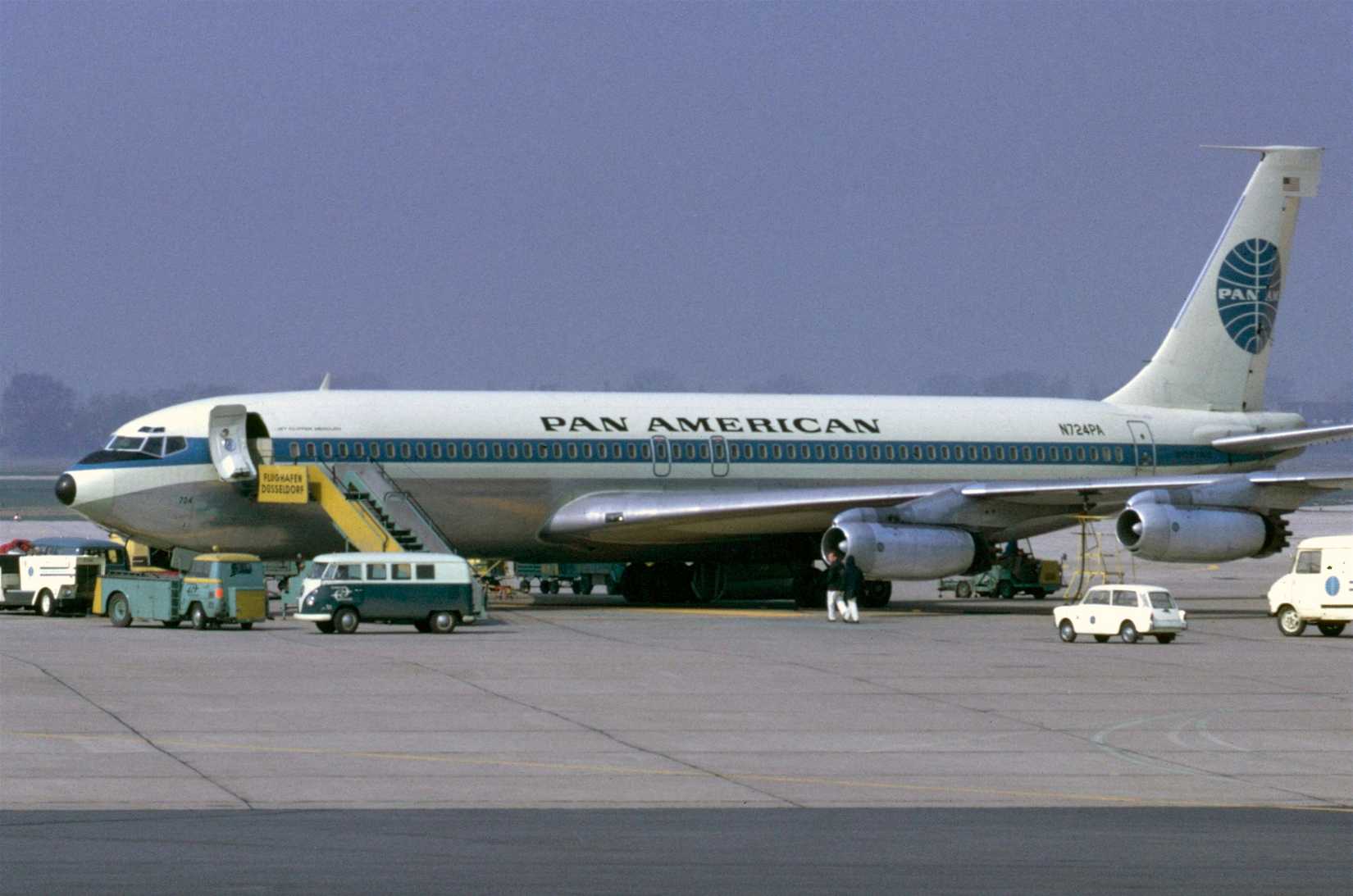
Boeing first began development of the 707 in the early 1950s. At that time, jet engine technology was nowhere near as advanced as it is today, as it was still in its early stages of development. In general, jet engines at the time did not produce enough thrust individually to power a large, long-range aircraft on their own. Because of this, Boeing decided to utilize four jet engines to achieve the necessary performance for takeoff, cruise, and long-distance travel.
Additionally, safety was another key factor in deciding to use four engines on the 707. In the 1950s, jet engines were not nearly as reliable as modern engines. As a result, inflight engine failures were a legitimate concern. Boeing decided to use four engines on the 707, which meant that if one engine failed, the aircraft could continue flying safely on the remaining three engines. This was especially crucial for international routes where diversion airports could be thousands of miles apart.
Boeing also needed to consider regulations at the time of the 707’s introduction. Long-range flights over oceans and remote areas were restricted for twin-engine aircraft due to safety concerns. Only aircraft with three or four engines could fly on transoceanic routes, especially since extended-range twin-engine operational performance standards (ETOPS) had not yet been introduced. This led Boeing to design the 707 with at least three engines, and later settle on four engines.
How Did The Boeing 707 Begin Development?


Boeing saw significant success developing aircraft for military applications during World War II. This includes the production of popular aircraft such as the B-17 Flying Fortress and the B-29 Superfortress. However, in the years after the war, the commercial aviation industry was dominated by Douglas Aircraft and Lockheed. Additionally, Boeing began working on jet aircraft technology in the late 1950s, resulting in the development of the Boeing 367-80.
This prototype jet was initially developed for military applications. However, the demonstration aircraft was also intended to showcase the potential of jet-powered commercial flight. Most of the commercial airliner market was dominated by propeller-driven aircraft. Boeing saw the 367-80 as a turning point for the industry, helping to introduce jet-powered transport into the commercial market. Overall, the Boeing 367-80 had the following performance specifications:
|
Length |
127 feet ten inches |
|---|---|
|
Height |
38 feet |
|
Wingspan |
129 feet eight inches |
|
Gross weight |
190,000 pounds |
|
Typical cruise speed |
480 knots (550 miles per hour) |
|
Range |
3,070 nautical miles (3,530 miles) |
|
Service ceiling |
43,000 feet |
The 367-80 was just a demonstrator aircraft for Boeing. The company eventually utilized the basis of that aircraft to develop its first jet-powered commercial airliner, later designated the Boeing 707. This aircraft had a longer and wider fuselage, a greater range, and the ability to transport passengers in a five-abreast configuration. These upgrades made it extremely competitive with the Douglas DC-8, Douglas’s own jet-powered commercial airliner.
When Was The Boeing 707 Introduced To Commercial Service?


The first production Boeing 707 conducted its maiden flight on December 20, 1957, kicking off a short flight test program. Eventually, the aircraft received type certification from the Federal Aviation Administration (FAA) in September 1958. Pan-American World Airways (Pan Am) was selected as the Boeing 707’s launch customer, so it received delivery of the first production aircraft.
Pan Am officially introduced the aircraft into commercial service on October 26, 1958. The airline flew the first Boeing 707 on flight 114, from Idlewild Airport, now known as John F. Kennedy International Airport (JFK), in New York City, New York, to Orly Airport (ORY) in Paris, France. This service also featured a stopover for refueling in Gander, Newfoundland. This flight took just under nine hours, including the pit stop, which was significantly faster than the 14 hours required for a piston aircraft service.
Since then, Boeing has introduced several variants of the Boeing 707. This includes the Boeing 707-020, which entered service in July 1960 with 
|
Variant |
First Flight |
|---|---|
|
707-120 |
1957 |
|
707-120B |
1959 |
|
707-138 |
1959 |
|
707-320 |
1959 |
|
707-320B |
1961 |
|
707-320C |
1963 |
|
707-420 |
1977 |
What Airlines Operated The Boeing 707?


Since the introduction of the original Boeing 707 in 1958, airlines around the world took delivery of the 707 for commercial service. Pan Am was the original operator and launch customer of the 707. Pan Am was also the largest operator of the 707, flying over 130 Boeing 707s, including a large fleet of 707-320s. Overall, the largest operators of the Boeing 707 include:
|
Airline |
Total Boeing 707s |
|---|---|
|
Pan Am |
130+ |
|
American Airlines |
120+ |
|
Trans World Airlines (TWA) |
100+ |
|
British Overseas Airways Corporation (BOAC) |
37 |
|
Air France |
22 |
Qantas was another popular operator of the Boeing 707. Boeing designed the 707-138 and 707-138B specifically for Qantas flights, as the airline wanted a shortened variant capable of long-range flights due to its unique route network. Several European customers found use of the Boeing 707, including 
The Boeing 707 was popular among other commercial operators within the US. This includes 
Are Boeing 707s Still Flying Today?


Since the Boeing 707 was introduced in the late 1950s, all commercial operators of the aircraft have since removed the aircraft from service. Instead, most airlines prefer the efficient and capable operations of modern airlines. Overall, most airlines retired their 707 fleets in the 1980s and early 1990s.
However, the Boeing 707 airframe has proven to be incredibly durable and adaptable. Boeing developed several military variants of the 707, including the E-3 Sentry AWACS, E-6 Mercury, and E-8 Joint STARS. These aircraft are still widely used by the United States military and other air forces around the world. However, many of these aircraft have since been re-engined with more modern engines, such as the CFM56 turbofan engine.
Beyond the 707’s military applications, the aircraft is still utilized by several private owners or government agencies. For example, Congo Presidential Flight still flies a 66-year-old Boeing 707 for government transport. According to ch-aviation, Omega Air still operates two Boeing 707s for cargo operations.
What Design Features Made The Boeing 707 So Popular?


The Boeing 707 was Boeing’s first jet-powered commercial airliner that took the commercial industry by storm. It featured a sleek fuselage with swept wings that were angled at about 35 degrees. This reduced drag and allowed the aircraft to reach higher cruise speeds. Like other swept-wing aircraft, the Boeing 707 was prone to potential Dutch Roll flying characteristics.
The aircraft was powered by four Pratt & Whitney JT3C turbojet engines. These were eventually upgraded to more powerful and more efficient JT3D engines. Even so, these upgraded engines were each capable of providing nearly 20,000 pounds of thrust. These powerful engines helped the Boeing 707-320C achieve the following performance specifications:
|
Length |
152 feet eleven inches |
|---|---|
|
Height |
42 feet |
|
Wingspan |
145 feet nine inches |
|
Maximum takeoff weight (MTOW) |
333,600 pounds |
|
Maximum speed |
Mach 0.887 (588 miles per hour) |
|
Range |
2,900 nautical miles (3,300 miles) |
|
Service ceiling |
42,000 feet |
The pressurized cabin of the fuselage allowed the aircraft to reach high altitudes, where jet engines operate more efficiently. Depending on the configuration, the aircraft could seat between 140 and 180 passengers. Typically, airlines flew the Boeing 707 with a 3-by-3 seating configuration.
source