


Booking cargo is already a sport. Insurance emails here. Financing calls there. Delay risk? That’s a problem for fuMost freight forwarders optimize for existing customers. This makes business sense. Existing customers they drive the volume, they win more often, they’re predictable. The data shows this (more on that in a second) but so do their homepages.
Look at the homepages of the world’s top 25 freight forwarders (based on Armstrong & Associates’ list). 15+ of them optimize first for existing shipments – pushing “Track,” “Login,” “Portal” buttons front and center. Only a handful prioritize transactional flows for new customers.
The websites reflect the strategy: serve the customers you already have.
But here’s what the data says: small customers grow – on average – 349% if you keep them. And existing customers win at nearly double the rate of new ones. In other news, they are both great for different reasons.
The question isn’t whether to focus on growth or retention. It’s how to do both.
Context and Setup
We analyzed quote data across hundreds of forwarder offices that are managing rates, quoting and marking wins in our rate management solution, crunching nearly half a million quotes sent to tens of thousands of customers over the past few years.
We looked at quote activity, win rates, customer retention patterns, and growth trajectories and, most importantly, how new customers behave differently from existing customers…and what that means for forwarder strategy.
What Actually Happens
Most forwarders optimize for existing customers – and the data shows why.
Existing customers win at nearly double the rate of new customers. In 2025, existing customers won 22.7% of quotes. New customers won 13.4%. That’s a 70% difference. The customers forwarders keep that are operating at scale trust their forwarders more and award them more business.
This pattern holds across most years. In 2021, the gap was even wider: existing customers won 18.6% vs new customers at 6.4%. The gap narrowed in 2023 (both groups won around 22%), but otherwise existing customers consistently outperform.
It’s also top heavy, with large customers driving most volume.
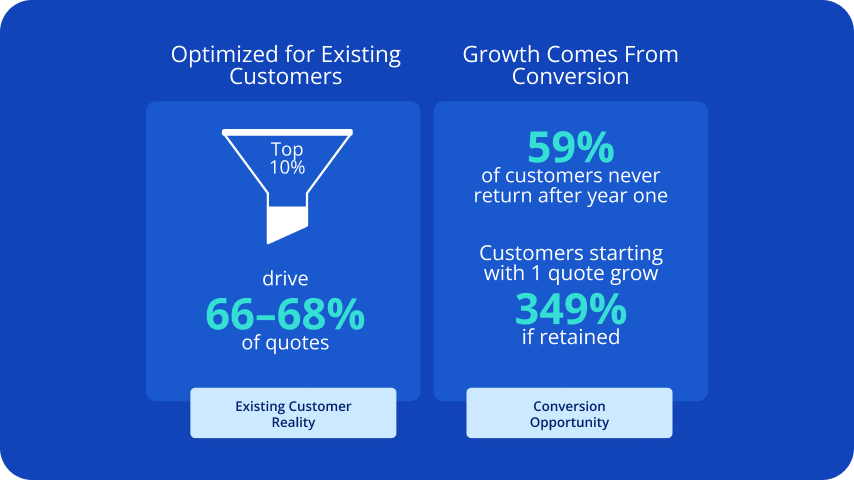
Top 10% of customers account for 66-68% of all quotes, consistently across all years. The concentration is structural, not temporary.

Top customers quote frequently with a median of 20.5 quotes per year. Even for SMBs, thats multiple times per month.
So when forwarders optimize their digital tools and workflows for existing customers – portals, tracking systems, account management – they’re optimizing for the customers who drive 80% of volume and win at double the rate. That makes sense.
You see this reflected in their homepages: “Track,” “Login,” “Portal” buttons front and center. The digital experience is built for the customers who already know you, who already trust you, who already drive most of your volume.
But small customers grow dramatically – if you keep them.
Customers who start with just 1 quote grow 349% on average. They go from 1 quote to nearly 5 quotes. Customers starting with 2-5 quotes grow 116% on average.
But here’s the catch: 58.7% of customers are one-year only. They never come back. Only 41.3% return for a second year.
Win rates increase with relationship depth.
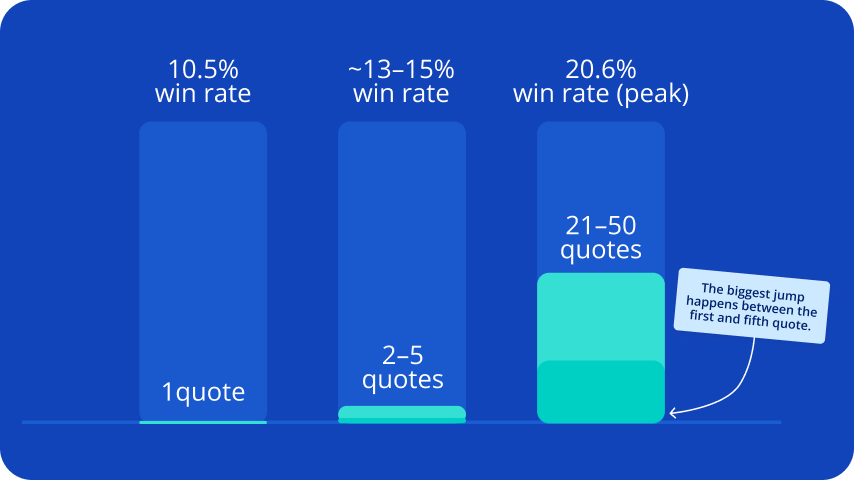
Customers with 1 quote win 10.5% of the time. Customers with 21-50 quotes win 20.6% of the time – the peak. After that, win rates plateau slightly (50+ quote customers win 19.5%).
The pattern is clear: more quotes = higher win rate, up to a point. Relationship depth drives success.
What Changes When You Look at Large vs Small Customers
Large customers stabilize – small customers grow.
Customers starting with 20+ quotes actually shrink 21% on average. They’ve reached their natural volume. This is normal – not a problem.
But customers starting with 1 quote grow 349% on average. Those starting with 2-5 quotes grow 116%. The small ones that stick around become your core.
The long tail is real, but small in volume.
85% of customers have fewer than 5 quotes in at least one year. But they only account for 11% of total quotes. 69% of customers always have fewer than 5 quotes – and they drive just 8% of quote volume.
So yes, the long tail exists. But it’s not where the volume is.
Here’s what’s interesting:
Small customers that stick around grow dramatically. The ones who start with 1 quote and come back grow 349%. The problem is most don’t come back.
The sweet spot is customers with 21-50 total quotes.
They have the highest win rates (20.6%) and represent the optimal relationship depth. They’re past the testing phase but haven’t reached their natural volume ceiling yet.
What Changes When You Look at Retention
Retention is where the value is.
41.3% of customers return for a second year. 20.8% return for a third year. But here’s what matters: customers who return grow dramatically.
Multi-year customers who started with 1 quote grow 349%. Those who started with 2-5 quotes grow 116%. The ones who stick around become your core.
But most customers don’t stick around.
58.7% of customers are one-year only. They never come back.
The retention problem is clear: 59% of customers never return. But the 41% who do return grow dramatically. The question is: what can you do to improve that 41%?
Digital tools can help – if you use them right.
The forwarders who track wins properly see improving win rates over time (13.5% in 2020 to 21.9% in 2025). They’re using digital tools to manage relationships, not just process quotes.
But most forwarders use digital tools to optimize for existing customers – portals, tracking, account management. Fewer use them to convert new customers to existing ones.
Why This Matters
The data tells a clear story: existing customers are easier to win, and they win at higher rates. But new customers are where growth comes from – if you can convert them to recurring customers.
Most forwarders optimize for existing customers because that’s where the volume is. Over 80% of quotes go to the top 10% of customers. That makes sense.
But the forwarders who also optimize for new customers are building something different. They’re creating a path for the long tail to become the core.
The math works: If you can convert a new customer (13% win rate) to an existing customer (23% win rate), you’ve nearly doubled your chances. And if you can get them from 1 quote to 5 quotes, you’ve increased their win rate from 10% to 20%.
The retention problem: 59% of customers never come back. But the 41% who do return grow dramatically. The question is: what can you do to improve that 41%?
The concentration reality: Top 10% drive 66-68% of volume. That’s structural. But small customers that stick around grow 349%. The opportunity is in conversion.
The digital opportunity: Most forwarders use digital tools to serve existing customers better. Fewer use them to convert new customers. But digital tools can automate the low-touch journey for new customers, making it easier to serve them profitably without scaling headcount.
What to Do About It
- First, track retention rates. How many new customers come back for a second quote? How many grow from 1 quote to 5 quotes? The offices we analyzed show that 41% of customers return for a second year – but that means 59% don’t. What can you do to improve that?
- Second, optimize for both journeys. Existing customers want speed and efficiency. New customers want education and hand-holding. The forwarders who serve both are building something different.
- Third, use digital tools to convert, not just serve. Most forwarders use digital tools to optimize for existing customers – portals, tracking, account management. But digital tools can also help convert new customers. Automated follow-ups, educational content, low-touch quote processes – these can help new customers become existing ones.
- Fourth, focus on the conversion funnel. Customers with 1 quote win 10.5%. Customers with 21-50 quotes win 20.6%. The path from new to existing doubles your win rate. Track that path.
- Fifth, don’t ignore small customers. Yes, they win at lower rates. But they grow 349% if you keep them. The problem isn’t small customers – it’s that 59% never come back.
- Sixth, protect your core. Top 10% drive 66-68% of volume. They quote 40+ times per year. They win at 20%+. They’re your bread and butter. Don’t lose them.
- Seventh, digitize the long tail. The long tail is small in volume but massive in count. Digitization should make it easier to serve them profitably. If you can automate the low-touch journey for new customers, you can scale without scaling headcount.
How to Use This Story with Others
When you’re explaining why digitization matters for new customers, these numbers help. Yes, existing customers drive most volume. But new customers are where growth comes from. And if you can convert them to existing customers, you’ve doubled your win rate.
The Bottom Line
Most forwarders optimize for existing customers. That makes sense – they drive 80% of volume and win at double the rate.
The forwarders that win long term are the ones who optimize for new customers, too. New customers win at 13%. Existing customers win at 23%. Small customers grow 349% if you keep them. The opportunity is in the conversion.
source