


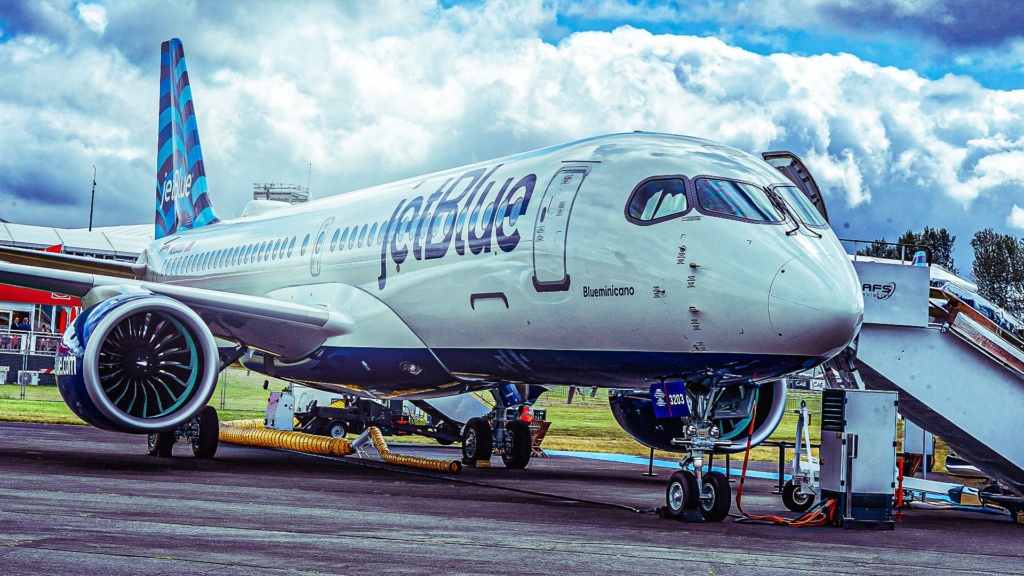
While the Airbus A220 is widely regarded as a success today, the aircraft’s early years were defined by headwinds rather than momentum. Originally introduced by Bombardier in the early 2010s as the CSeries, the program struggled to gain traction and attract orders, challenges that were compounded by US tariffs imposed at 

Since then, the aircraft has become a commercial success, with numerous airlines around the world operating the type. The A220 family includes two variants: the -100 and the -300. The A220-100 seats about 100 to 120 passengers, while the larger A220-300 accommodates 120 to 150. The -100 offers a slightly longer maximum range of 3,450 nautical miles (6,390 km), compared to the -300’s 3,400 NM (6,297 km).
Most airlines exclusively operate the larger -300, but 
The Aircraft JetBlue’s A220s Are Replacing


It is no secret that JetBlue replaced its aging Embraer E190 fleet with the Airbus A220-300. The E190s had served the airline since November 2005, when JetBlue became the launch customer for the type. This 100-seat Embraer jet enabled the carrier to expand into smaller markets, as the A320-200, which made up the entire fleet at the time, was too large for lower-demand routes. The E190’s first new market for JetBlue was Austin, Texas, followed by Richmond, Virginia.
The aircraft also became a workhorse in the Northeast, flying many short-haul routes, including up to eight daily flights between Boston and New York City. JetBlue retired its final E190 from commercial service in September 2025. The fleet retirement was not solely driven by age, since the type was not particularly old for airliner standards. Instead, it was driven by operating costs. The E190 proved expensive to maintain and operate, especially for a 100-seat jet. Since JetBlue anticipated its retirement, the airline never invested in cabin upgrades.
This left the interiors dated by the time of retirement, as in-flight entertainment screens were small, and many amenities and cabin features now expected by travelers were missing. When evaluating a replacement for the E190, JetBlue considered two aircraft families: Embraer’s next-generation Embraer E195-E2 and the Airbus A220 series. The E195-E2 can seat between 120 and 146 passengers and fly up to 3,000 nautical miles (5,556 km). It also leads its segment in fuel efficiency.
However, JetBlue ultimately selected the A220, citing its greater flexibility, higher capacity, and longer range. As reported by CBC, a secondary factor in the decision was Airbus’s acquisition of the program, which allowed JetBlue to streamline its fleet under a single manufacturer. JetBlue placed its initial order shortly after Airbus took over the program from Bombardier.
Why Did JetBlue Opt For The Larger A220 Variant?

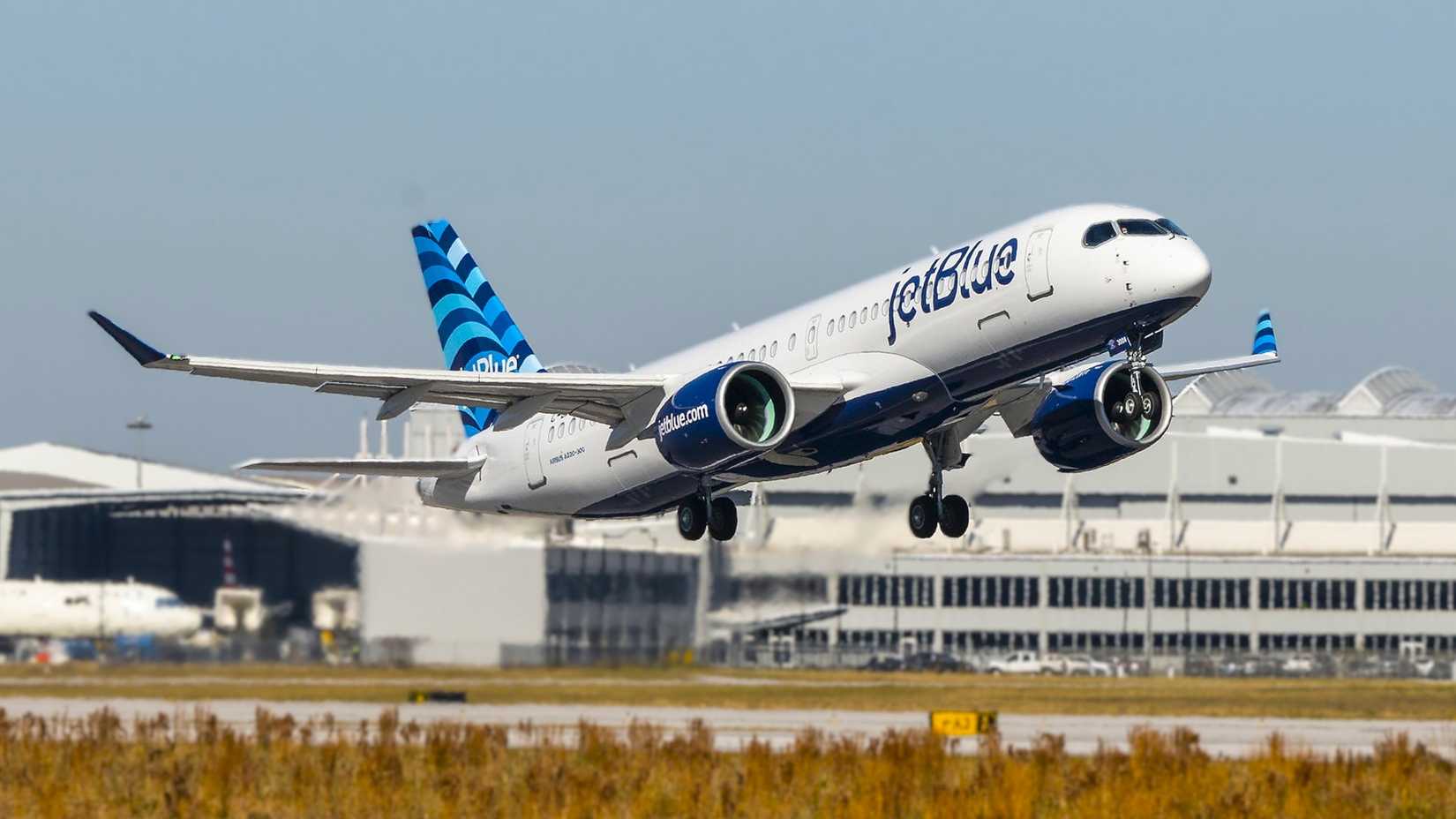
To put it simply, the main difference between the A220-100 and A220-300 is seating capacity. The smaller variant offers a similar passenger capacity to the aircraft it replaces, the Embraer E190, which might seem like a natural fit. However, JetBlue sought to expand its capacity and network flexibility. In JetBlue’s 2018 press release announcing the initial order, the airline stated that “the aircraft’s range and seating capacity will add flexibility to JetBlue’s network strategy.”
It added that the larger model would provide “financial and network advantages over the current 100-seat Embraer configuration.” The A220-300 is also slightly more efficient. Because it can carry 15–20% more passengers with only a small increase in total fuel consumption, its fuel burn per seat-mile is lower according to Aircraft Commerce, making it more efficient on a per-seat basis. This efficiency advantage, combined with higher capacity, makes the -300 more favorable than the -100.
When compared to the outgoing E190, the benefits are even more striking. JetBlue states that the A220 is expected to reduce operating costs by 30% per seat and lower fuel costs by 40% per seat. One major advantage both A220 variants have over the retired E190 fleet is their ability to reach the West Coast. JetBlue highlighted this in its 2018 and 2022 statements, noting that the new aircraft opens the possibility for transcontinental service.
However, it seems JetBlue is not yet fully capitalizing on that range, though the flexibility remains for future expansion. For now, the airline is primarily utilizing the A220’s efficiency on shorter Northeast routes. With JetBlue scaling back its overall West Coast presence, operating the aircraft on those longer routes is not part of its current strategy. This is especially true since the A220s do not feature the airline’s premium Mint cabin, which limits their appeal on high-yield transcontinental markets that are better served by the A321 fleet.
JetBlue’s November A220 Schedule

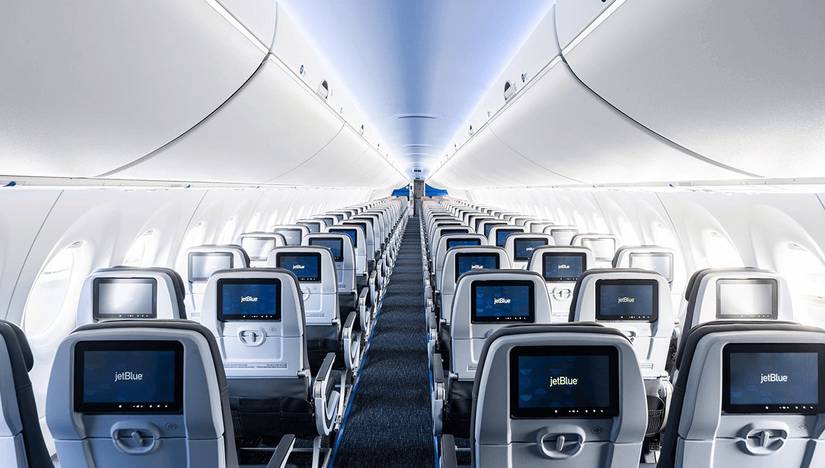
Similar to the former E190 network, JetBlue primarily uses the A220 to shuttle passengers along the East Coast, connecting key city pairs. Fourteen of the fifteen most frequent A220 city pairs are linked to either 

The average flight times on these routes range from about one to two and a half hours. Both BOS–DCA and BOS–JFK also rank among JetBlue’s top three most frequent routes across its entire network, highlighting how vital this middle-market segment remains to the airline’s strategy. The A220 allows JetBlue to serve these short, high-frequency markets efficiently without relying solely on its larger A320 family aircraft.
|
Most Frequent Scheduled JetBlue A220 Routes (November 2025) |
||
|---|---|---|
|
Rank |
Route |
Round-Trip Flights |
|
1 |
Boston – Washington National |
208 |
|
2 |
Boston – New York-JFK |
172 |
|
3 |
New York-JFK – Buffalo |
113 |
|
4 |
New York-JFK – Atlanta |
112 |
|
5 |
Boston – Raleigh |
104 |
|
Source: Cirium, an aviation analytics company |
||
JFK and Boston have always been at the core of JetBlue’s operations. The airline’s first flights in 2000 operated from JFK to Fort Lauderdale and Buffalo, both markets that remain key to its network today. JetBlue opened its flagship Terminal 5 at JFK in 2008, after initially operating from Terminal 6, and is now investing in a major renovation of T5. The airline launched service to Boston in 2004 and operated 1,400 flights from a single gate in its first year. Since then, JetBlue has rapidly expanded its presence in Terminal C.
JetBlue’s Wider Fleet

JetBlue has operated the Airbus A320 family since its very first flights in 2000. Similar to low-cost carriers such as Southwest and Ryanair, the airline initially adopted a single-aircraft strategy centered around the A320 to streamline maintenance and reduce fixed costs. Despite its low-cost foundation, JetBlue has always aimed to offer a more premium experience and is thus more closely aligned with being a hybrid carrier, having pioneered features such as free live TV through DirecTV and Sirius XM Radio at every seat.
In the mid-2010s, JetBlue introduced the larger A321 into its fleet, marking a significant shift in the airline’s identity. Along with the new aircraft came JetBlue’s first business-class product, Mint, designed to attract business travelers on transcontinental routes such as New York–Los Angeles and Boston–San Francisco. Building on this momentum, JetBlue made bold moves to enter the transatlantic market, and, in August 2021, it launched A321LR service between New York (JFK) and London.
|
Most Frequent Scheduled JetBlue Non-A220 Routes (November 2025) |
||
|---|---|---|
|
Rank |
Route |
Round-Trip Flights |
|
1 |
New York-JFK – Los Angeles |
260 |
|
2 |
Fort Lauderdale – San Juan |
163 |
|
3 |
Fort Lauderdale – Los Angeles |
156 |
|
4 |
Palm Beach – Westchester |
147 |
|
5 |
Fort Lauderdale – Boston |
143 |
It is clear from the data above that the A320 family serves a distinctly different segment of the market compared with the A220. Three of JetBlue’s most frequent non-A220 routes are transcontinental, spanning coast to coast and lasting several hours longer than the typical 1-2.5 hour segments flown by the A220. The other two routes are longer East Coast journeys originating in Florida. Taken together, this data shows that the A320 series dominates JetBlue’s longer, higher-demand routes.
The Bottom Line

JetBlue is clearly committed to the A220-300, as it offers better efficiency and greater flexibility, especially as demand on JetBlue’s short East Coast routes continues to grow. The A220 series as a whole aligns well with JetBlue’s brand and passenger experience standards, fitting the airline’s ‘premium low-cost’ or hybrid identity.
As JetBlue continues to take delivery of nearly half of its A220 orders, its route network will continue to adapt around the type’s growing presence. The airline has announced plans to introduce a new domestic first class-style product on the A220, which could make the type more appealing for longer routes by attracting additional business travel demand. This is a key revenue driver in the US transcontinental market.
source