


Every time an aircraft checks in with air traffic control, pilots identify themselves using a unique call sign, something like “Delta November Three Seven Two,” not “DN372”. They also exchange rapid-fire radio messages across crowded frequencies, with very rare cases of confusion. How is that possible? The answer lies with a linguistic tool older than the jet age: it is based on the phonetic alphabet. Standardized codewords like Alfa, Bravo, and Charlie ensure clarity and safety for pilots and air traffic control, even under pressure or poor radio conditions.
This article explores why the phonetic alphabet is used in aviation, how it developed, and why it remains essential in modern digital communication systems. We’ll look at the alphabet’s origins, its global standardization by the International Civil Aviation Organization (ICAO), and how it functions across cockpit-to-tower exchanges, emergency communications, and even training. Finally, we’ll compare it with other systems used in the past, showing how this simple code became one of the most effective safety tools in aviation history.
How Did The Phonetic Alphabet Originate?

The roots of the modern phonetic alphabet go back to early radio era efforts to make voice transmissions unambiguous. In the 1920s–30s, radio operators routinely misheard similar-sounding letters (for example, B/P or M/N). Therefore, militaries and civil agencies developed local spelling alphabets (the US Army used “Able, Baker, Charlie,” while British sets featured “Ack, Beer, Charlie”) to reduce errors. Those regional systems improved clarity at home but created problems for international coordination during and after World War II, when Allied forces and civil aviation increasingly needed a single, reliable standard.
To solve that problem, international bodies tested and refined a global radiotelephony alphabet. The International Civil Aviation Organization ( ICAO), working with national authorities, ran listening tests across multiple languages and noisy conditions to measure which code words were least likely to be misunderstood. Hundreds of words were analyzed for phonetic clarity, frequency balance, and rhythm. The ideal word had to meet three tests: it couldn’t sound like any other letter, it had to survive distortion over long distances, and it had to be pronounceable by people of any linguistic background.
That process produced a provisional alphabet in the early 1950s and, after further trials and Allied agreement, ICAO adopted the final version as an international standard. NATO followed soon after, ensuring that civilian pilots and military crews used the same alphabet: the familiar “Alfa, Bravo, Charlie … Zulu”, chosen for cross-language intelligibility rather than tradition.
A few small spelling decisions were deliberate practical choices: “Alfa” (not “Alpha”) and “Juliett” (with two t’s) were chosen to avoid mispronunciation or confusion in languages where the “ph” digraph or a silent final “t” could be problematic. The result is a compact, multilingual‑friendly system that has survived because it reliably reduces critical communication errors in aviation, maritime, military and emergency services worldwide.
How Is It Used In Aviation Communication?


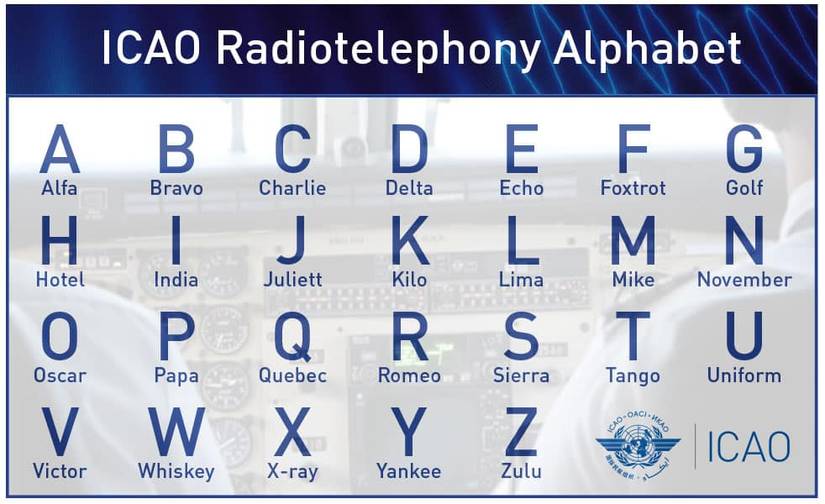
The phonetic alphabet is a 26-word system designed to ensure that each letter of the English alphabet can be transmitted clearly by voice, even over poor-quality radio connections. Instead of saying “B,” a pilot says Bravo. Instead of “D,” they say Delta. Those small substitutions eliminate confusion between similar-sounding letters, especially in the noisy, clipped, and often distorted environment of radio communication. The phonetic alphabet is woven into almost every exchange between aircrew and air traffic control.
It appears in call signs (“Delta Two Three Seven”), aircraft registration numbers (“November Eight Eight Seven Alfa”), and even routine weather reports. Each airport broadcast, known as the ATIS, cycles through the alphabet sequentially: “Information Bravo,” “Information Charlie,” and so on, so pilots instantly know which weather update is current. It’s also vital in emergencies or abnormal operations.
If an aircraft loses communication or experiences a malfunction, pilots use the alphabet to confirm details precisely, even if the signal is weak. “Mayday Mayday, Speedbird One Alfa Juliett declaring emergency” is far less likely to be misunderstood than a string of ambiguous letters.
It’s used constantly, often invisibly: in call signs, weather updates, taxi instructions, and emergency declarations. When a pilot spells out a flight plan, or even confirms a transponder code, those words aren’t optional jargon. They’re the foundation of how modern aviation keeps communication uniform, no matter where you fly.
|
Letter |
Word |
Pronunciation |
|---|---|---|
|
A |
Alfa |
AL-FAH |
|
B |
Bravo |
BRAH-VOH |
|
C |
Charlie |
CHAR-LEE |
|
D |
Delta |
DELL-TAH |
|
E |
Echo |
ECK-OH |
|
F |
Foxtrot |
FOKS-TROT |
|
G |
Golf |
GOLF |
|
H |
Hotel |
HOH-TELL |
|
I |
India |
IN-DEE-AH |
|
J |
Juliett |
JEW-LEE-ETT |
|
K |
Kilo |
KEY-LOH |
|
L |
Lima |
LEE-MAH |
|
M |
Mike |
MIKE |
|
N |
November |
NO-VEM-BER |
|
O |
Oscar |
OSS-CAH |
|
P |
Papa |
PAH-PAH |
|
Q |
Quebec |
KEH-BECK |
|
R |
Romeo |
ROW-ME-OH |
|
S |
Sierra |
SEE-AIR-RAH |
|
T |
Tango |
TANG-GO |
|
U |
Uniform |
YOU-NEE-FORM |
|
V |
Victor |
VIK-TAH |
|
W |
Whiskey |
WISS-KEY |
|
X |
X-ray |
ECKS-RAY |
|
Y |
Yankee |
YANG-KEY |
|
Z |
Zulu |
ZOO-LOO |
The system also eases cognitive load. Pilots don’t have to spell mentally, as they think in phonetics. This automaticity allows them to focus on flying, not spelling, even under high stress. That linguistic muscle memory, drilled into every flight training program worldwide, is one of aviation’s quietest safety mechanisms.
What Makes It So Effective?

The success of the phonetic alphabet relies on solid bases: the system’s design incorporates several principles that make it nearly foolproof:
- Phonetic separation: each code word is phonetically different from every other, so letters like B and P or M and N are unlikely to be confused even over a poor radio link. For example, “Bravo” and “Papa” are easy to tell apart because their vowel and consonant patterns don’t overlap.
- Natural cadence: many code words have a clear syllable pattern or stress that helps them punch through background chatter; think of the short‑long rhythm of “Tango” or the clear two‑syllable beat of “Foxtrot.” That cadence makes the words easier to grasp on first hearing.
- Cross-linguistic neutrality: words were chosen to be straightforward for non‑native speakers: simple syllables, common vowel sounds and no unusual consonant clusters. This cross‑linguistic neutrality reduces pronunciation errors in international communications.
- Acoustic balance: Many words start with voiced consonants (B, D, G) followed by open vowels, because they are easier to detect at low bandwidths and in the presence of static. That’s why several entries begin with strong consonants followed by clear vowel sounds.
- Redundancy and testing: The alphabet doesn’t rely solely on unique sounds; it uses pattern separation. Even if one sound is lost in static, the rest of the word still carries enough unique audio “shape” to be recognized. That’s why Uniform or Sierra can still be understood even if partially garbled, as their patterns are acoustically distinct.
|
Year |
Event |
|---|---|
|
1920s–40s |
Military and civil alphabets coexist (Able Baker, Ack Beer). |
|
1951 |
ICAO commissions testing of phonetic candidates across 30 languages. |
|
1956 |
“Alfa to Zulu” adopted as a global aviation standard. |
|
1960s |
NATO adopts the same alphabet for joint communications. |
|
2000s–Present |
Still unchanged: used in aviation, maritime, and emergency services worldwide. |
The creators didn’t stop at clarity. They tested how words performed when clipped, echoed, or partially obscured. This “acoustic redundancy,” as linguists describe it, makes the alphabet resilient against the unpredictable distortions of radio communication. Even with new technologies like datalink messaging, the alphabet remains indispensable. In emergencies, when digital systems fail, radio and phonetics remain the pilot’s most trusted tools.
A word like November still conveys its shape even when the first syllable drops out, and it was the last word changed in the alphabet, to enhance clarity and international comprehensibility. The letter N was originally represented by the word Nectar, but it was considered too similar to the word Victor, for V.
Who Actually Created The Phonetic Alphabet?


Behind the polished simplicity of Alfa Bravo Charlie lies years of research, testing, and revision, much of it led by two key figures: Major R. E. Handy of the US Army Air Corps and the Canadian linguist Jean-Paul Vinay. Together, their efforts in the early 1950s transformed what had been a loose patchwork of military alphabets into a single, scientifically tuned language for global aviation.
Major Handy, working within the framework of the International Civil Aviation Organization (ICAO), was tasked with solving what had become an international safety problem: pilots from different countries simply couldn’t agree on how to pronounce the same letters. Rather than impose an American or British system, Handy’s team gathered data from radio operators, pilots, and air traffic controllers in over 30 countries. Their question was simple but revolutionary: which words could everyone pronounce clearly, even in bad radio conditions?
Jean-Paul Vinay, a bilingual linguist from the University of Montreal who specialized in phonetics and comparative linguistics, helped design a battery of listening and pronunciation tests to measure each candidate word’s acoustic distinctiveness and cross-language intelligibility. He proposed that words should have a balance of vowels and consonants, clear stress patterns, and minimal confusion when clipped or distorted over radio. Many of the final changes, such as spelling Alfa with an “f” and Juliett with two “t”s, came directly from Vinay’s recommendations to accommodate speakers of Romance languages.
By 1956, Handy’s ICAO committee, guided by Vinay’s data, finalized the alphabet that we still use today. It was not the work of intuition or tradition, but of careful linguistic engineering. Every syllable was tested, every accent accounted for, every decision rooted in measurable clarity. The result is one of the few mid-century systems that remains completely unchanged.
Are There Any Drawbacks Or Exceptions?

No system is flawless. Occasionally, heavy static or strong accents can distort even the phonetic alphabet. Words like Mike and Nine share similar vowel sounds and can still be confused, while Papa and Bravo can blend under poor transmission conditions. Yet compared with any alternative, the ICAO alphabet remains the most resilient system ever devised for human speech over radio.
Regional quirks do exist. In some parts of the world, you might still hear relics of older systems, an occasional Able or Baker, usually among military or legacy crews. But these are exceptions, not the rule. The vast majority of pilots adhere to the global standard because the risks of deviation are simply too high.
Even so, aviation thrives on redundancy. Every transmission is verified, repeated, and acknowledged, so even if a single word falters, the message gets through.
What’s The Overall Takeaway?

The phonetic alphabet might seem simple, but it represents one of aviation’s greatest design feats: a global communication system that has remained unchanged for nearly 70 years. It was engineered with care, tested with science, and refined by experience, and it continues to save lives daily by keeping pilots and controllers perfectly aligned in the most unforgiving of environments.
In an age where aircraft can communicate digitally and automation grows more capable, one thing remains irreplaceable: the human voice. The phonetic alphabet endures not because it’s nostalgic, but because it’s timeless, a system that turns 26 letters into 26 anchors of understanding across every frequency and every continent.
source