


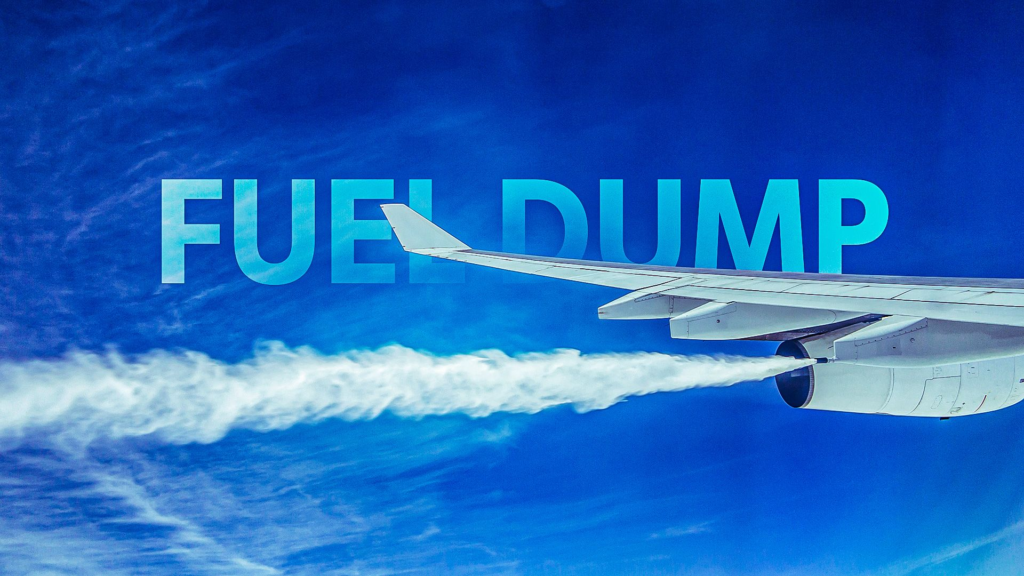
With rising aviation fuel costs and an increased global focus on the sustainability and environmental impact of the aviation industry, purposefully dumping fuel from an aircraft can seem like an extremely wasteful practice. However, there are a number of scenarios in which fuel dumping is needed so that the aircraft can land as safely and as quickly as possible.
In this article, we will take a closer look at the concept of fuel dumping, what the process involves, and which aircraft are able to dump fuel. We will also examine the different scenarios in which pilots may need to dump fuel prior to landing.
What Is Fuel Dumping?


Commercial aircraft are certified with a Maximum Take-off Weight ( MTOW) and a Maximum Landing Weight (MLW). The MTOW is higher than the MLW because the aircraft is expected to burn off a significant amount of fuel before landing at its destination.
For long-haul flights, aircraft often take off at or near MTOW to accommodate fuel for intercontinental travel, and in the case of large aircraft such as the Boeing 747, the difference between MTOW and MLW can be as much as 200,000 lb. However, unexpected circumstances can occasionally arise, which would mean that the aircraft needs to land earlier than originally planned, which is when fuel dumping may occur.
For example, if an aircraft flying from New York John F. Kennedy International Airport (JFK) to London Heathrow Airport (LHR) develops a technical problem shortly after take-off, it would need to land at a diversion airport, but would need to jettison a certain amount of fuel before doing so to bring it under safe landing weight limits.
Why Might Pilots Need To Dump Fuel?


A variety of situations can arise that may require pilots to dump fuel before landing. One of the most common reasons is due to a medical emergency involving one or more passengers or crew members onboard. In such situations, the priority is to get medical assistance as soon and as safely as possible.
Another scenario that may lead to fuel dumping is if a technical problem arises, which means that the aircraft is unable to continue to its intended destination and must land sooner than planned at a diversion airport. Examples may include Engine Failure or malfunction, pressurization issues, landing gear malfunctions, and smoke or fire warnings.
Depending on the severity and urgency of the situation, there may not be time to dump sufficient fuel before landing, in which case the only alternative for pilots is to land the aircraft above its standard landing weight. This is not believed to have led to any serious incidents in the past, but the potential for damage to the aircraft and the resulting repairs that could be costly and time-consuming make it far from ideal.
Which Aircraft Are Able To Dump Fuel?

It is important to note that not all aircraft have the ability to dump fuel. Generally, only large, long-range commercial or military aircraft are equipped with fuel dumping systems. Such long-haul aircraft carry large amounts of fuel for intercontinental flights and need a way to quickly reduce weight if they must return shortly after take-off.
Modern aircraft also allow the crew to selectively dump fuel from specific tanks and set target weights, giving them precise control over the process. Some of the commercial aircraft able to dump fuel are outlined in the table below:
|
Airbus |
Boeing |
|---|---|
|
Airbus A330 |
Boeing 747 |
|
Airbus A340 |
Boeing 767 |
|
Airbus A350 |
Boeing 777 |
|
Airbus A380 |
Boeing 787 |
By contrast, narrow-body aircraft such as the Boeing 737 and Airbus A320 families generally do not have fuel dumping capabilities. These aircraft are usually designed to be able to land at or near their take-off weight, so in an emergency, they may either hold in a pattern to burn off fuel or perform an overweight landing if necessary. Fuel dumping systems are often costly and complex, so they are installed only when operationally necessary.
When it comes to military aircraft, large cargo planes and tankers like the C-17 Globemaster or KC-135, also have fuel dumping capabilities for operational flexibility and emergency procedures. However, while commercial aircraft are often equipped with dedicated fuel jettison systems, military aircraft typically rely on manual methods, such as releasing external fuel tanks, to achieve similar outcomes. In a tragic incident dating back to 1965, a KC-135 experienced significant yaw shortly after take-off and began dumping fuel to reduce weight. Unfortunately, the aircraft crashed into a suburban neighborhood, killing all seven crew members onboard and 23 people on the ground.
How Does Fuel Dumping Work?

Aircraft fuel dumping is a controlled procedure used to quickly reduce an aircraft’s weight in an emergency. It is typically performed by wide-body, long-haul aircraft that take off with more fuel than their certified maximum landing weight allows.
The process is initiated by the pilots from the cockpit using dedicated fuel management controls. When activated, fuel is pumped from the aircraft’s fuel tanks and expelled through specialized nozzles, usually located near the wingtips. These nozzles are designed to spray the fuel in a fine mist, promoting rapid evaporation.
Dumping typically occurs at high altitudes (usually above 5,000 to 10,000 ft) to ensure the fuel vaporizes before reaching the ground. Before dumping fuel, pilots are required to declare an emergency or explain the situation to air traffic control, obtain clearance for a dumping zone, altitude, and duration, ensure the aircraft is at a safe altitude to allow evaporation, and avoid dumping over populated areas, protected environments, or sensitive airspace. In its 2022 Fuel Dumping Report, the FAA states:
“On rare occasions, due to emergencies, aircraft in the National Airspace System (NAS) must land before they have consumed most of their fuel, and therefore, weigh too much to land safely. In these cases, pilots must dump enough fuel to bring the aircraft to a safe weight, as determined by the manufacturer’s limitations and airport conditions before landing. Under Federal Aviation Administration’s (FAA) guidance, such fuel dumps are to be performed over remote or oceanic areas, or at an altitude at which the jettisoned fuel can atomize before reaching the ground. However, in dire emergencies, when the lives of the crew and passengers are at risk, pilots have the discretion to monitor circumstances and bypass guidance to ensure a safe landing for the aircraft and passengers aboard.”
The Environmental Concerns Of Fuel Dumping


Fuel dumping also raises a number of environmental concerns. Aircraft fuel is composed primarily of kerosene-based hydrocarbons, which can contribute to air pollution and water contamination if not properly evaporated.
At high altitudes, most of the fuel disperses and vaporizes, posing minimal risk. However, when fuel is dumped at low altitudes, it can fall to the ground, affecting people, plants, animals, and water sources.
Organizations such as the US Environmental Protection Agency (EPA) and European Aviation Safety Agency (EASA), monitor the impact of such events and impose regulations to limit where and how fuel can be dumped. In general, the aviation industry works to avoid fuel dumping unless absolutely necessary.
Incidents Involving Fuel Dumping


Fuel dumping is a rare and controlled procedure, and pilots follow strict protocols and coordinate with air traffic control to ensure safety. As a result, most fuel dumping events occur over oceans or unpopulated areas and are uneventful. One example of a successful fuel dumping procedure dates back to 2002, when a British Airways Boeing 747 developed a landing gear issue on departure from Los Angeles International Airport (LAX), bound for London Heathrow Airport (LHR).
The aircraft dumped fuel over the Pacific Ocean before returning to its departure airport and landing safely. Another example involves a 

However, there have been several notable incidents that have drawn public and regulatory attention. One of the most widely reported cases occurred in January 2020, when a 
However, it dumped fuel at a relatively low altitude (around 2,000 ft), which allowed the fuel to reach the ground before fully evaporating. Dozens of people on the ground experienced skin and respiratory irritation, prompting investigations by the FAA and a lawsuit which saw Delta Air Lines agree to a $79 million settlement. Following this incident, and combined with increasing environmental pressures, there has been a greater focus on fuel dumping in the media.
source