


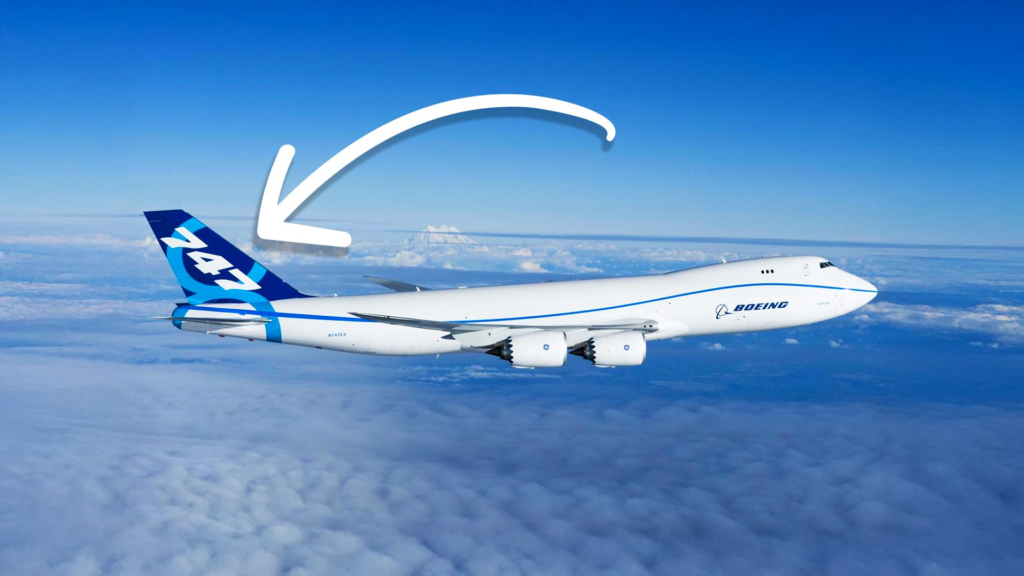
The Boeing 747-8I’s large vertical stabilizer, or tail, is a striking part of the aircraft’s stretched silhouette. The fuselage extends the plane to 250 feet, making it the longest passenger aircraft 

The huge tail was required for more directional control authority from the vertical stabilizer, or “stab,” to maintain stability. Elsewhere in the jet, Boeing did its best to preserve common hardware wherever physics allowed, and enlarging the vertical stabilizer was one of the most notable changes. In the final iteration of its iconic jumbo jet, Boeing delivered a “Queen of the Skies” that flies farther and hauls more than ever before yet behaves very much like the 747-400 before it.
Super Size Jumbo Jet


The 747-8 was originally slated for service entry in 2009, but a series of programme delays, caused by development issues and a knock-on from the interruptions suffered by the 787 program, meant the first stretched aircraft didn’t leave the ground until 2010. The new jet finally entered service with Cargolux in 2011 as a freighter first. The 747-8 Intercontinental passenger variant followed in 2012, debuting with 
The maximum take-off weight is higher than that of any 747 before it, but the airframe did not grow proportionally heavier. New aluminum alloys and more carbon-fiber parts throughout enable the jet to carry the extra load without a significant weight penalty. As a result, the 747-8I can carry more passengers and cargo, fly farther, and consume less fuel per seat than the 747-400. In 2012, 747 chief project engineer Bruce Dickinson told FlightGlobal.
“About 70% by structural weight is new. In many respects, though, we could state almost all of the airplane is new, as we have heavier gauge materials that have similar construction as the 747-400. We strove for a lot of commonality in general, though, as it is a huge advantage to us for our installed fleet. You see that with a lot of our systems, where we’ve tried to keep it common.”
The 747-8I operates at maximum takeoff weights up to 987,000 pounds and cruises at high altitudes where the air density is very low. The vertical stabilizer must be effective across this entire operational envelope, from sea level with heavy crosswinds to high-altitude cruise where rolling tendencies need dampening. The engines sit farther from the fuselage because the new wing is wider. That spacing increases yaw if an engine fails, which also demands a larger tail with a more powerful rudder to keep the jumbo under control.
The Role Of The Vertical “Stab”


Roughly 30% of the millions of individual parts on a 747-8 are either unchanged and many of the rest remain only slightly modified from the -400. The approach that let the company certify the aircraft as a derivative rather than a brand-new type.
One area that did not change is the vertical tail, where the fin and rudder increased in size by about 5%. The stretched fuselage placed the center of gravity farther from the rudder hinge line, so it was unavoidable to improve the side force produced by the tail when correcting yaw.
The vertical stabilizer’s size and design directly influence the aircraft’s minimum control speed, which determines the lowest safe operating speed during single-engine operations. That metric is a critical certification requirement that affects the aircraft’s operational options at airports worldwide.
Although the 747-8 is visibly new, Boeing was able to keep enough of the 747-400 characteristics intact for operators not to face a steep learning curve and for maintenance to avoid restocking a warehouse full of new spare parts. The 747-8’s increased the fin area, revised rudder balance, and strengthened the tail spar combination to mitigate differences and retain basically the same characteristics as a -400 for pilots at the stick as well as regulators and airports.
The Ultimate 747


The 747-8 Intercontinental is essentially just a bigger and more efficient version of the earlier 747 variants. Boeing did not change the basics of the aircraft, and simply grew the plane in some key dimensions. The wing is lighter and stronger, thanks to research conducted on the 787 Dreamliner, and has a larger span with raked tips instead of the older winglets. The wider, smoother wing reduces drag at cruise speed without significantly altering the plane’s performance.
The body of the airplane was stretched both in front of and behind the wings. The longer body does change how the aircraft balances in flight. How quickly it pitches up or down is a bit different, so several design aspects were tweaked to keep the ride stable. The famous “hump” on top was also lengthened, providing more cabin space without significantly impacting how quickly the cabin can be re-pressurized.
Below is a snapshot of the 747-8I, by the numbers, according to Boeing’s public data online:
|
Spec |
747-8I |
|---|---|
|
Passengers |
410 |
|
Range |
13,650 km (7,370 NM) |
|
Length |
76.3 m (250 feet, 2 in) |
|
Wingspan |
68.4 m (224 feet, 5 in) |
|
Height |
19.4 m (63 feet, 6 in) |
|
Cruise Speed |
Mach 0.86, 659 mph (1,061 kmh) |
|
Total Cargo Volume |
6,225 ft3 (175 m3) |
|
Maximum Takeoff Weight |
447,700 kg / 987,000 lb |
The 747-8I’s four GEnx-2B67 engines, each producing 66,500 pounds of thrust, present unique challenges during engine-out scenarios. The General Electric GEnx engines hanging farther outboard on the wider wing means more asymmetric thrust compared to the -400 if one or more engines is shut down in flight. The geometric effects of a longer body and wider engine spacing, combined with an increase in per-engine, create a higher “one-engine-inoperative” yawing force.
The Whale Tails: XL 747s


In spotter jargon the label “whale-tail 747” is applied to the special jumbos with vertical stabs that are distinctly large or feature extra fins. Perhaps obviously, because it creates a rear view like that of a whale’s flukes. A dramatic version appeared long before the 747-8 when NASA converted two early 747-100s into Shuttle Carrier Aircraft.
NASA basically bolted two tall auxiliary fins onto the tips of the horizontal tail and added a dorsal extension to the main fin. Another example is the 747SP, where Boeing removed almost 14 meters of fuselage to create a long-range Special Performance model that was extremely long-range. Engineers increased the tail fin’s height by roughly one meter to keep the smallest 747s stable. The novel variant was the platform of NASA’s fly telescope, dubbed the Stratospheric Observatory For Infrared Astronomy, or SOFIA.
More special-mission and oversized-cargo derivatives have followed the same aerodynamic logic. The 747-400 Large Cargo Freighter (LCF), better known as the Dreamlifter, has a vast bulbous fuselage for hauling Boeing 787 fuselage and wing sections across the globe. The US Air Force’s E-4B command-post platform and the YAL-1 Airborne Laser test-bed needed similar dorsal extensions to account for their unique configurations.
More Giants Of The Sky


The 747-8 Intercontinental is already imposing, yet its tail fin is overshadowed by the Lockheed C-5 Galaxy, Airbus A380, Antonov An-225 and the Hughes H-4 “Spruce Goose” which all stand a little taller. The C-5 may not be a civilian aircraft but it remains the heavy airlift of choice for the US Armed Forces, the A380 competes directly with the remaining 747-8s today. Sadly, Mirya was destroyed during the Russian invasion of Ukraine, and as many may know, the Spruce Goose never quite got off the ground (or water, rather).
The A380 carries a double-deck fuselage from nose to tail, so its side area is far larger than that of the 747-8I. Similar to the 747-8 wing and engine redesign, the A380 needed enough yaw authority to hold it straight if an immensely powerful Rolls-Royce Trent 900 or Engine Alliance GP7200 quit during the critical moments of take-off.
|
Aircraft Rank |
Tail Height |
|---|---|
|
1. Hughes Hercules H-4 “Spruce Goose” (tied) |
79 feet, 4 inches (24.18 meters) |
|
2. Antonov An-225 Mirya (tied) |
79 feet, 4 inches (24.18 meters) |
|
3. Airbus A380 |
79 feet, 1 inch (24.10 meters) |
|
4. Lockheed C-5 Galaxy |
65 feet, 1 inch (19.84 meters) |
|
5. Boeing 747-8 |
63 feet, 6 inches (19.40 meters) |
The Antonov AN-225 Mriya was designed to haul the Soviet Buran orbiter and other outsized cargo on its back, a mission that adds enormous sail area ahead of the center of gravity that blocked much of the airflow to a conventional fin. Antonov engineers installed a very tall central vertical stabilizer and, crucially, twin dorsal fins on the tips of the horizontal tail.
The historic, iconic, and romanticized Spruce Goose was the biggest flying boat ever made. Its hull was tall enough to clear ocean swells with a wing that spanned almost 100 meters. Its operations called for excellent low-speed control in gusty cross-winds, so Howard Hughes gave the H-4 a huge single fin augmented by two outboard vertical tabs at the horizontal-tail tips. In each case, the farther the center of gravity lies from the point where the tail can command side force, the more vertical surface and height is required.
- ICAO Code
-
B748
- IATA Code
-
74H
- First Flight Date
-
February 8, 2010
- Amount Built
-
157
- Engine Count
-
4
source