



Supersonic aircraft are readily recognizable by the long, pointy noses, while transonic planes, like today’s commercial jets, are much more rounded. At transonic speeds, the rounded nose is more aerodynamically efficient. Look a little closer, and Boeing noses are more pointy compared with their Airbus counterparts. Remarkably, nose designs do not vary much between narrowbody and widebody aircraft, except for the double-decker Airbus A380 and Boeing 747, as well as the clean-sheet 787 Dreamliner.
With Boeing and Airbus aircraft, both narrow and widebody planes typically share the same nose design. This is more remarkable when considering that these types of aircraft tend to cruise at different speeds. While the nose does affect the aerodynamic performance of the aircraft, it is not as important as the wings. This is one reason why updated aircraft (like the A330neo and Boeing 777X) have new wings, but not new noses. Let’s explore the differences and why Airbus and Boeing may have chosen these designs.
The Difference Between Boeing & Airbus Noses


It can be difficult for many people to tell a Boeing aircraft apart from an Airbus aircraft. One of the easiest ways to distinguish the Boeing 737 from the A320 is that the 737 has flattened engine bottoms. That steams the 737 being a much older design (1960s vs 1980s) that was originally built with smaller engines and shorter landing gear. However, another way to tell the difference is by their noses.
With the partial exception of the 787 Dreamliner, Boeing noses are sharper, pointed, and look more like a bird’s beak. By contrast, Airbus noses are rounder, bulbous, and have a smoother curve, while being more bubble-like. One way to think of it is that Airbus aircraft look a bit more like a dolphin’s nose, while Boeing aircraft more closely resemble that of a bird.
The noses also have some branding value. It may not be attractive for Boeing to make their aircraft look even more similar to Airbus aircraft than they already are, or vice versa, so looking at the noses is one of the easiest ways to tell them apart.
Boeing Has The Older Design

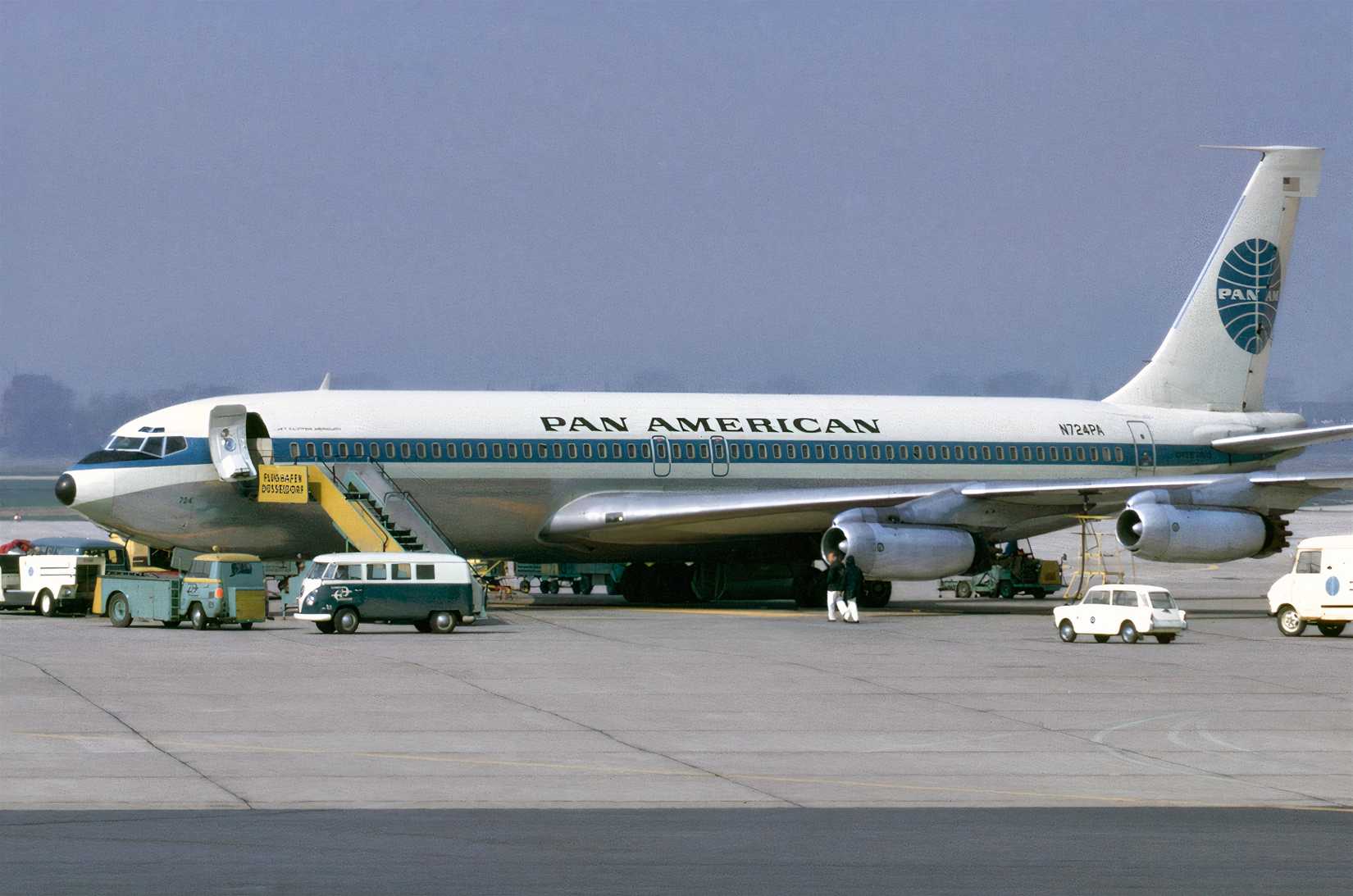
It can be argued that nose shape has more to do with history than anything else. Boeing is a much older company that almost invented commercial aircraft travel as it is known today. At the very least, it has certainly played a very important role in the maturation of the industry. The noses on Boeing’s older commercial jets, like the 727, the 737, and the 707, were all very similar to each other. Having made these noses for so long, it is what Boeing engineers are familiar with and the company has expertise in.
To some degree, these noses are a shape that works and is something that Boeing engineers are already very good at making cockpits inside. Boeing designed these noses with wind tunnel testing before the advent of computer simulations, and, when a new aircraft design came along, there wasn’t much of an incentive to change from what they were used to.
By contrast, Airbus is a much newer company that had the benefit of experimenting with the most efficient form of a nose with early computer modeling before wind tunnel testing. After all, the A320 is two decades newer than the Boeing 737. This is why Mentour Pilot argues it is likely that the nose on an A320 is slightly more aerodynamic than that on a 737, but it is also so small that it isn’t worth Boeing redesigning the nose. Both Airbus and Boeing have redesigned their wings for updated aircraft, but not the noses.


Airbus A330neo Vs. Boeing 787: Which Aircraft Gets More Miles Per Gallon?
Which jet rules fuel efficiency? Discover real MPG, expert insights, and airline data in this in-depth comparison.
Boeing’s Emphasis On A Higher Mach

One factor is that in the 1950s and early 1960s, it was thought that the natural progression of commercial aircraft was to go supersonic. In the 1950s and 1960s, the Europeans (Concorde), Soviets (Tu-144), Boeing, and Lockheed all worked on supersonic commercial aircraft. However, even before these, starting with the Boeing 707, subsonic aircraft were faster than today. Indeed, the Boeing 727 had a cruise Mach slightly higher than today’s widebody jets.
From the 707 onward, Boeing emphasized higher cruise Mach numbers as well as fuel efficiency. The more pointed nose helped to reduce the wave drag as the aircraft approached transonic speeds. This chiselled, streamlined radome was continued on subsequent Boeing 737 and 757 aircraft. The latter 767 and 777 widebodies continued the familiar look while also being optimized independently.
|
Aircraft |
Nose |
|---|---|
|
Boeing 707, 727, 737, 757, 767, 777 |
Classic pointed nose |
|
Airbus A320, A300, A310, A330, A350 |
Classic rounded nose |
|
Boeing 787 |
More organic and blended |
|
Airbus A380, Boeing 747 |
More rounded due to twin decks (A380 extra rounded) |
Mentour Pilot suggests that Airbus’s nose might be more efficient at its intended speed, while other sources suggest Boeing’s is more efficient. It can also be noted that both may be true as narrowbody aircraft have slower cruise Machs (around 0.78) compared with widebody aircraft (around Mach 0.85). Whatever the case, the aerodynamic performance difference is not substantial, not least compared to differences in wing design.
Airbus’s Emphasis On Larger Cockpit Space


Meanwhile, starting with the A300, Airbus had a philosophy of having a large cockpit space, higher ergonomic visibility, and easy avionics access. A rounded nose helps maximize volume, so Airbus aircraft typically have more space for avionics, more room for wiring, and a larger and rounder radome to house the weather radar. That radar is also easier for maintenance access.
The different nose shapes also impact the radars and cockpits. Boeing aircraft have smaller and more compact weather radar installations, while avionics racks need to be placed differently compared with Airbus. Additionally, the A320, A330, A340, A350, and A380 all share a common cockpit concept to preserve commonality. Another benefit is that the rounded nose allows for better pilot downward visibility on approach.
When it comes to fuselage width, the Airbus A320 has a maximum internal cabin width of 12 feet and one inch, compared with 11 feet and seven inches on the 737. The A330 is wider than the Boeing 767, at 17 feet and three inches versus 15 feet and six inches. Meanwhile, the A350 (new production standard) is slightly wider than the Boeing 787, at 18 feet and four or five inches compared to 18 feet and zero inches, and the Boeing 777 is the widest in-production aircraft, at 19 feet and three inches.

Why The Airbus A380 Has Such A Unique Nose Shape
The A380’s nose is larger and rounder than most other aircraft.
The Boeing 787 Dreamliner Somewhat Muddies The Waters

Still, the once-clear nose shapes between Boeing and Airbus have begun to soften. Indeed, the 787’s nose looks more like a hybrid, and is different from those on the 737 and other earlier aircraft. Perhaps the aircraft with the most similar nose is the old British de Havilland DH.106 Comet that entered service in 1952 with BOAC (a forerunner of British Airways), and whose nose noticeably drooped down. A longer, but sloping nose also helps pilots see the runway and see in front of the aircraft more effectively.
It seems likely this is a very aerodynamic nose for this type of aircraft flying at that particular speed. Likely, the nose was difficult to engineer back in the 1950s and 1960s, and difficult to fit the radar. This is suggested as the reason why the nose design went out of use. However, the 787 reintroduced it as technology has moved on and engineers have used to more advanced engineering techniques and composite materials.
If this is true, then the more pointy 787/Comet nose is likely to be the type of nose that will be found on subsequent aircraft, like the 797, if Boeing ever gets around to designing it. Separately, Boom Supersonic’s Overture will have advanced cameras for the pilots to work around the pilot visibility issue. The aerodynamics of supersonic flight are very different from transonic flight, with the nose, wings, tail, and fuselage all needing considerable design changes.
Nose Shape Is Not The Most Important Aspect Of Aircraft Design

Overall, the aerodynamic performance of the nose shapes between Airbus and Boeing is not particularly impactful on the aerodynamic performance of the aircraft. Airbus has preserved its nose shape on the clean-sheet Airbus A350, so the fact that Boeing updated the nose shape on the clean-sheet 787 suggests a shape closer to Airbus could be marginally more efficient.
The 2012 comedy movie The Dictator touches on this conundrum, with the eponymous protagonist complaining that “the missile is too round, it needs to be pointy! Round is not scary. Pointy is scary.” However, his scientist colleague confirms that “the shape of the missile top has nothing to do with aerodynamics.”
While the shape of the nose is still relevant, the differences between Boeing’s and Airbus’s designs are not as important as redesigning the wings, wingtip devices, or constructing the aircraft out of composite materials. Boeing continues to make aircraft with the same nose shape as it did in the 1950s. It’s more important to preserve radar and cockpit designs and ensure commonality over aircraft types. For passengers, the shape is an easy way to distinguish between Boeing and Airbus aircraft.
Some other ways passengers can distinguish Boeing 737s from A320s include the flat-bottomed engines on the 737 and the lower landing gear. Meanwhile, the A320 may be powered by Pratt & Whitney GTF turbofans, while all MAX jets and most NEO aircraft are powered by the CFM International LEAP family. Additionally, the A320 has a wider fuselage, and its Power Transfer Unit (PTU) makes a distinctive “barking” sound during taxing.
source