



Figure 1. A Locust laser direct energy weapon, shown here mounted on an infantry squad vehicle, was used in the area near El Paso International Airport in February. Photo: US Army.
By Colleen Mondor
April 1, 2026, © Leeham News: On Feb. 26, the Federal Aviation Administration (FAA) announced another Temporary Flight Restriction (TFR) in southern Texas airspace. As it did two weeks prior when closing the airspace over El Paso International Airport and a portion of southern New Mexico, the agency cited “Special Security Reasons.”

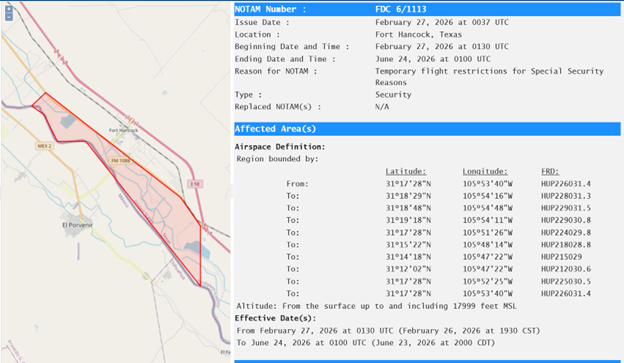
Figure 2. Fort Hancock TFR #FDC 6/1113 courtesy tfr.faa.gov.
Within 24 hours of the new closure, which was centered on Fort Hancock, about 50 miles southwest of El Paso, multiple media outlets reported that the TFR involved operations of the Customs and Border Protection Service (CBP) and were not coordinated with the FAA. The Fort Hancock closure, coupled with a recent report of the military’s plans to possibly fire lasers near Reagan National Airport, has reinforced concern over the FAA’s control of the national airspace, a task with which it has been legally mandated by Congress since its 1958 inception.
First El Paso Area TFR Timeline

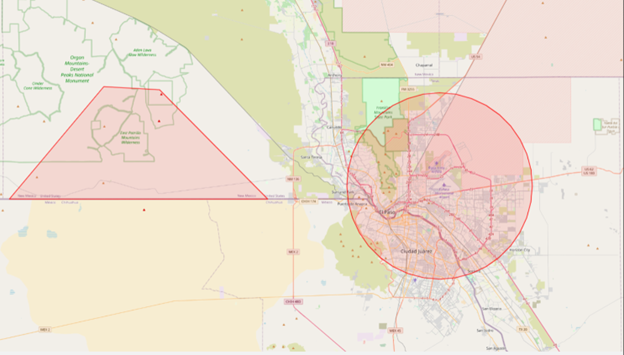
Figure 3. Screenshot of El Paso TFR #FDC 6/2233 taken prior to deletion from tfr.faa.gov.
Reporting on the first airspace closure began with local news site El Paso Matters, which noted the FAA’s sudden issuance, shortly after midnight on Feb. 11, of a Notice to Airmen (NOTAM) closing airspace around the airport and a nearby area of New Mexico encompassing the East Potrillo Mountains Wilderness. Both areas border Mexico.
An anonymous source familiar with the NOTAM told the site that all air traffic was “…halted in a 10 nautical mile range around the airport, so encompassing El Paso and Fort Bliss, from the ground to 17,000 feet.” This included commercial operators, the military, medevac, and law enforcement.
The NOTAM stated that the closure would remain in effect until February 20. This was the same day that officials from the FAA and the Pentagon were scheduled to review potential impacts and mitigation measures for a test of what was later reported to be the Locust laser weapon system.
No advance notice
In the early morning of Feb. 12, on the Reddit/ADSB community, El Paso City Councilman Chris Canales posted that local government officials, including the military, were not given advance notice of the closure. The Army, he wrote, “…is fretting about their flights tomorrow just as much as everyone else.” According to Canales, Albuquerque Center, the regional Air Route Traffic Control Center, was also not given notice.
The FAA remained silent until reopening the El Paso airspace at 5:54 AM ET with a short post to X. Forty minutes later, Secretary of Transportation Sean Duffy posted that a “cartel drone incursion” had been addressed by the FAA and DOW. (DOW refers to the Department of War, which is the nickname given by the current administration to the Department of Defense (DOD).) No statement was offered from FAA Administrator Bryan Bedford.

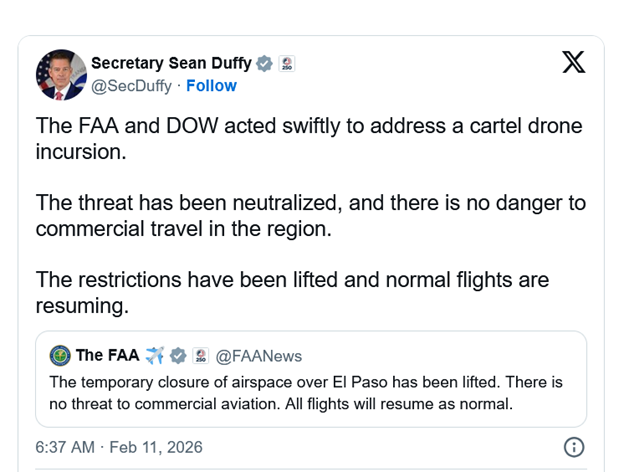
Figure 4. Secretary of Transportation Sean Duffy tweeted that the FAA and the Department of War acted to block drug cartel drone activity. The “intruder” turned out to be party balloons.
Civil aircraft were safe–or not
A few hours later, multiple media organizations, quoting an unnamed administration official, reported that following the incursion of Mexican cartel drones into US airspace, “The Department of War took action to disable the drones. The FAA and DOW have determined there is no threat to commercial travel.” CNN countered this information with its own unnamed sources who were “briefed by the FAA”. One of them said the issue was military activity involving drones and “laser countermeasure systems” in airspace adjacent to El Paso’s flight paths, while the other said the airspace was closed after DOD “…could not assure the safety of civilian aircraft in the area.”
The Mexican cartel drone story devolved further when the New York Times updated its story, alleging that it was CBP utilizing anti-drone lasers on loan from DOD, which actually targeted a “party balloon”. The article referenced multiple anonymous sources briefed on the situation, including two who claimed FAA officials “warned the Pentagon that if they were not given sufficient time and information to conduct their review, they would have no choice but to shut down the nearby airspace.”
Conflicting reports of coordination
Another source, however, identified as a “senior administration official,” disputed this conclusion, insisting that the Pentagon and Department of Transportation (DOT) had been coordinating with the FAA and “there was no threat to commercial air travel.” By then, CNN had updated its own story to note multiple balloons had been struck that week and DOD personnel were present. All of this contributed to the FAA’s decision to close the airspace.
Reuters would later report that AeroVironment’s LOCUST laser counter-drone weapons system was used in El Paso airspace. While the defense sector celebrates the LOCUST’s low cost and ease of use, its use in civilian airspace and the risks it poses to aircraft from unplanned damage to engines, fuselage, or empennage remain unknown.
By the end of the day, after attending a closed-door meeting with Bedford, Senate Commerce Committee Chair Ted Cruz told the Times, “At this point, the details of what exactly occurred over El Paso are unclear.” Cruz is the junior senator from Texas.
Response of Elected Officials
Cruz, whose committee oversees aviation matters, was not alone in his frustration; many elected officials had no idea what precipitated the airspace closure. But while it was obvious that CBP, DOD, and DOT were all involved to some degree or another, it was to the FAA that politicians aimed their ire.
El Paso Mayor Renard Johnson held a news conference that Wednesday morning, where he challenged how the FAA had handled the situation. “I want to be very, very clear that this should’ve never happened,” he said. “You cannot restrict airspace over a major city without coordinating with the city, the airport, the hospitals, and the community leadership.”
FAA erred, say politicians
Rep. Gabe Vasquez (D-NM) asserted it was a conflict between DOD and the FAA over anti-drone laser testing that prompted the closure. “Through my conversations with federal and local officials, it has become abundantly clear the FAA was tracking the counter-drone tests for multiple days, and the FAA responded — in error — with the disproportionate response of abruptly closing our airspace for 10 days,” he said. “The statements this administration has put out about the situation are misleading at best and a cover-up for their incompetence at worst.”
Rep. Veronica Escobar (D-El Paso) also blamed the FAA. “I want to emphasize that this was an FAA decision, but what I can say is that nothing happening on Fort Bliss would have impacted the El Paso airport or its operations,” she said at a news conference. She also stressed there was no threat. “There was not a threat, and which is why the FAA lifted this restriction so quickly,” she said.
As Cruz and fellow Senate Commerce Committee member Ben Ray Lujan (D-NM) called for classified briefings on the matter, the FAA’s Bedford was questioned by the press following an unrelated congressional meeting. He responded by telling reporters to “Read Secretary Duffy’s tweet.”
The Second Airspace Closure
Hours after the second airspace closure was announced on Feb. 26, Democratic members of the House Transportation and Infrastructure and Homeland Security committees released a statement following a briefing where they were informed that DOD personnel shot down a CBP drone “…using a high-risk counter-unmanned aircraft system.”
A Joint statement from the FAA, DOD, and CBP issued that same night asserted the military “employed counter-unmanned aircraft system authorities to mitigate a seemingly threatening unmanned aerial system operating within military airspace.” It doubled down on the earlier assertion of drone threats on the border, insisting the three agencies were “…working together in an unprecedented fashion to mitigate drone threats by Mexican cartels and foreign terrorist organizations at the U.S.-Mexico Border.” It did not explain how a CBP drone was perceived as “threatening”.
What was also missing in this statement, as in the one issued in response to El Paso, was the acknowledgment that responsibility for control of the national airspace resides solely with the FAA.
Civilian Control of National Airspace
The 1958 Federal Aviation Act, which created the independent Federal Aviation Agency as a precursor to the modern DOT-controlled FAA, became law following three midair collisions. One of them, in 1956, involved two passenger airliners over the Grand Canyon and disclosed the limits of air traffic control. The other two, which resulted in 61 deaths in April and May 1958, involved collisions between military jets and passenger airliners and revealed the military’s habit of flying without civilian communication in shared airspace.
The FAA’s control of national airspace was established with the passage of the 1958 Act. The agency’s most challenging period regarding that mandate occurred, without question, on Sept.11, 2001. During the terrorist attacks, it was Ben Sliney, FAA National Operations Manager, who called a ground stop 18 minutes after the first aircraft impacted the World Trade Center. One minute later, Mike McKormick, Air Traffic Control Manager for New York Center, ordered “ATC zero” or the complete closure of New York City airspace.
Shortly thereafter, at 9:42 AM, the FAA announced the closure of all US airspace and the immediate landing of all aircraft. Exhibiting unprecedented levels of coordination and professionalism, FAA employees were involved in the emergency landings of more than 4,500 aircraft across the country. That this was accomplished without incident or accident remains a largely unheralded achievement in the history of civilian airspace control.
Drones and the challenges to the FAA
Drones present new technological challenges for the FAA, and under section 383 of the 2018 FAA Reauthorization Act, the agency was directed to address them through coordination with various federal departments and agencies, including DHS and DOD. The law charged the FAA to “develop a plan for the certification, permitting, authorizing, or allowing of the deployment of technologies or systems for the detection and mitigation of unmanned aircraft systems.”
This included not only errant civilian drones but potentially hostile drones as well. As part of its coordination, the FAA was to ensure that such technologies would not “…adversely impact or interfere with safe airport operations, navigation, air traffic services, or the safe and efficient operation of the national airspace system.” Testing of prospective new technologies began at five airports in 2021 and continued in subsequent years.
“Swarm” enters restricted air space
In December 2023, several drones, appearing to act as an associated “swarm,” entered restricted airspace and overflew Langley Air Force Base in Virginia. The military has been unable to determine if the drones were launched with hostile intent or who controlled them. But the Langley infiltration increased pressure to counter drones near military bases, and more significantly for the FAA, to expand the military’s mandate to use whatever means necessary to stop them. (“Swarms” are generally defined as a group of drones that act in an interconnected manner as one unit. There is no consensus on how many drones constitute a swarm, however, or in the case of the drone activity at Langley, how many drones were actually even seen.)
In response to questions before the House Armed Services Committee in April 2025 concerning the military’s ability to detect and counter drones, Air Force Gen. Gregory Guillot, commander of the United States Northern Command and North American Aerospace Defense Command, declared that what the military needed most was a change to U.S. Code § 130i.
This law, entitled “Protection of certain facilities and assets from unmanned aircraft,” requires coordination between the Pentagon, DOT and FAA for, among other things, anything “which might affect aviation safety, civilian aviation and aerospace operations…” Guillot told the committee the military sought to expand its drone response abilities to all U.S. military installations and to extend beyond the fence perimeter.
According to Guillot, such changes would allow the military to shoot down drones “…not just that are in self-defense, but anything that is surveilling and planning the next attack on us within five miles of the border.”
He also said, “We have to knock out not only aircraft or UAS that are a direct threat, but also that are surveilling over the installation. I’d like to even see it expanded beyond the installation to ensure they can’t see anything sensitive on our bases.”
The committee did not ask Guillot whether specific coordination with the FAA would be necessary immediately prior to shooting down any drones, or who would be responsible for such communications. The planned use of an FAA drone tracking system, now accessible through the DISCVR tool, to identify drone operators was also not discussed.
Pentagon updates guidance; FAA concerns
In January 2026, the Pentagon Joint Inter-Agency Task Force 401 (JIATF-401) released updated guidance for counter-unmanned aerial systems (cUAS) operations. It removed the existing fence-line limitation and extended UAS surveillance beyond the “installation perimeter”. The guidance noted interagency coordination for deterring drones with the Departments of Homeland Security and Justice; it did not mention DOT or the FAA.
The FAA was worried about cUAS efforts before the guidance changes. In an October 2023 report, the Government Accountability Office (GAO) noted concerns from the FAA that some counter-drone technologies “pose a potential threat to ‘safety of life systems’ including air navigation services and onboard navigation.”
The FAA also noted counter-drone technology posed “an indirect risk to persons and property on the ground or other aircraft in flight…” Unfortunately, the version of this GAO report released to the public in March 2024 omitted information deemed sensitive by DHS and, according to the GAO, some of the omitted information “…was, in part, the basis for GAO conclusions” in the report.
One of the key elements GAO explored in the document was “legal authorities held by federal and local entities related to using drone detection and counter-drone technologies at airports.” This legal authority, and whether it should be wielded by the FAA or others, appears to be at the center of the Texas and New Mexico airspace closures. The FAA has made no further statement on either airspace TFR.
Pentagon Weighs Use of Lasers in DCA Airspace
On March 31, the New York Times reported that the Pentagon was considering using lasers to counter alleged drone infiltration by an unknown number of drones exhibiting swarm behavior over Fort McNair, where Secretary of State Marco Rubio and Secretary of Defense Pete Hegseth are currently housed. According to unnamed sources who spoke to the Times, the Pentagon may relocate a LOCUST system to the army base, which is about two miles from Reagan National Airport and thus within Class B, or controlled, airspace. The Times stated that in early March, a demonstration of the LOCUST system was conducted on a jet aircraft for eight seconds in White Sands Missile Range with FAA observers. While the military regarded this as a successful exhibition of the system’s safety on aircraft, the FAA has continued to study the test.
When asked by Leeham News if the FAA would make public its study of the White Sands test, or how the agency proposed to safeguard pilots from the inadvertent targeting of aircraft cockpits by military lasers, or if air traffic controllers would be notified prior to the use of the lasers near DCA so they could divert potentially affected civilian aircraft, the agency responded that it “…appreciates the collaboration with the Department of War and its shared commitment to addressing emerging drone threats and safeguarding the flying public. The recent demonstration provided valuable data to inform the FAA’s safety assessment of the laser system. We look forward to continuing to work with the Department of War and interagency partners to protect the homeland while ensuring the safety of the National Airspace System.”
President Eisenhower’s Remarks
The day after the May 20, 1958, midair collision between Capital Airlines flight 300 and a United States Air Force (USAF) T-33 jet trainer that killed 12 near Brunswick (MD), the members of the House Appropriations subcommittee overseeing civil aviation funds demanded an emergency rule to force the military to file instrument flight plans. This would place them in regular communication with Civil Aeronautics Authority (CAA) personnel. (The CAA operated functions later assumed by the FAA.)
The demand came after a closed-door meeting with civil and military air officials, including CAA Administrator James Pyle. Late that night, the CAA turned down the request. It claimed that air traffic controllers could not handle the sudden influx of more flights into the system.
For its part, the military opposed the rule, claiming it would force a reduction in training and other missions. Unwilling to wait on aviation authorities, Commerce Committee Chair Rep. Oren Harris (D-AR) introduced a bill the same day that became the Federal Aviation Act. On the Senate side, the bill was also introduced on May 21 by Senator Mike Monroney (D-OK).
Eisenhower puts military under FAA airspace control
On May 22, President Dwight Eisenhower issued a presidential proclamation requiring the military to file flight plans below 25,000 feet; contrary to the CAA’s concerns, air traffic controllers handled the additional traffic without issue.
On August 23, the Federal Aviation Act was signed into law. It established that the “development and operation of a common system of air traffic control and navigation for both military and civil aircraft” resided with the administrator of the new aviation agency.
In remarks supporting the legislation published two months earlier, Eisenhower had written, “I recommend that the Federal Aviation Agency be given full and paramount authority over the use of by aircraft of air space over the United States and its territories except in circumstances of military emergency or urgent military necessity.”
The president certainly could not have foreseen an era in which drones would become so prevalent in national airspace. His comments still stand, however, as an admonishment to those who would embrace extreme measures in response to fears of attack from every corner, some of which turn out to be only party balloons and federal equipment. As the drone industry continues to lobby for more freedoms to operate beyond visual line of sight, use of force rules for the military and DHS in civilian airspace become that much more significant. Whether or not the FAA will adhere to Eisenhower’s recommendation that it retain “full and paramount authority” is a question that the agency is finding more complex and urgent with each passing day.
Related
source