


The United States has more military aircraft and a bigger defense budget than the next four of the top five countries combined. Statistics from the World Population Review confirm that it is the world champion of air power in terms of fleet size. Russia would be the US Armed Forces’ closest near-peer adversary, but the widening gap of qualitative and quantitative advantages makes an enormous difference between the two.
The People’s Liberation Army Air Force (PLAAF) of China has experienced both growth and technological advancement in recent years. The Indian Air Force (IAF) and Japanese Air Self-Defense Forces (JASDF) have focused on modernization while struggling to keep up force levels.
The good old Stars and Stripes has a firmly secured place on top of the stack, but the constant evolution of air power demands vigilance to stay there. The different strategies employed by each force, in terms of tactics, force structure, and logistics, have helped shape each of the world’s five greatest air forces today.
Raw Fleet Numbers

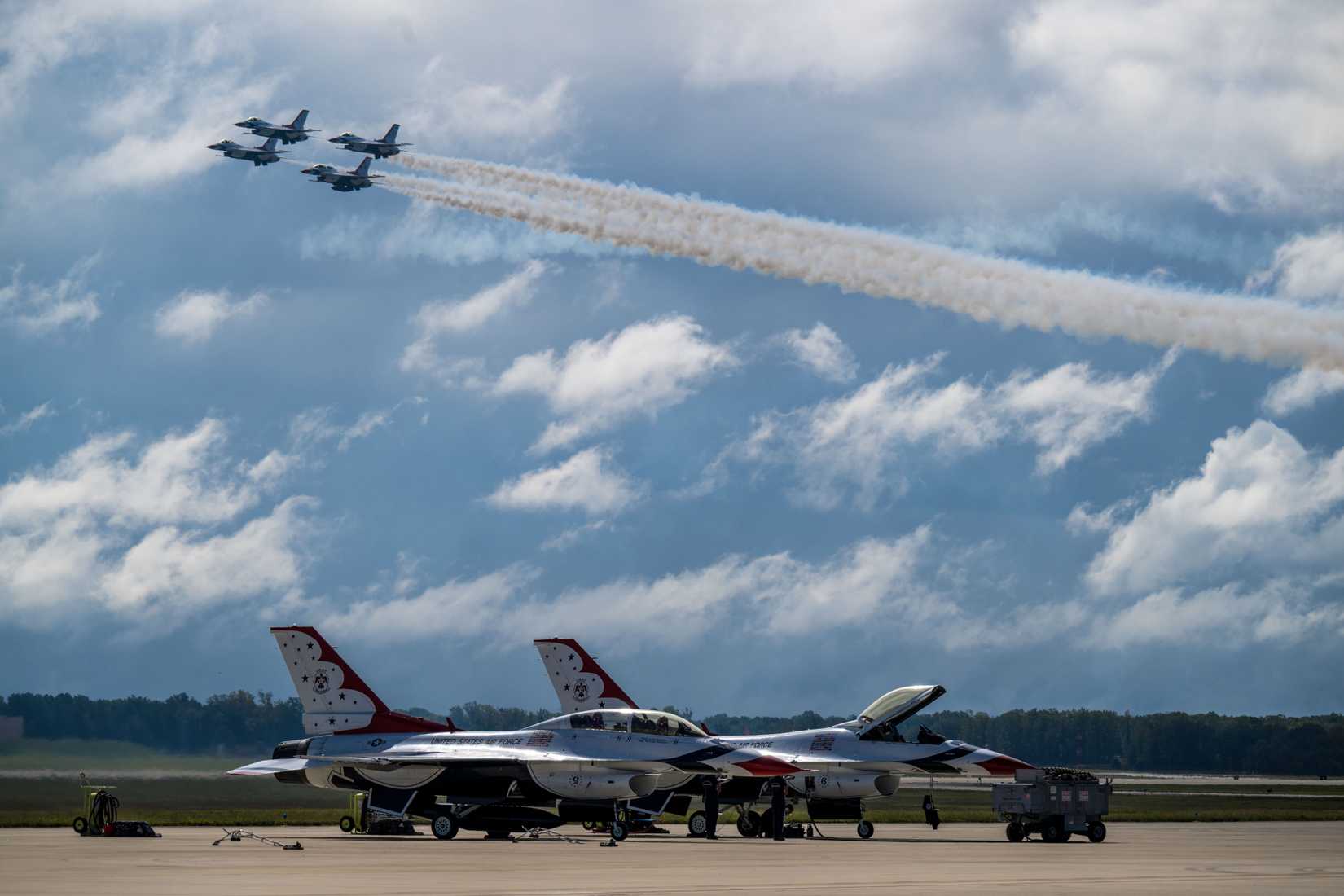
It comes as no surprise that the United States continues to lead by a significant margin in the realm of air power. The strategy of US forces has placed a heavy focus on air power since World War II. According to the World Directory of Modern Military Aircraft (WDMMA), there are 5,004 military aircraft of all kinds in the US Air Force. The US Army has 4,333 helicopters, equivalent to the second-largest air force in the world, measured alone.
The US Navy has 2,504 airframes of all types, ranking fourth when considered independently. With 1,211 tactical helicopters, jets, and transports, the US Marines could independently be ranked seventh in the world. The top five air force rankings by country are listed below:
|
Ranking |
Military Fleet Count |
|---|---|
|
1. USA |
14,486 |
|
2. Russia |
4,211 |
|
3. China |
3,304 |
|
4. India |
2,296 |
|
5. Japan |
1,459 |
Bringing up second place, Russia’s fleet is the only one on this list that is in decline. The ongoing armed conflict with Ukraine means regular combat losses. Its defense industry has been unable to ramp up to meet demand for replacements due to Western sanctions that have halted the flow of critical parts and materials not readily available in Russia.
China is growing its stealth fighter fleet, a naval air arm, helicopter forces, and airlift capabilities in parallel. Although not yet a force capable of rivaling America, it is a sizable threat to US partners in the Asia-Pacific region like Japan, the Philippines, Singapore, and Australia.
India maintains a large force to counter the influence of China and balance the power in the region, as well as deter the threat of its rival, Pakistan. Japan, on the other hand, maintains a defensive fleet concentrated solely on protecting its domain from the aggression of China.
Top Fighter Jets


There is still no rival to the Lockheed Martin F-22 Raptor, although the new F-35 Lightning II is a highly capable supporting stealth fighter. Russian Sukhoi Su-57 Felon stealth fighters are said to meet the standards of fifth-generation stealth fighters, but few exist. According to a probable fleet count of just over 200, the PLAAF has more stealth aircraft than Russia.
The US F-22 fleet is nearly 200-strong, while its F-35 numbers are around the 800-mark now. US partners in Asia and Europe bring the global fleet count to over 1,230. The PLAAF J-35 is poised to begin mass production in the near future, potentially with a naval variant as well, to boost China’s fifth-gen numbers.
The Indian Air Force (IAF) is in discussions with Lockheed Martin to possibly produce F-16V jets under license, known as the F-21. India has already turned down a Su-57 export version and declined an offer from the US to buy F-35s, with no clear answer as to what the nation’s first stealth platform will be.
Mitsubishi’s F-15J and F-2 are license-built models of the Boeing F-15C/D and LM F-16C/D. The F-2 is significantly larger than the standard F-16 in terms of wing and surface area, which is a noticeable difference. In time, the F-35 and sixth-generation GCAP, or BAE Tempest, will take their places.
The Biggest Budget

A global team of academics told the Stockholm International Peace Research Institute in April 2025 that 60% of global defense spending is allocated to the top five nations with the highest military spending. China, Russia, Germany, India, and the United States are the top five countries in terms of spending. The US military’s budget accounts for 37% of the global defense budget.
According to Air & Space Forces, the USAF even had a greater share of the overall military funding in 2025 than the Army. Below is an order of the top five air forces by budget:
|
Ranking |
2024 Defense Budget |
|---|---|
|
1. USA |
$997 billion |
|
2. China |
$314 billion |
|
3. Russia |
$149 billion |
|
4. Germany |
$88.5 billion |
|
5. India |
$86.1 billion |
China’s modernization drive, which emphasizes unmanned and stealth platforms, is largely responsible for the country’s budget growth. Russia’s spending is focused on sustaining the invasion force in Ukraine, with a smaller share toward modernization of its forces.
In response to Russia’s overt aggressiveness, Germany increased its defense spending by 28% in 2024. After the United States, Germany is Ukraine’s second-largest military aid supplier. The fleet size for the German Army and Air Force is only a few hundred strong, despite having a larger budget than Japan’s Self-Defense Forces.
Although India has been strengthening its defense capabilities at home, imports are still a major factor in the aircraft industry. And Japan doesn’t make the list of top five spenders, even though it has a larger fleet than the German Air Force.
The Most Stealth Fighters

Since its inception in 2001, the F-35 Lightning II program has expanded to become the largest combat aircraft project in history. The Joint Strike Fighter (JSF), another name for the F-35, has been put into service, or ordered, by 20 countries around the world. The revolutionary stealth fighter has grown the number of fifth-gen jets in service sixfold since 2017.
The core of the program is the United States, Japan, the United Kingdom, Australia, and Italy. Together, they will field almost 3,000 airframes in three variants when all the combined orders are fulfilled. The United States operates more than two-thirds of the worldwide fleet, but allies are steadily expanding their fleets. Below is the list of top F-35 fleets by country:
|
Ranking |
F-35 Fleet Numbers (Total Planned) |
|---|---|
|
1. USA |
1,763 F-35As, 340 F-35Cs, 353 F-35Bs |
|
2. Japan |
105 F-35As, 42 F-35Bs |
|
3. United Kingdom |
138 F-35Bs |
|
4. Australia |
100 F-35As |
|
5. Italy |
60 F-35As, 30 F-35Bs |
The average price of an F-35 is currently tagged at $82 million, thanks to large-scale orders from the US and partner nations, according to Defense Express. That means the more capable, stealthy F-35 is 30-40% less expensive than mainline fighters of the previous generation that are in production now.
A new Boeing F-15EX Eagle costs $90 million on the low end and up to $97 million. The fourth-gen Dassault Rafale that serves the French Armed Forces is estimated to cost $131 million. The Eurofighter Typhoon comes in at around $117 million per fighter, according to Defense Media. The cost to capability balance of the F-35 has given a massive airpower advantage to every operator in the rapidly growing global fleet.
The Most Airlift Power

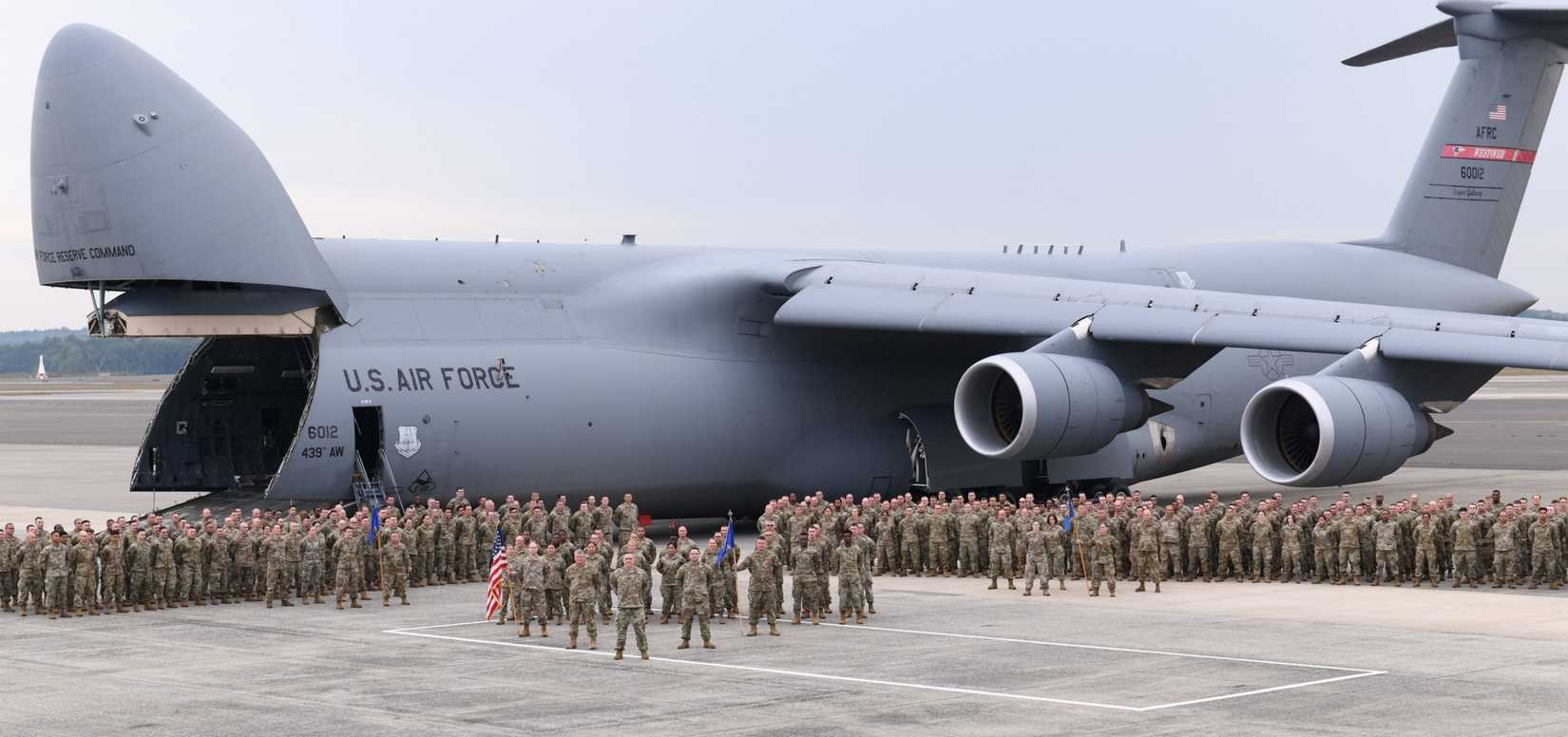
The USAF is the undisputed leader in airlift, possessing about half of all military-spec transport aircraft (fixed-wing) worldwide, according to Global Firepower. In terms of payload capacity, the Ukrainian Antonov An-225 Mriya was actually superior to the United States Air Force’s Lockheed C-5M Galaxy. Sadly, it was destroyed when Russia struck the historic Antonov Airport just outside Ukraine’s capital of Kyiv, as Reuters reported.
That still leaves the An-124 Ruslan, which is capable of hauling an astounding 150 tons of cargo versus the C-5M’s 130-ton max. This is where the American advantage of quantity comes in, as the US fleet has around 50 operational super heavies, but Ukraine can only muster a few of its massive jets today.
The C-5 is slightly longer than the An-124 from nose to tail, but the Antonov is larger in all other dimensions, according to a head-to-head comparison provided by Aviator Joe. With more than twice the endurance at 5,162 NM (9,560 km) compared to 2,430 NM (4,500 km), the Galaxy has a much greater strategic reach than the Ruslan.
The USAF also has more than 200 examples of the Boeing C-17 Globemaster III and over 400 Lockheed C-130s in operation. China has a diminutive fleet of Y-20s, which are lower-performance planes akin to the C-17. India also has C-17s, while Japan and Germany each have C-130s on their flightlines as well, but nowhere near the numbers that the US has.
source