


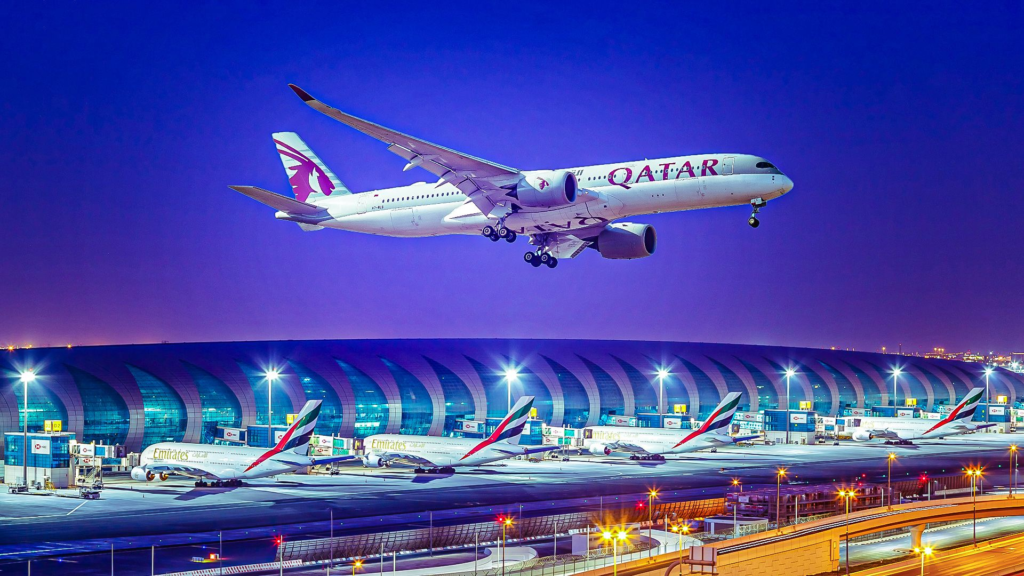
Just five airlines collectively operate well over 1,000 twin-aisle aircraft, influencing how people travel across continents and oceans. Examining the five airlines that currently operate the biggest widebody fleets in the world provides a glimpse into how business strategies, geographical advantages, and calculated investments combine to form each airline’s strategy. According to The Aviation Brief, the top five are: Emirates, United Airlines, Qatar Airways, Delta Air Lines, and Turkish Airlines.
|
Carrier |
Widebody count |
|---|---|
|
Emirates |
264 |
|
United Airlines |
227 |
|
Qatar Airways |
199 |
|
Delta Air Lines |
176 |
|
Turkish Airlines |
154 |
Widebody aircraft are defined as twin-aisle jets. They are built to transit oceans or continents in a single sortie carrying heavy payloads of passengers, cargo, or both. These machines are essential to long-haul aviation as we know it today. The airlines that have the biggest fleets of these aircraft typically have a powerful impact on international travel trends. They set the standard for cabin comfort, determine the cities with the best service, and frequently act as unofficial national ambassadors in the process.
Turkish: International Focus

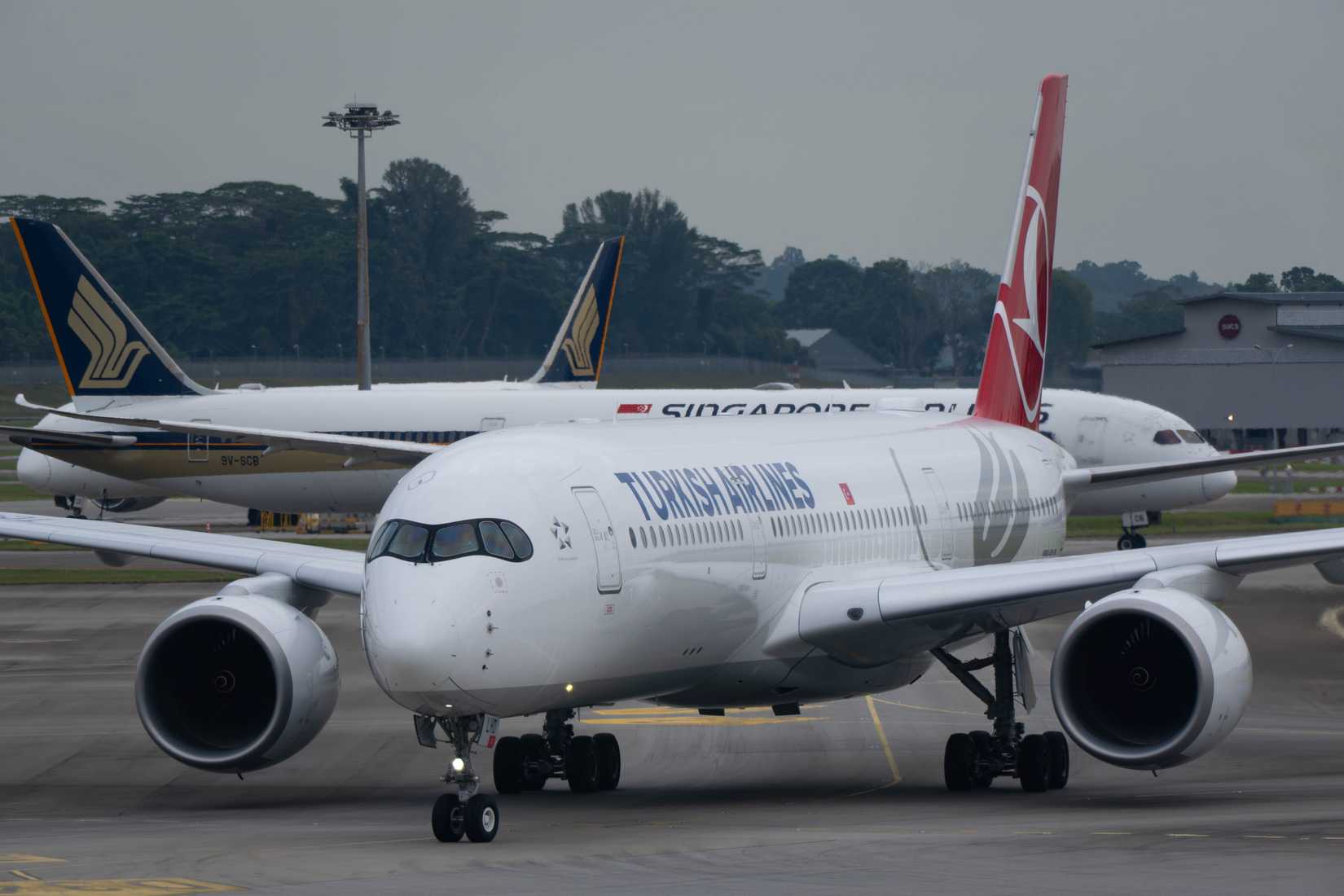


Cabin spaces are also moving upmarket. A bespoke business-class suite with privacy doors will debut on incoming A350 deliveries. Retrofits are already slated for the existing 777-300ERs. Premium economy will finally appear on the incoming A350-1000s, offering a mid-tier price point to compete directly with the Gulf carriers. All seats, even in economy, will tie into WiFi and new inflight entertainment that streams gate-to-gate.
On the ground, the airline’s cargo arm is expanding into a new hub at Istanbul Airport. From there, two dozen A330-200Fs and a dozen 777Fs will ferry perishables and precious cargo between continents. The belly space of every new passenger widebody is factored into those calculations, giving Turkish a cost advantage with a mixed fleet versus pure freighter or passenger competitors.
Turkish Technic’s adjacent maintenance complex underpins the fleet plan. New widebody bays, a composites center, and an engine test cell capable of handling the Trent XWB and GEnx for heavy checks stay in-house. An on-airport SAF blending facility is set to start feeding flights next year, and the airline has committed to an all-SAF first departure to every continent by 2027. The move aims to keep Turkish Airlines competitive not just in terms of reach and price, but in its sustainability narrative as well.
Delta Air Lines: Atlanta’s Armada

Every A350 and A330neo rolls out of Toulouse headed for 
Behind the scenes, fleet renewal is accelerating rapidly. Management has indicated that once competitors secure Boeing’s 787 delivery slots, the stretched A350-1000 might be used to replace the highest-density 767 services out of Atlanta and New York. More A350-900s are arriving nearly every month. The remaining 767-400ERs and the final Pratt & Whitney-powered 757s will retire as the newcomers take up residence, reducing fuel consumption on transatlantic flights by about 25% and freeing up bandwidth for repair at Delta TechOps in Atlanta.
That maintenance, repair, and overhaul (MRO) arm, already the largest airline-owned operation of its kind in the world, is banking on predictive analytics. New jets have more than a billion sensor points that flag components before failure. The payoff is evident in dispatch reliability, which has risen above 99 % on the A350 fleet and supports Delta’s growing presence in slot-constrained airports like Heathrow (LHR) and Haneda (HND).
The carrier maintains a number of contractual agreements with different suppliers, aiming for 10 % SAF usage by 2030. Delta is even converting ground-service vehicles at key hubs to electric or renewable diesel. A successful 2025 test flight blended 40 % SAF in one Trent XWB engine and spotlighted the pathway to higher blend ratios across the Airbus lineup.
Belly-hold cargo to move pharmaceuticals and e-commerce paints Delta’s widebody strategy as a balanced operation with a blend of “right-sized” aircraft, tech-driven platforms and strategic partnerships that make the world reachable without straining the balance sheet.
Qatar: Investing In The 777X

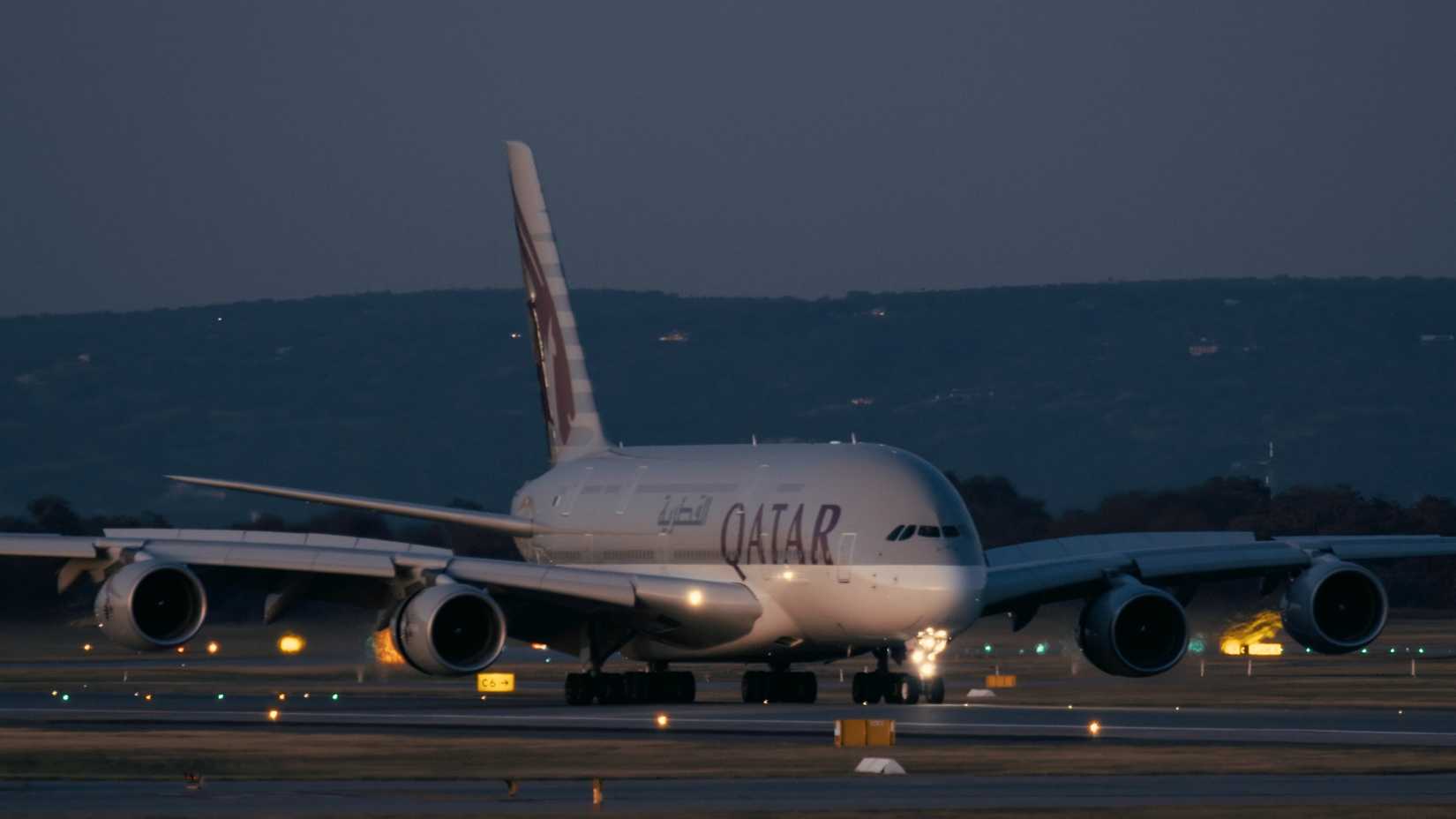

The award-winning Qsuite has migrated from the 777s and A350-1000s to selected 787-9s, giving every widebody variant lie-flat privacy pods with closing doors. A second-generation product is already in prototype, squarely aimed at the ultra-long hauls the 777-9 will fly. At the same time, a new Premium Economy cabin is debuting on the A350-900 to capture price-sensitive leisure traffic without diluting the business-class brand.
Behind the curtains, Qatar Airways Cargo remains the world’s largest international freight carrier, fielding more than 30 777Fs and two 747-8Fs that shuttle nightly between Doha and global pharma and e-commerce hubs. The coming 777-8F will slot in with a payload similar to the 747-400F but on 30 % less fuel, reinforcing a network that already supplies half of all imported perishables consumed in the Gulf region.
On the sustainability track, Qatar has inked multibillion-dollar offtake deals with Gevo and Shell to secure Sustainable Aviation Fuel at European and US gateways, complementing a home-grown initiative to blend waste-derived SAF at Ras Laffan. Meanwhile, a fleetwide rollout of drag-reducing riblets and AI-assisted flight-path planning shaved an average of two minutes off every Doha departure last year. Add in Hamad International’s solar-powered midfield expansion, and the carrier’s carbon intensity is on course to fall 25 % by 2030—all while preserving the high-touch service culture that keeps Qsuite at the top of every frequent-flier wish list.
United: The World’s Largest Airliner Fleet

Instead of being the “largest-in-class,” 
Following the arrivals, there will be retirements. Aging 767-300ERs are slated to exit by 2030, releasing expensive maintenance slots and simplifying pilot training, while the workhorse 777-200ERs are being refitted with identical interiors to avoid a “cabin lottery” on the customer side. Until the 777-8, which has not yet been deployed, or a redesigned 787 version provides comparable thrust with reduced trip expenses, the high-capacity 777-300ERs remain in service for extremely crowded departures.
United’s IT operations division is investing in predictive analytics and increasing Dreamliner check capabilities behind the scenes, using over a million real-time sensor data. Ground technicians can scan a widebody in a matter of minutes and send the appropriate parts before the next pushback thanks to the RFID chips attached to galleys, seats, and restrooms.
A major component of the carrier’s climate agenda is Sustainable Aviation Fuel. With the belief that vertical integration will reduce supply risk, United has committed to offtake of more than 10 billion gallons through 2040 and owns equity in companies like Fulcrum BioEnergy and Alder Fuels. At Chicago O’Hare, a modest but expanding fleet of electric tugs and hydrogen fuel-cell service trucks patrols the ramp, and the airline’s venture arm is supporting battery-electric commuter planes that may eventually transport passengers into the hub network with no tailpipe emissions.
Emirates: The Widebody Czar


The mega-fleet is kept running by Emirates Engineering, one of the biggest airline-run MRO complexes in the world, which performs A-checks overnight in 12 hangars and completes A380 D-checks entirely in-house. Additionally, the division collaborates with Lufthansa Technik Middle East and Collins Aerospace to locally build cabin components, reducing prices and turnaround times.
This is the current Emirates fleet and pending deliveries per ch-aviation:
|
Model |
Active |
Future |
|
A350-900 |
9 |
56 |
|
A380-800 |
92 |
|
|
777-200F |
11 |
10 |
|
777-200LR |
9 |
|
|
777-300 |
||
|
777-300ER |
118 |
|
|
777-8 |
35 |
|
|
777-9 |
170 |
|
|
787-10 |
15 |
|
|
787-8 |
15 |
Operations are being reshaped by environmental pressure. In Dubai and at important outposts like Singapore and Amsterdam, Emirates has inked multi-year sustainable aviation fuel offtake agreements. By 2024, the airline hopes to have 50% of all fuel uplifted in Dubai blended with SAF. This goal was confirmed by a successful test flight in January 2024 using a GE-90 engine with 100% SAF.
source