


The secretive U.S. Air Force NT-43A RAT55 was spotted flying with a NASA callsign in one of the areas reserved for the launch of the Artemis II mission, opposite to the one used by the WB-57 Canberra.
NASA is set to launch the Artemis II mission on Apr. 1, 2026, at 6:24 pm EDT (22:24 GMT), which will be the first crewed lunar flight since Apollo 17 in 1972. As usual for NASA missions, one of the agency’s WB-57 Canberra high-altitude research aircraft will observe the launch while flying in the airspace surrounding the Launch Complex 39B of the Kennedy Space Center (KSC), from where the Space Launch System (SLS) rocket and Orion spacecraft will depart.
Tomorrow, we launch.
At sunset tonight, Artemis II waits on the pad, ready to carry astronauts potentially farther than any humans have traveled in more than half a century.
The next era of exploration begins. pic.twitter.com/vdABkjRrnf
— NASA Administrator Jared Isaacman (@NASAAdmin) April 1, 2026
However, it appears that the WB-57 will be joined by another specialized, much more secretive asset: the U.S. Air Force’s NT-43A. The highly-modified Boeing 737-200, better known with its callsign RAT55, is usually employed as Radar Airborne Testbed (RAT) thought to be used almost exclusively to evaluate the radar signatures of stealthy aircraft.
#A10635/#AE654A as #NASA522 RATT55 on a NASA mission! https://t.co/LZN47lr8nW
— Norb (@norb420) March 31, 2026
“Thought” could be the key word here, as one would not expect this platform to be observing the launch of a NASA mission, since SLS and Orion are not stealth aircraft whose radar signature needs to be evaluated. Although there is no official confirmation and we can’t be sure about the involvement of RAT55, there are some hints worth noting.
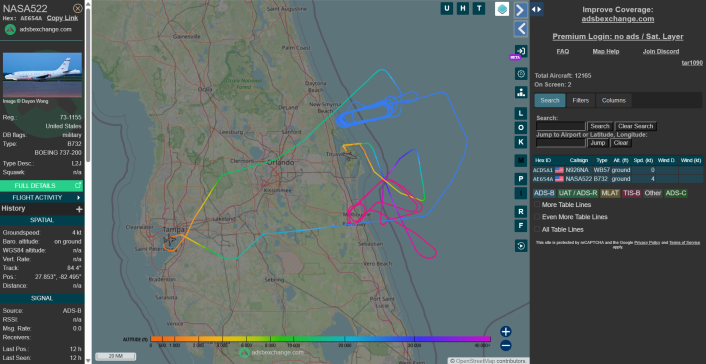
The first and more obvious is that the aircraft was tracked while flying on Mar. 31 with a NASA callsign, specifically NASA522. The identity of the aircraft was also confirmed by a photo sent to us by @Brevardjetphoto, which you can see as the cover of this article, captured as the aircraft was flying over Melbourne, Florida, on the way to its assigned area.
This is correct, there are two separate NOTAMs for support aircraft that match both flight tracks. This was an obvious rehearsal. pic.twitter.com/X3i5RbP4T2
— Dillon Shropshire (@Dillonshrop06) April 1, 2026
The second is that the NT-43 was flying at the same time of the WB-57, with each occupying an area reserved by NOTAMs (NOtice To AirMen) for the launch.
Specifically, the WB-57 was flying in an area reserved to the south of Launch Complex 39B. The WB-57’s presence was also mentioned in the NOTAM 03/652 (KZMA-A1037/26) itself:
!CARF 03/652 ZMA AIRSPACE DCC ARTEMIS II WB-57 SUPT STNR ALT RESERVATION WI AN AREA DEFINED AS 283100N0803100W TO 280300N0792900W TO 273700N0795000W TO 280000N0810000W TO POINT OF ORIGIN FL450-FL500 2604012100-2604020100
The NT-43 was flying in an area opposite to the WB-57’s, to the north of the launch pad, reserved by NOTAM 03/643 (KZMA-A1035/26):
!CARF 03/643 ZMA AIRSPACE DCC EROP K0949 WINDOWABC SUPT STNR ALT RESERVATION WI AN AREA DEFINED AS 285000N0804700W TO 290400N0792900W TO 292800N0793400W TO 291500N0810100W TO POINT OF ORIGIN FL200-FL350 2604012125-2604020105
Both aircraft were visible on flight tracking websites, further confirming their loiter areas. Moreover, AirNav Radar’s flight activity page for NASA522 mentions a scheduled flight for Apr. 1 at 5 pm, thus before the launch (planned at 6:24 pm), in addition to the Mar. 31 flight.
The combination of all these elements appears thus to point to the NT-43 RAT55 being used to collect data about the launch of Artemis II in support of NASA. The tracks also allowed to determine that the NT-43 is flying from MacDill Air Force Base, Florida, while the WB-57 is operating from the Kennedy Space Center’s historic Shuttle Landing Facility (SLF).

It is however not possible to determine which type of data will be collected by this specialized aircraft. As mentioned earlier, this aircraft is usually employed to evaluate the radar cross section (RCS) of stealthy aircraft by using two very large radar arrays hosted by two radomes on the nose and tail, which give the aircraft its characteristic appearance.
The aircraft has also electro-optical/infrared (EO/IR) sensors installed on both radomes, although their capabilities are nowhere near the ones of the WB-57’s large sensor installed on the nose. The aircraft can also be fitted with dorsal fairings for additional equipment.
NT-43A RAT55
The NT-43A is considering one of the most secretive variants of the Boeing 737 series. The aircraft was initially a T-43 trainer, based on the Boeing 737-200 airliner, later converted to the new configuration and assuming the “NT” designation, where the “N” prefix stands for “Special Test, Permanent.”
The aircraft is fitted with advanced radar technology, with two very large radar arrays hosted in special radomes on both the nose and the tail. Each radome also has a small electro-optical/infrared (EO/IR) sensor on top, and additional equipment can be installed in dorsal fairings that sometimes are visible on the aircraft.

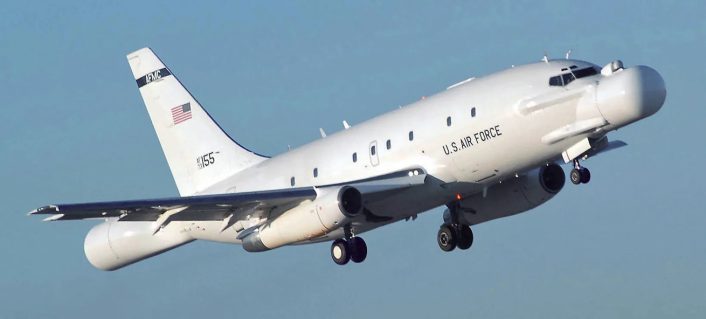
The RAT55 callsign reportedly comes from the term Radar Airborne Testbed (RAT) and the final numbers of the NT-43’s serial 73-1155. The secretive platform operates primarily from Groom Lake, otherwise known as Area 51, but sometimes it also make public appearances outside the Nevada Test and Training Range (NTTR).
RAT55 is thought to be used almost exclusively to evaluate the radar signatures of stealthy aircraft. This includes new designs and prototypes as well as existing platforms like the B-2 Spirit, which must have their stealth capabilities tested on a regular basis to ensure the aircraft’s radar cross-section readings are at their anticipated levels.
source