


A month after the start of the hostilities, the U.S. Marine Corps is increasing its presence in the Middle East with the arrival of a F-35C squadron and the USS Tripoli Amphibious Ready Group.
Mar. 28, 2026, marks a month since the U.S. and Israel launched Operations Epic Fury and Roaring Lion, respectively, in an effort to completely dismantle Iran’s military. Although U.S. officials once again reiterated that operations in Irany might end “in the next couple of weeks,” multiple assets of the U.S. Marine Corps arrived in the U.S. Central Command’s (CENTCOM) Area of Responsibility (AoR).
USS Tripoli Arrives
In fact, CENTCOM stated on Mar. 28 that, on the previous day, the USS Tripoli (LHA-7) Amphibious Ready Group (ARG) and the 31st Expeditionary Unit (MEU) have now arrived in the region. The ARG was dispatched to the Middle East two weeks earlier while it was sailing from the Pacific Ocean.
U.S. Sailors and Marines aboard USS Tripoli (LHA 7) arrived in the U.S. Central Command area of responsibility, March 27. The America-class amphibious assault ship serves as the flagship for the Tripoli Amphibious Ready Group / 31st Marine Expeditionary Unit composed of about… pic.twitter.com/JFWiPBbkd2
— U.S. Central Command (@CENTCOM) March 28, 2026
The ARG made a quick stop this week at Naval Support Facility (NSF) Diego Garcia, possibly for a resupply before heading into their assigned area of operations. It is yet unclear what would be the role of the Marines.
That was a quick pit stop. 👇
NSF DIEGO GARCIA UPDATE: ARG Departs, DDG Arrives
Mar 25 imagery shows a fast turnover at the logistics hub.
➡️ Tripoli ARG has already pushed off to continue their transit. In their place, a lone Arleigh Burke-class destroyer is now alongside.… https://t.co/QoJhvvJvY0 pic.twitter.com/pgsewaBc80— MT Anderson (@MT_Anderson) March 25, 2026
The Tripoli ARG includes the America-class amphibious assault ship USS Tripoli (LHA-7), and amphibious transport docks USS San Diego (LPD-22) and USS New Orleans (LPD-18). USNI News has previously reported that USS San Diego was in port in Japan, and thus only the USS Tripoli and USS New Orleans would head to the Middle East.
On board the vessels are about 3,500 Sailors and Marines, with the 31st MEU alone counting 2,200 Marines. Of these, 1,200 form the Ground Combat Element, while the remainder are part of the support units and Aviation Combat Element.

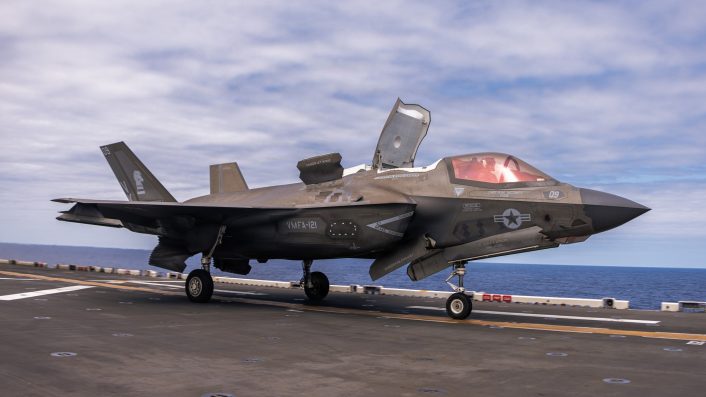
Multiple aviation assets are deployed aboard. Among these are the MV-22B Osprey tiltrotors, CH-53E Super Stallion, UH-1Y Venom and MH-60S Seahawk helicopters for troop transport, as well as the AH-1Z attack helicopters and F-35B Lightning II fighter jets for close air support.
USMC F-35Cs to the Middle East
Earlier last week, ten F-35C Lightning II fighter jets of the U.S. Marine Corps arrived at RAF Lakenheath in the UK. The aircraft arrived there in two cells, one on Mar. 24 and the second on Mar. 25.
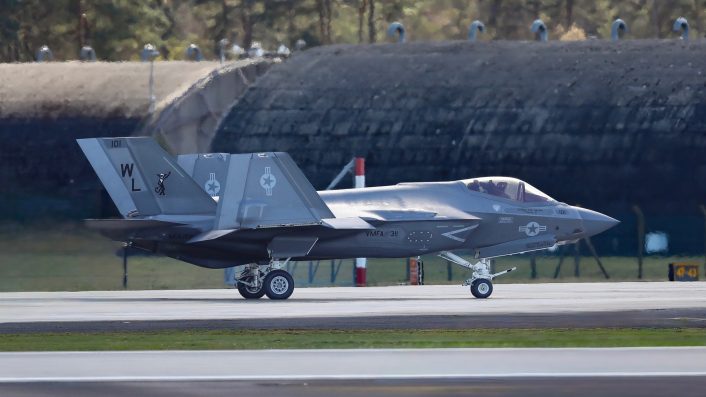
After a short stay, eight of the F-35s departed once again divided in two cells, one on Mar. 26 and the second on Mar. 28. According to some reports, these aircraft might be headed for Ovda Air Base, in Israel.
KC-135 #GOLD97-98 are dragging “WL” F-35C #MAZDA41-44 out to Ovda AB from RAF Lakenheath. The first four departed on Thursday as #MAZDA31 flt, while two more remain on deck. https://t.co/LE0yRTGQJA pic.twitter.com/D3TuflOL7r
— EISNspotter (@EISNspotter) March 28, 2026
Two F-35Cs are still on the ground at the British base. One allegedly lost its air refueling probe during its flight over the Atlantic Ocean, while the other had an unspecified issue on the ground at Lakenheath.
#USAF United States Air Force – Coronet East
Boeing KC-135 Stratotanker 2x#AE07BA 62-3557 – GOLD 87#AE035D 58-0063 – GOLD 88
+ MAZDA 31-34 Flt 4x F-35Cs
Four U.S. Marine Corps F-35Cs departed RAF Lakenheath this morning supported by KC-135s GOLD 87 and GOLD 88. They had made… pic.twitter.com/kzbTLq0CFy
— Armchair Admiral 🇬🇧 (@ArmchairAdml) March 26, 2026
A squadron of Marine F-35Cs is already in the Middle East, embarked on the USS Abraham Lincoln (CVN-72). It is unlikely the newly arrived squadron will be embarked on the aircraft carrier, while it is more likely it will operate from a land base.
#USAF United States Air Force – Coronet East
Boeing KC-135 Stratotanker 2x#AE035D 58-0063 – GOLD 97#AE047B 58-0117 – GOLD 98
+ MAZDA 41-44 Flt 4x USMC F-35C’s
Four U.S. Marine Corps F-35C’s departed RAF Lakenheath this morning supported by GOLD 97/98. Two aircraft remain,… pic.twitter.com/a2KwSznjxX
— Armchair Admiral 🇬🇧 (@ArmchairAdml) March 28, 2026
USS Ford Port Call
The USS Gerald R. Ford (CVN-78) arrived in the port of Split, Croatia, on Mar. 28, for a port call during its lengthy deployment, which has seen the vessel at sea since June 24, 2025. Previously, the USS Ford stopped in Souda Bay, Greece, to resupply, refuel, and conduct repairs from Mar. 23 to 26.
The world’s largest aircraft carrier, USS Gerald R. Ford (CVN 78) anchored in the Port of Split, Croatia, March 29, following an Adriatic Sea transit from Souda Bay, Greece. Read more https://t.co/kipkNDNtZC pic.twitter.com/e6WJpP28Rp
— U.S. Naval Forces Europe-Africa/U.S. 6th Fleet (@USNavyEurope) March 28, 2026
Two weeks ago, on Mar. 12, a fire broke out aboard the U.S. Navy aircraft carrier, with an official statement from the U.S. 5th Fleet saying the fire originated in the ship’s main laundry spaces. The statement stressed that the fire was not combat-related and the aircraft carrier remains fully operational.
UPDATE: 🇺🇸CSG 12
CVN-78 remains in the region, stopping in 🇭🇷Split todayImage still captured from video posted by EdoStuff Aviation (https://t.co/4eqfHOQYd8)https://t.co/mykoEDCbq9 pic.twitter.com/osimUx60cC
— MT Anderson (@MT_Anderson) March 28, 2026
According to the latest statement from the 6th Fleet, “while in Souda Bay, Forward Deployed Regional Maintenance Center personnel, including structural engineers, naval architects, and other subject matter experts, conducted a repair assessment.” Additionally, “military and federal civilian law enforcement continued investigations into a fire aboard the ship originating in the ship’s laundry facilities.”
Regarding the repairs, the statement also said the “ship’s force personnel and local industry partners supported the rehabilitation of seven berthing compartments affected by the fire.” According to USNI News, quoting a Pentagon spokesman, “more than 100 racks were lost in the fire,” and “the Navy took 1,000 mattresses off the future USS John F. Kennedy (CVN-79)” to complete the repairs on USS Ford.
Even More Bombers
Additional bombers are on the way to RAF Fairford in the UK. Three B-1B Lancer strategic bombers arrived there on Mar. 26, and two B-52H Stratofortress bombers arrived at the British base on Mar. 28.
More Bombers Arrive to RAF Fairford #FreeIran
— Operation EPIC FURY —A total of 3 additional B-1B “Lancer” bombers, operating as callsigns “PURSE33”, “PURSE34” and “PURSE35” have arrived at RAF Fairford (EGVA) this afternoon, bringing the total US bomber fleet to 21… pic.twitter.com/6YPSqqeiTi
— DefenceGeek 🇬🇧 (@DefenceGeek) March 26, 2026
The latest arrival brings the current bomber deployment at Fairford to 23 airframes, of which 15 are B-1s and eight are B-52s. This is one of the largest bomber deployments ever recorded.
correction flt of 2
— Mike B (@jamjake01) March 28, 2026
Two more B-52s for RAF Fairford today, this time from Barksdale AFB 🇺🇸 this is BAZOO51 LA tail 20 miles out just now. pic.twitter.com/t3Oh14iKhv
— Saint1 (@Saint1Mil) March 28, 2026
Meanwhile, bomber missions are continuing both from Fairford and from the U.S. On Mar. 27, for instance, B-2A Spirit stealth bombers were again part of a round-trip mission to Iran, while a B-1 mission was launched from Fairford.
Bomber Mission 40 – The B-2 Spirit Returns! #FreeIran
— Operation EPIC FURY —Alongside a single flight of B-1B “Lancer” bombers from RAF Fairford, the other visitors to Iran yesterday were a flight of B-2A “Spirit” bombers from Whiteman AFB (KSZL) in the mainland US. At… pic.twitter.com/YRDCpo3yyj
— DefenceGeek 🇬🇧 (@DefenceGeek) March 28, 2026
A-10s and Special Operations Aircraft
After the U.S. military highlighted the role of the A-10C Thunderbolt II during the operations in Iran, it appears more might be headed downrange. In fact, a squadron of A-10s landed at Pease Air National Guard Base.
Few more pics of the 190th FS landing #TABOR91_93 pic.twitter.com/b6Px7sSoBU
— Dave O’Brien (@DaveOTGphotog) March 28, 2026
According to reports, their next stop could be either Lajes, in the Azores, or RAF Lakenheath, in the UK. Both airbases have become transit hubs for the assets flowing into the Middle East.
#USAF United States Air Force – Coronet East
Boeing KC-135 Stratotanker 1x#AE04DB 57-1437 – GOLD 50
+ TABOR 91-96 flt 6x A-10A Thunderbolt IIs
Six Fairchild Republic A-10 Thunderbolt IIs from the 190th Fighter Squadron arrived at Pease Air National Guard Base this evening,… pic.twitter.com/NR3F8zBELi
— Armchair Admiral 🇬🇧 (@ArmchairAdml) March 27, 2026
Meanwhile, A-10s already deployed are being increasingly noted in action both in Iran and Iraq. In fact, it has been reported the aircraft was used to target Iranian-backed militia in Iraq this week.
USAF A-10 Warthogs spent most of the day strafing Iranian-backed militia positions around Mosul, Iraq. pic.twitter.com/5GLcm1XVnN
— OSINTtechnical (@Osinttechnical) March 24, 2026
On Mar. 24, three AC-130J Ghostrider gunships arrived at RAF Lakenheath after a stop at Keflavik’s airport, Iceland. Notably, these aircraft usually land at the nearby RAF Mildenhall, which hosts a squadron of MC-130J Commando II special operations aircraft.
AC-130J #HEEL55, #HEEL51, & #HEEL53 headed up to Keflavik on Sunday and on to Lakenheath yesterday, making their way to the Middle East for a routine six month deployment. In contact with Gander Radio HF 11279. pic.twitter.com/LhSJNTmx9H
— EISNspotter (@EISNspotter) March 25, 2026
#USAF United States Air Force
16:51 – HEEL 51 1x AC-130J Ghostrider, inbound RAF Lakenheath from Keflavik, following HEEL 55. Working Lakenheath Command Post on 313.575, no Mode-S. https://t.co/Ont0Fx6aDa
— Armchair Admiral 🇬🇧 (@ArmchairAdml) March 24, 2026
The AC-130Js departed Lakenheath on Mar. 27. The AC-130J has not yet been employed over Iran, according to the U.S. Central Command’s (CENTCOM) updates, thus the aircraft would be a new addition to the capabilities already deployed.

As for the MC-130s, their number at RAF Mildenhall has been steadily increasing this month, with reports of up to 41 aircraft arriving there. Notably, most of these aircraft were unmarked and even the serial numbers were removed.
#USAF United States Air Force – Iran War
Special Operations Command / RAF Mildenhall
27 March – 0020zThe build-up and transit of MC-130J Commando IIs at RAF Mildenhall has been ongoing since the start of March. So far, there have been at least 41 MC-130Js (excluding based… https://t.co/6LNrEzCrz8 pic.twitter.com/qkZrOe9CvN
— Armchair Admiral 🇬🇧 (@ArmchairAdml) March 27, 2026
Among them were also 11 MC-130Js with the newest modifications, which include the new Silent Knight radar for flying at low altitude during special forces’ missions. At least 15 MC-130s departed in the last few days headed to the Middle East.
source