


The U.S. Air Force said Thursday that government-owned autonomous software programs have been successfully integrated into both of its prototype collaborative combat aircraft, in a major milestone.
In a statement, the service said this shows a central pillar of its CCA strategy — that they can be easily modified and upgraded using a modular open systems architecture — can work, and improve how the defense industrial base operates.
CCAs are drone wingmen that are intended to fly sem-autonomously alongside aircraft such as the F-35A and next-generation F-47 fighter. The Air Force hopes to field at least 1,000 CCAs in varying configurations, and have them carry out missions such as strike operations, reconnaissance, electronic warfare and as decoys to lure enemy fire away from piloted fighters.
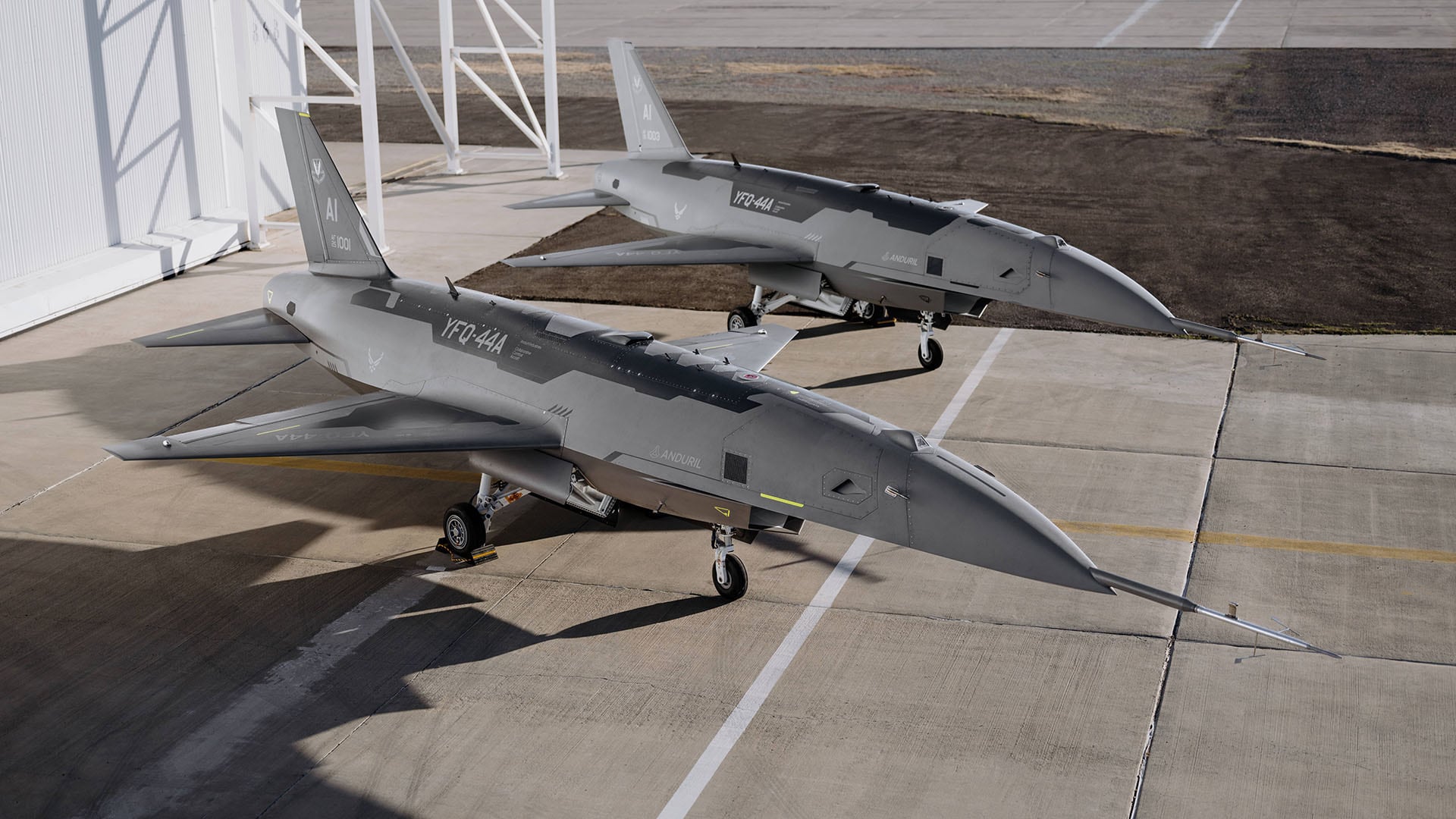
The Air Force in 2024 contracted with General Atomics and Anduril Industries to make its first CCAs, the YFQ-42A and YFQ-44A, respectively. Ground testing for both began in spring 2025, and later that year, flight tests began.
This third-party autonomous software was integrated into both CCA models using a system called Autonomy Government Reference Architecture, or A-GRA, the service said. This shows that mission software can be “decoupled” from the hardware used by specific vehicles, the service said, and make technology integration easier.
“Verifying A-GRA across multiple partners is critical to our acquisition strategy,” Col. Timothy Helfrich, the Air Force’s portfolio acquisition executive, said in the statement. “It proves that we are not locked into a single solution or a single vendor. We are instead building a competitive ecosystem where the best algorithms can be deployed rapidly to the warfighter on any A-GRA compliant platform, regardless of the vendor providing the algorithm.”

By preventing “vendor lock,” the Air Force said, the service will be able to rapidly install new software and algorithms into CCAs, making a more agile force that can keep up with evolving threats.
General Atomics and Anduril each released their own statements about the integration success.
General Atomics said the integration of RTX subsidiary Collins Aerospace’s software — dubbed the Sidekick Collaborative Mission Autonomy — using A-GRA allowed the YFQ-42A to conduct its first semiautonomous airborne mission and launch flight tests.
The software’s integration with the YFQ-42A’s flight control system allowed “robust and reliable” data exchange with the CCA’s mission systems, which ensured the drone precisely carried out the software’s commands.
General Atomics said a human operator on the ground transmitted commands directly to the YFQ-42A, which the drone then accurately followed, for more than four hours.
“We are excited to collaborate with Collins to deliver enhanced autonomous mission solutions,” said David Alexander, president of General Atomics Aeronautical Systems Inc. “The integration of Sidekick with our YFQ-42A demonstrates our commitment to innovation and operational excellence in unmanned aircraft technology.”
Jason Levin, Anduril’s senior vice president of engineering, called integrating mission autonomy into CCAs “a meaningful step towards fielding a real operational capability by the end of the decade.”
“YFQ-44A was designed from the ground up with an emphasis on modularity,” Levin said. “The aircraft’s simple design, external weapons stores, and open hardware and software architectures ensure that the aircraft can easily be configured with a range of mission systems, software suites and payloads to support a wide variety of missions.”
Levin said Anduril has worked closely with Shield AI on integrating its autonomous software for several months, and that the company “look[s] forward to flying YFQ-44A with their software onboard very soon.”
Stephen Losey is the air warfare reporter for Defense News. He previously covered leadership and personnel issues at Air Force Times, and the Pentagon, special operations and air warfare at Military.com. He has traveled to the Middle East to cover U.S. Air Force operations.
source