


By Scott Hamilton
Nov. 11, 2025, © Leeham News: The Nov. 7 UPS MD-11F crash and a new trade theft secret lawsuit are likely to impact the air freighter new sales and conversion markets.

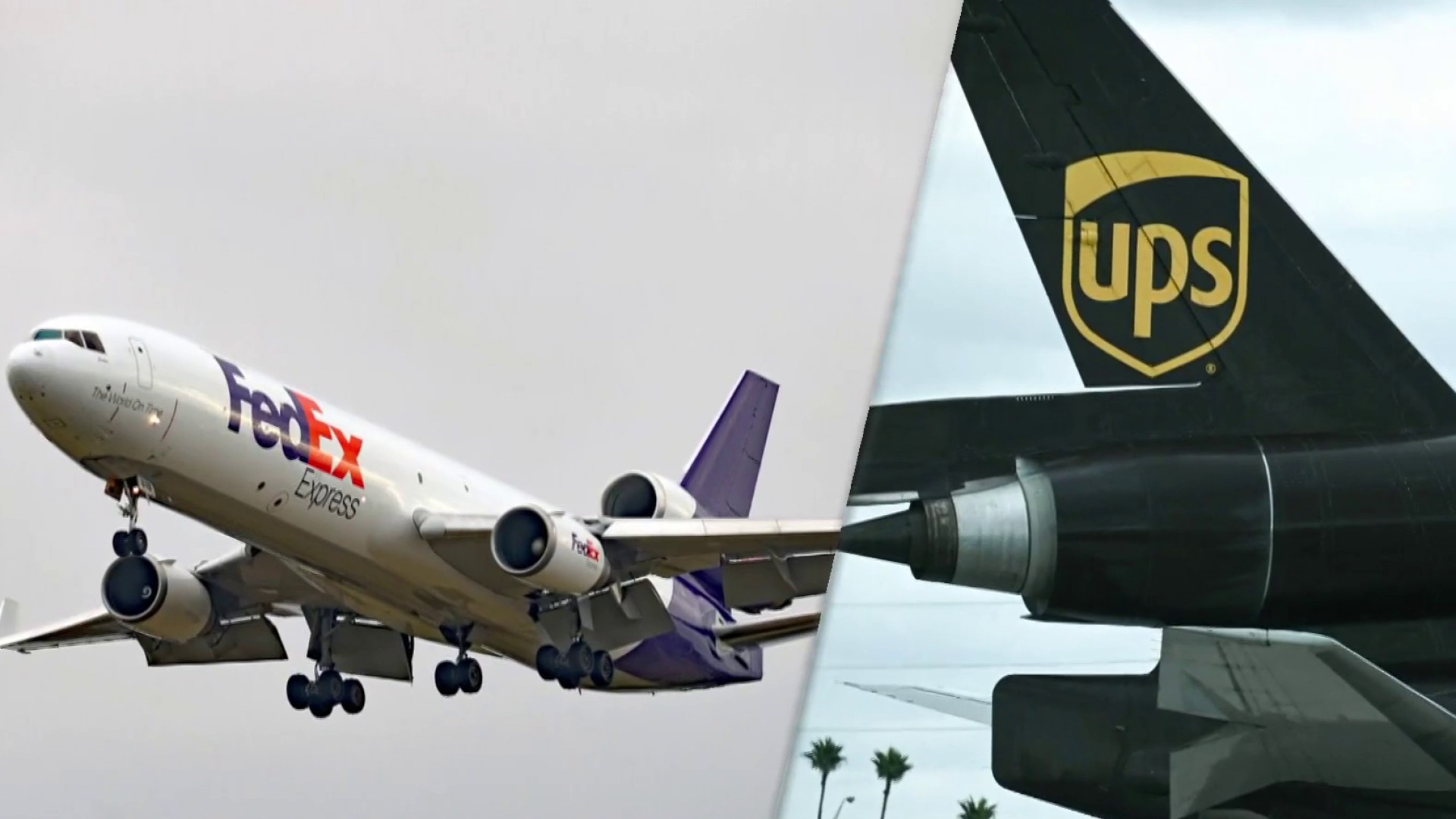
Boeing MD-11Fs of FedEx and UPS were grounded following the Nov. 7 crash of a UPS MD-11. Credit: NBC News.
Boeing recommended grounding MD-11Fs pending inspections of the engines and pylons, a move mandated within a day by the Federal Aviation Administration. The cause of the crash is unknown. The No. 1 engine separated from the widebody cargo airliner on takeoff from the Louisville (KY) airport. The airplane had passed the V1 commitment speed when a fire broke out, and the engine and pylon separated from the airplane.
The cause of the fire and the sequence of separation remain under investigation. More than a dozen people were killed, including the three pilots on the plane and the rest on the ground, when the plane crashed into an industrial park.
A theft of trade secrets lawsuit was filed on Oct. 20 in the US Federal District Court in Oregon by P2F company Precision Aircraft Solutions LLC against Mammoth Freighters, also a P2F conversion company. Precision converted Boeing 757s from passenger to freighter configuration and now converts Airbus A321ceos. Mammoth converts Boeing 777-200LRs and 777-300ERs.
One of the principals of Precision, William Wagner, left Precision and years later co-founded Mammoth. About 20 employees from Precision went to work for Mammoth and, for a time, Precision and Mammoth cooperated on the latter’s process to achieve a Supplemental Type Certificate (STC) for its conversions, according to the complaint filed in federal court. Precision alleges that its former employees signed Non-Disclosure Agreements that restricted the use of its trade secrets for the benefit of Mammoth.
The unrelated UPS crash and the lawsuit may have ramifications for the respective segments of the air cargo market.
UPS crash ramifications
UPS and its chief rival FedEx are the largest operators of MD-11Fs. The former has 27 aircraft and FedEx has 25. Tiny Western Global Airlines has two. All were grounded by the Boeing recommendation and the FAA emergency Airworthiness Directive. These may be returned to service following inspection and fixes, if any are needed.
UPS planned to retire its MD-11 fleet within the next two years.
Airbus has made presentations to FedEx and UPS for several years for its new A350F, so far without success. Its competition is Boeing’s 777-8, which is the same size as the 777-300ER passenger airplane (and the converted 777-300ER undertaken by Mammoth and two rival companies). The A350F is based on the -300ER-sized A350-1000, but it is slightly shorter.
Analysis by LNA’s Aircraft Performance and Cost Model (APCM) concludes that the A350F is generally the better aircraft for volumetric payload and the 777-8F is generally the better performer for heavy payloads. UPS and FedEx are volumetric operators.
The A350F uses the Rolls-Royce Trent XWB-97 engine, which has had durability issues in harsh Middle East and severe salt-air environments. Rolls claims to have resolved many of these problems. The 777-8F will use the newer GE Aerospace GE9X, which has yet to enter service due to the long delays to certify the 777-9. LNA’s APCM concluded that the GE9X is more fuel efficient than the older, smaller-diameter Trent XWB-97.
The A350F is supposed to enter service in 2027. LNA is told that initial customers have been informed by Airbus that EIS may slip to 2028. The 777-8F is supposed to enter service in 2030, but a new certification delay casts doubt over this.
Earlier Airbus production slots
Regardless, Airbus has earlier delivery slots than Boeing, provided its sales department doesn’t fill the slots with A350 passenger models. Notably, for the first time, Airbus has more freighter sales (74) than Boeing (59) for competing aircraft. Wins from either UPS or FedEx will be a major blow to Boeing, which has dominated both fleets forever.


Trade secret theft lawsuit
The trade secret theft lawsuit filed by Precision against Mammoth comes shortly before Mammoth expects to win a Supplemental Type Certificate for the 777-200LRF conversion. Conversion of the first 777-300ER is underway.
Precision’s lawsuit includes details of its allegations. It may be downloaded here: Precision v Mammoth 10-20-25. As of the end of business on Nov. 10, Mammoth hadn’t filed its response.
The allegations could have the effect of delaying new orders for Mammoth. This is what happened when Mammoth filed theft of trade secret lawsuits against the parties of a rival company, Kansas Modification Center (KMC). KMC was developing a forward-cargo door conversion of the 777-300ER and initially had discussions with Wagner, who eventually co-founded Mammoth.
KMC was not sued. The defendants were its marketing entity, Sequoia Aircraft Conversions, LLC, and its founders, David Dotzenroth and Charles Wiley Dotzenroth, Andy Mansell of the financial advisory firm Split Rock, and NIAR, the aerospace research arm of the University of Kansas at Wichita, the engineering firm for KMC. Mammoth sued because it alleged these entities benefited from conversations and presentations from Wagner.
Once these lawsuits were filed, KMC’s efforts to take orders dried up, although there was also market doubt about funding for the project. Eventually, Mammoth dropped all lawsuits before trial, with no compensation from any party.
While the KMC project was a start-up, Precision has been in business since 2001. It claims the improper taking of trade secrets and loss of some 20 engineers has harmed it financially and its standing in the industry. It asks for a jury trial.
Competitive landscape
IAI Bedek of Israel is a competitor to Mammoth and KMC. The STC for its 737-300ER P2F conversion was recently issued, years later than expected. The COVID-19 pandemic, changes to the certification process by the FAA following the Boeing 737 MAX crisis, and difficulties in obtaining Boeing licenses for its intellectual property led to the delays. IAI’s first conversions have just been delivered to operator Kalitta Airlines. The aircraft are owned by the lessor AerCap. KMC has yet to win more than a handful of orders.
Feedstock to the three companies relies upon the retirement by passenger airlines of the 777-300ER. This feedstock has virtually dried up due to certification delays of the 777-9, which is required before the 777-8F will be certified, and due to delays in the Boeing 787 and Airbus A350 programs. Airlines that planned to retire the 777-300ER (and in some cases, the 777-200LR and A330-300) have had to retain the older airplanes in order to maintain capacity. IAI, KMC, and Mammoth have each been affected.
Related
source