


Travel researchers studied one million reviews of the 20 biggest airlines serving the United Kingdom. All the flyers that were asked to review the legroom on the carriers that they flew with, the most complaints were focused on American Airlines and United Airlines.
American Airlines was found to be the worst of all the North America-based operators, but United Airlines was right behind it as the second-worst American-based carrier in terms of legroom. According to The Sun, 

The Legroom Verdict


The flyers that described their experiences gave extremely negative reviews of British Airways compared to others, but Ryanair was also among the worst ranking, as the second most cramped. What’s notable about the results is that budget airlines were found to be better by many flyers. These observations were based on the experience of the travelers, not the dimensions provided by carriers.
Below are the five airlines that received the highest number of complaints about legroom, according to the survey results, according to OddsMonkey:
|
Airline |
Number Of Legroom Complaints In TripAdvisor Reviews Online |
|---|---|
|
British Airways |
52.6% |
|
Ryanair |
51.4% |
|
|
47.2% |
|
|
43.8% |
|
Air Canada |
42.1% |


The only budget airline, or low-cost carrier (LCC), to fall in the top five worst of the worst was Ryanair. EasyJet didn’t make it into the top ten most complained-about, but many other budget carriers had far fewer negative reviews about space in front of the seat.
Qatar Airways even received more complaints than Wizz Air, Vueling, Aer Lingus, Jet2, and SunExpress. One exceptionally displeased British Airways customer gave this review, as recounted by The Sun:
“British Airways was not only the worst, but it was also false advertising to call it business class. The seats were the same as economy seats with other passengers close in front and behind, and no legroom.”
The United Airlines Situation

A lot of the frustration around these issues comes from the fact that customers are paying more to a full-service airline than they would be to a budget carrier. When there’s a gap between expectation and reality, this leaves a very bad taste in the mouth of any flyer, regardless of cabin class. Legacy carriers and mainline operators are held to a higher standard, which is only natural given that the airfare comes with a steeper price tag.
That is to say that the actual dimensions of the seat space may not be worse or better, but it does harm the Airlines’ reputation to charge more for the same or worse product. United Airlines is considered to be the tightest seat choice of the four largest airlines in the United States. Delta Air Lines, Alaska Airlines, and American all technically have more space, even if it is a less than one-inch difference.
United’s newer Airbus A321neo aircraft are configured with more seats than competitors like Delta or American. It is also speculated that some of the upgrades to amenities like larger overhead bins and better seatback in-flight entertainment (IFE) have also reduced the physical space available between seats.

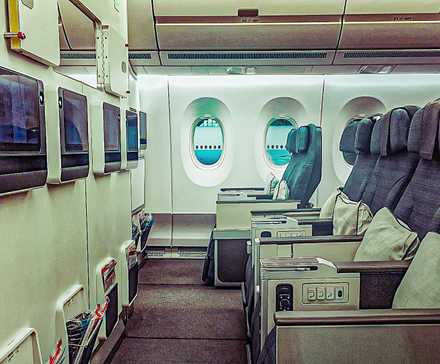
Here’s How Much More Spacious Premium Economy Is Compared To Economy Class
Premium Economy delivers 5–8 more inches of legroom, wider seats, and deeper recline—offering a calmer, more comfortable upgrade from standard Economy
The Deal With American Airlines

American Airlines has changed the cabin configurations on a number of its legacy aircraft to match its newer models. The 737 MAX 8, which has slowly been replacing older aircraft, has set a new standard for the airline’s seat density across the fleet. American has also removed seatback entertainment on a number of domestic aircraft. The absence of any kind of entertainment to distract from the physical constraints of the cabin makes crampedness even more noticeable.
American’s average seat pitch in economy is approximately 30 inches. While this is technically more than Spirit or Frontier’s 28 inches, it is significantly less than fellow legacy competitors like JetBlue or Southwest, which offer around 32 inches. To maintain a 30-inch pitch while fitting more people, AA uses “slimline” seats with thinner padding.
source