


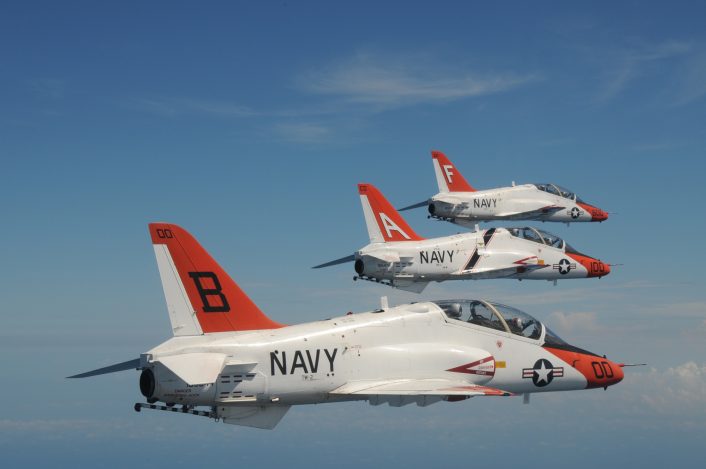
The U.S. Navy has released the final Request for Proposals for the Undergraduate Jet Training System which will replace the T-45 Goshawk, confirming an accelerated schedule with a focus on costs.
The U.S. Navy has released on Mar. 26, 2026, the final Request for Proposals (RFP) for the Undergraduate Jet Training System (UJTS) program, which will replace the aging T-45 Goshawk trainer fielded in 1991. The new aircraft will be used for the intermediate and advanced training of naval aviators of both the U.S. Navy and U.S. Marine Corps.
The RFP
The Request For Proposals, whose initial draft was released in early February, will cover the Engineering, Manufacturing, and Development (EMD) phase of UJTS, as well as the procurement of the first lot of Low-Rate Initial Production (LRIP) aircraft, Ground-Based Training Systems (GBTS) and Interim Contractor Logistic Services (I-CLS). The contract’s award is expected in March 2027.
An estimated fielding schedule attached to the RFP confirms that the service intends to procure 216 aircraft that should be able to provide 76,300 annual flight hours. The number of aircraft and the production rates reflect the information released in the last Request for Information (RFI) released in December 2025.
The fielding will follow an accelerated schedule, which sees the Navy receiving the first lot of seven LRIP aircraft in 2032. The production would then increase to 12 aircraft in 2023 and 20 in 2034, before a full-rate production of 25 aircraft per year from 2035.

These aircraft will be divided among three locations, with Naval Air Station (NAS) Meridian, Mississippi, receiving 95 aircraft starting in 2033, NAS Kingsville, Texas, receiving 95 aircraft from 2039, and the remaining 26 aircraft going to NAS Pensacola, Florida, from 2042.
As part of the program, the Navy will procure four EMD aircraft, together with two Unit Training Devices (UTD), two Desktop Avionics Trainers (DAT), three Brief/Debrief Stations (BDS), two Operational Flight Trainers (OFT) and a Ground Based Training System Software Support Station (GBTS SSS). Additionally, the contract will also include the aforementioned seven LRIP aircraft.
The cost will be also an important part of the selection process. The contract will include a Cost-Plus-Incentive-Fee (CPIF) section for the EMD, Firm-Fixed Price (FFP) for the LRIP Lot 1 and Cost-Plus-Fixed-Fee (CPFF) for Site Activation and I-CLS.
A key parameter in the cost evaluation will be the total estimated price, with the RFP stating that any offer over $1.751 billion “will be considered unreasonable and therefore unawardable.” The selection will also determine whether the proposed price is realistic, with a limit set at a total estimated price which can’t exceed 115% of the proposed price.

Additionally, the RFP sets a maximum price of $52.8 million in Fiscal Year (FY) 2027 and $181 million in FY2028. Overall, the selection will choose the offer which provides “the ‘best value’ to the Government.”
The RFP also opens to the possibility of two offers being selected “if funding is available and awarding two contracts offers the greatest value for the warfighter.” In that case, a single offer will be later down-selected.
UJTS Program
The U.S. Navy launched the Undergraduate Jet Training System (UJTS) to replace the aging T-45 Goshawk fleet. The service is looking to acquire a new aircraft on an “accelerated procured timeline” as it keeps facing problems with the T-45, which has been in service since 1991.
The new aircraft will notably be used in a much different way compared to the T-45, which has been used to train future naval aviators to land on aircraft carriers. In fact, the Navy said “the UJTS air vehicle will only be required to conduct Field Carrier Landing Practice (FCLP) to wave off.”

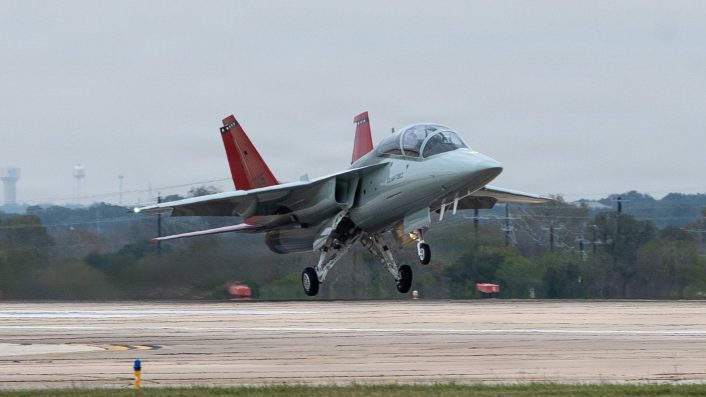
As we previously reported, a good portion of the training command’s syllabus is centered around the FCLP, which allows new pilots to train on land bases for the entire approach and landing maneuver as performed on the aircraft carrier, just short of the arrested landing. With the new requirement, future student pilots will only perform the approach phase of the current FCLP, going around once reached the minimums, without touching down on the runway.
The Navy says that this decision, which sets a completely different route compared to the T-45 Goshawk and, previously, the T-2 Buckeye, is “due to advancements in operational platform landing modes and in ground-based simulation.” This means the new naval aviators will rely more on automation and perform complete FCLPs only in the flight simulator.
This has sparked controversy, as the service is now planning to move this part of the training to the Field Replacement Squadrons (FRP), where the newly appointed naval aviators transition to their assigned aircraft. That would seem counterproductive as FRPs fly much more expensive aircraft, thus increasing the cost of training.
However, this choice has also reflections on the timeline. In fact, removing the FCLP portion of the training program from UJTS allows a much quicker fielding of the new aircraft, which could now be also an already operational type.

Thus, the new trainer aircraft will not require complex and lengthy structural modifications to be adapted to the new role. Normally, an aircraft that has to trap on the carrier and launch from a catapult, or at least conduct FCLPs, has to be designed from the ground up on that premise because the structural design needs to account for very significant stresses during carrier operations.
With the UJTS, the Navy also plans to field an extensive Ground Based Training System (GBTS). The service is “contemplating a four-tiered GBTS product line, consisting of Operational Flight Trainers (OFT), Unit Training Devices (UTD), Cockpit Procedural Trainers (CPT), and Desktop Avionics Trainers (DAT),” complete with “Live/Virtual/Constructive (LVC) integrated training.”
The attributes requested for the cockpit feature the safety and environmental characteristics common to all modern aircraft, with a cockpit configuration which mirrors the Navy’s newest fighters. In fact, both the F-35C Lightning II and the F/A-18E/F Super Hornet Block III feature Large Area Displays (LAD) and thus the service is looking for the same configuration in the new trainer.
As for the performance, the Navy is looking for an aircraft capable of a speed of at least Mach 0.9/450-500 KIAS, sustained AoA over 20 deg, sustained load factor of at least 6 G, operating ceiling of at least 41,000 ft and turn rate of at least 12 deg/sec. The RFIs also mentioned wing and/or wingtip pylons for stores carriage, which in the attachment are better specified as external fuel tanks, luggage pod and PMBR (Practice Multiple Bomb Rack) with six MK-76 type practice bombs.
The new UJTS aircraft is also required to integrate the new Precision Landing Mode (PLM), which is now on F/A-18s and F-35s and will eventually be the standard method for approaching the aircraft carrier for all naval aircraft. The PLM is expected to drastically reduce the number of corrections required during the final approach to the aircraft carrier.
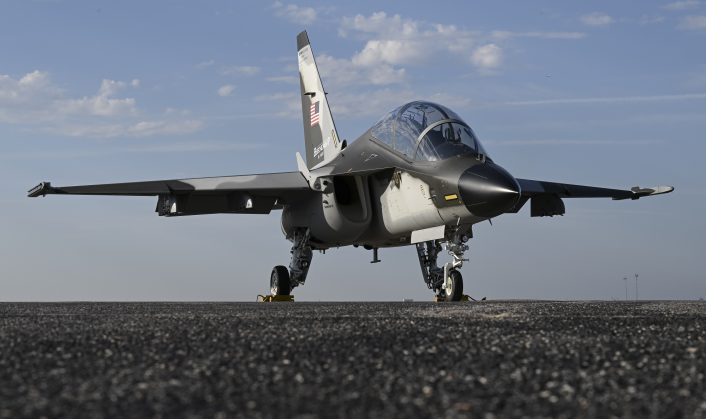
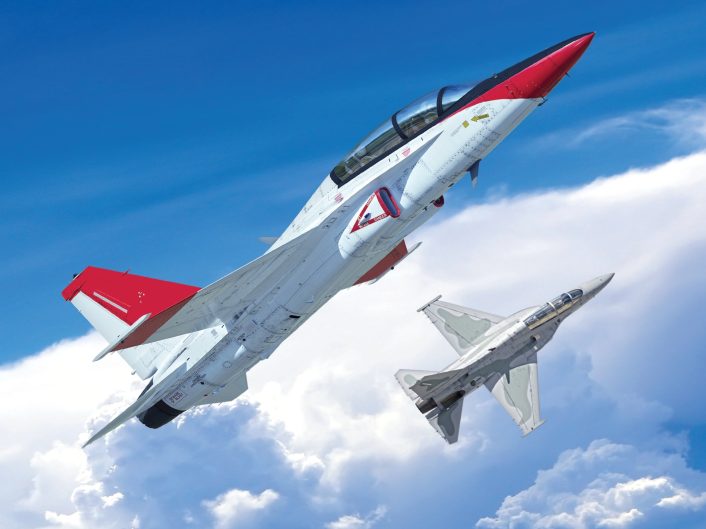
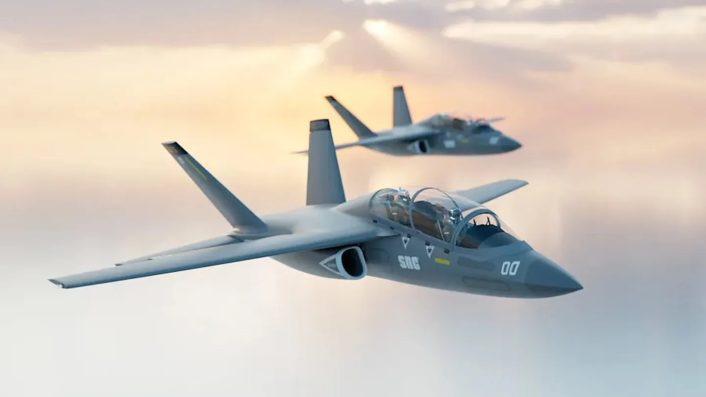
Among the companies that will compete for the UJTS are Beechcraft and Leonardo with the M-346N, Boeing with the T-7A (recently delivered to the U.S. Air Force), Lockheed Martin and KAI with the TF-50N and Sierra Nevada Corporation, alongside Northrop Grumman and General Atomics Aeronautical Systems, with the Freedom Trainer.
source