


Mission autonomy software by Collins and Shield AI was integrated on the YFQ-42 and YFQ-44 CCAs by using the government-owned A-GRA architecture.
The U.S. Air Force has reached a new milestone in its Collaborative Combat Aircraft (CCA) program, demonstrating that government-owned Autonomy Government Reference Architecture (A-GRA) can be successfully integrated with mission autonomy software. As part of this effort, General Atomics’ YFQ-42A and Anduril’s YFQ-44A were integrated with mission autonomy software provided by Collins Aerospace and Shield AI, respectively.
The testing focuses on proving that mission software can be rapidly ported between platforms, creating what the Air Force describes as a competitive and adaptable ecosystem for future autonomous air combat systems. The service explains this validates a core principle of the new acquisition strategy: decoupling software from hardware through an open, modular architecture to accelerate innovation and avoid dependence on a single vendor – the so-called “vendor lock.”
No more vendor lock. Just innovation & competition to get the best tech to the warfighter, faster. https://t.co/kgkis4r7yY
— General Ken Wilsbach (@OfficialCSAF) February 12, 2026
“Verifying A-GRA across multiple partners is critical to our acquisition strategy,” said Col. Timothy Helfrich, Portfolio Acquisition executive for Fighters and Advanced Aircraft. “It proves that we are not locked into a single solution or a single vendor. We are instead building a competitive ecosystem where the best algorithms can be deployed rapidly to the warfighter on any A-GRA compliant platform, regardless of the vendor providing the algorithm.
Software-first approach
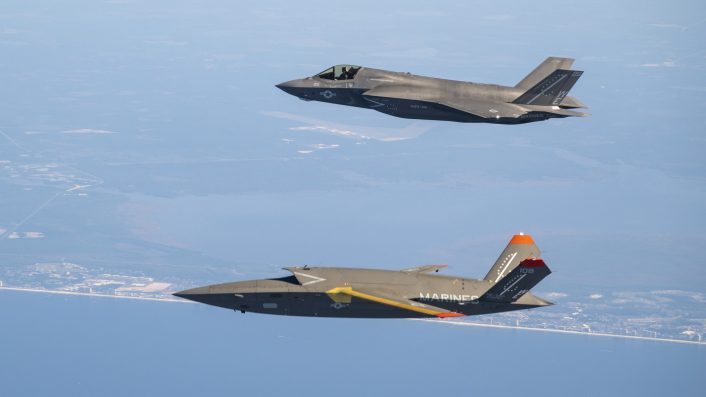
The Air Force’s CCA concept envisions large numbers of uncrewed aircraft operating alongside crewed fighters such as the F-35 and the future F-47. Once known as “loyal wingmen,” these aircraft are now expected to perform missions ranging from reconnaissance and strike to electronic warfare and decoy operations. The service has previously noted it intends to field in the long term at least 1,000 CCAs in different configurations.

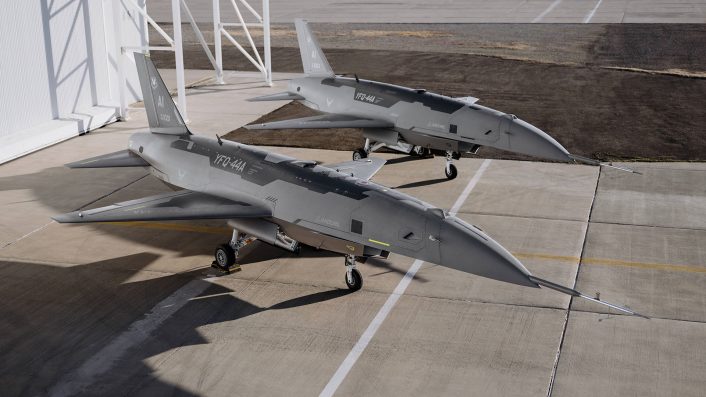
As an integral part of the CCA program, the service wanted to demonstrate the interoperability between mission autonomy software and airframes built by different manufacturers. This way the software will not be restricted to a single aircraft type, and can be integrated on newer CCAs in future.
The A-GRA standard is designed as a Modular Open Systems Approach (MOSA), something that has become a recurring aspect of recent development programs of the U.S. military, as we often reported here at The Aviationist. With the main focus of MOSA being the ability to easily integrate and upgrade components on an aircraft, the approach ensures that autonomy algorithms can be swapped or upgraded without the need for extensive modifications to the aircraft itself.
“We are seeing the vision of a modular, adaptable force come to life,” the Agile Development Office director said. “Integrating A-GRA onto multiple platforms so quickly demonstrates that our open-system approach works. It allows us to iterate tactics and capabilities across the fleet at a pace that keeps us ahead of the threat.”
YFQ-42A completes semi-autonomous mission
Following the U.S. Air Force’s statement, General Atomics Aeronautical Systems (GA-ASI) announced that its YFQ-42A has successfully completed the first semi-autonomous airborne mission using third-party autonomy software supplied by Collins Aerospace. Collins’ Sidekick Collaborative Mission Autonomy software was integrated through the A-GRA framework.

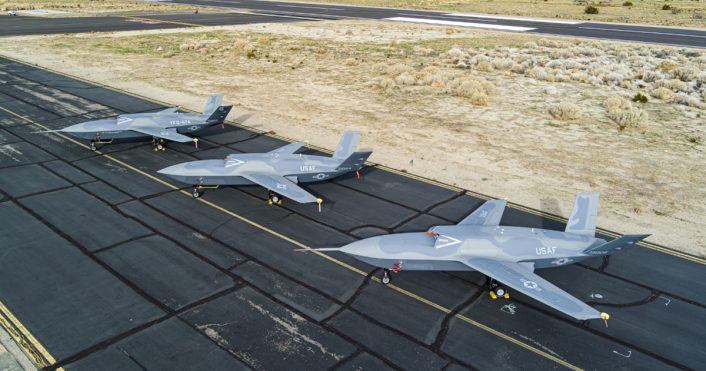
During the test, the autonomy software was activated from the Ground Station Console (GSC), and a human operator transmitted mission commands directly to the aircraft, which executed them accurately for more than four hours, says the company. A robust and reliable data exchange was established between the autonomy software and the aircraft’s mission systems, with the test highlighting both the effectiveness of Sidekick’s capabilities and the flexibility of the A-GRA architecture.
“We are excited to collaborate with Collins to deliver enhanced autonomous mission solutions,” said David R. Alexander, president of GA-ASI. “The integration of Sidekick with our YFQ-42A demonstrates our commitment to innovation and operational excellence in unmanned aircraft technology.”
Collins Aerospace characterized the flight as evidence of the maturity of its autonomy portfolio. That maturity is said to have allowed to conduct a rapid integration and move to mission execution in a very short time, although the timeframe has not been specified.
“The autonomy capabilities showcased in this flight highlight our dedicated investment to advance collaborative mission autonomy,” said Ryan Bunge, vice president and general manager for Strategic Defense Solutions, Collins Aerospace, an RTX business. “The rapid integration of Sidekick onto this General Atomics platform and its immediate ability to support a broad spectrum of combat-relevant behaviors underscores the strength and flexibility of our open systems approach.”
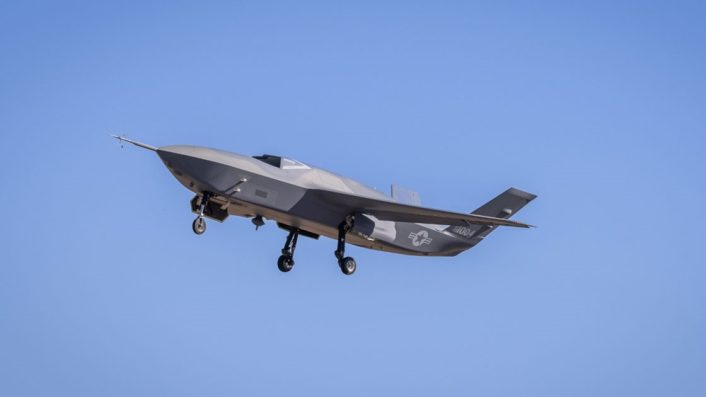
The YFQ-42A test builds on a development timeline that began in August 2025 with the aircraft’s first flight. Since then, General Atomics has flown multiple prototypes, with three visible in the most recent photo, and conducted demonstrations of autonomous takeoffs and landings using separate flight autonomy software.
Future YFQ-44A flight demo
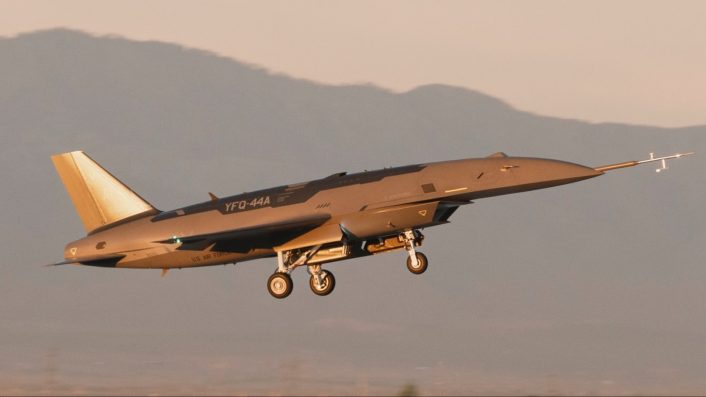
In parallel, Shield AI confirmed its selection as a mission autonomy provider for the Air Force’s CCA program, following a competitive Technology Maturity and Risk Reduction (TMRR) evaluation. The company’s Hivemind autonomy software has already been integrated onto Anduril’s YFQ-44A through A-GRA and is now undergoing system-level testing.
The U.S. Air Force just made autonomy software as important as the aircraft.
The @usairforce selected Hivemind for the Collaborative Combat Aircraft (CCA) program, the first time mission autonomy software has been decoupled from the aircraft. Hivemind has successfully… pic.twitter.com/jq08TtR4Xs
— Shield AI (@shieldaitech) February 13, 2026
Anduril, in fact, has been “working in very close collaboration with Shield AI for the last several months,” Jason Levin, the firm’s senior vice president of engineering, said in a statement, adding “[we] look forward to flying YFQ-44A with their software onboard very soon.”
In its statement, Shield AI said “Hivemind assumes the role of a human pilot or operator, enabling unmanned defense systems to sense, decide, and act.” The company further emphasized that its software can reroute the YFQ-44 around no-fly zones, respond to unexpected conditions, and complete missions without direct human intervention.
Gary Steele, Shield AI’s CEO, described the selection as validation of years of development work: “The Air Force is moving with urgency to explore how autonomy can reshape air combat, and we have spent years preparing for this—building, testing, and flying mission autonomy in the real world.”
Hivemind has previously been demonstrated on a range of platforms, as we often reported here at The Aviationist, including General Atomics’ MQ-20 Avenger, U.S. Navy BQM-177 target drones, and helicopters. This cross-platform portfolio aligns closely with the Air Force’s objective of making autonomy software platform-agnostic.
What this means for future airpower
The Air Force views CCAs as force multipliers, rather than replacements for crewed fighters. Their role will be to complement human pilots during complex missions, taking on the riskier missions, keeping pilots safe while creating attritable mass.
Moreover, by allowing a single crewed aircraft to command multiple uncrewed wingmen, the service also hopes to expand sensor coverage and complicate adversary defenses. The latter is an aspect not to be dismissed because, with the aircraft hosting modular payloads that can be quickly swapped, air defenses would not only have the problem of multiple targets to counter at once, but they would also have to prioritize them based on the capabilities they could or could not have.
As previously reported here The Aviationist, the Air Force’s long-term goal is not simply to build the two prototype drones that are already flying, but to establish a scalable framework in which multiple manufacturers and software providers can compete to deliver improved autonomy, sensors, and mission systems. This will be done with subsequent “Increments,” where the YFQ-42 and YFQ-44 are part of Increment 1 and new aircraft will be selected for the Increment 2 in the near future.
As shown by the milestones of the CCA programs in these months, this framework is beginning to take tangible form. At the same time, the successful use of A-GRA across two different aircraft and two different mission autonomy providers offer a new demonstration of “plug-and-play” capability of MOSA-based systems.
source