


That’s right, you probably guessed it, the most expensive fighter jet in the world is still Lockheed Martin’s F-22 Raptor. As the world’s first stealth fighter, the incredible warplane crafted by Skunk Works cost a pretty penny. On top of the immense research and development costs that went into the program, it had the misfortune of debuting just as enormous cutbacks were being levied against the US Armed Forces by Congress shortly after the Cold War came to a close.
While that era was certainly a momentous time in history for humanity, it drove the unit cost of each F-22 up into sky-high proportions. Estimates put the cost per airframe around $334 million, considering the added sunk cost of the procurement program’s full scope when the total number of jets manufactured was cut short.
The United States Air Force considers the “fly away” cost of an F-22 to be around $143 million, which is basically the pure cost for an airframe, omitting additional cost factors. The incredible jet was originally slated for a production run of 750 units. Slashing that number down to less than a third is the reason for its bloated cost. Going on almost 3 decades since its entry into service, that high price tag has proven to be a better investment than it perhaps appears on the surface.
The Competition In 2025

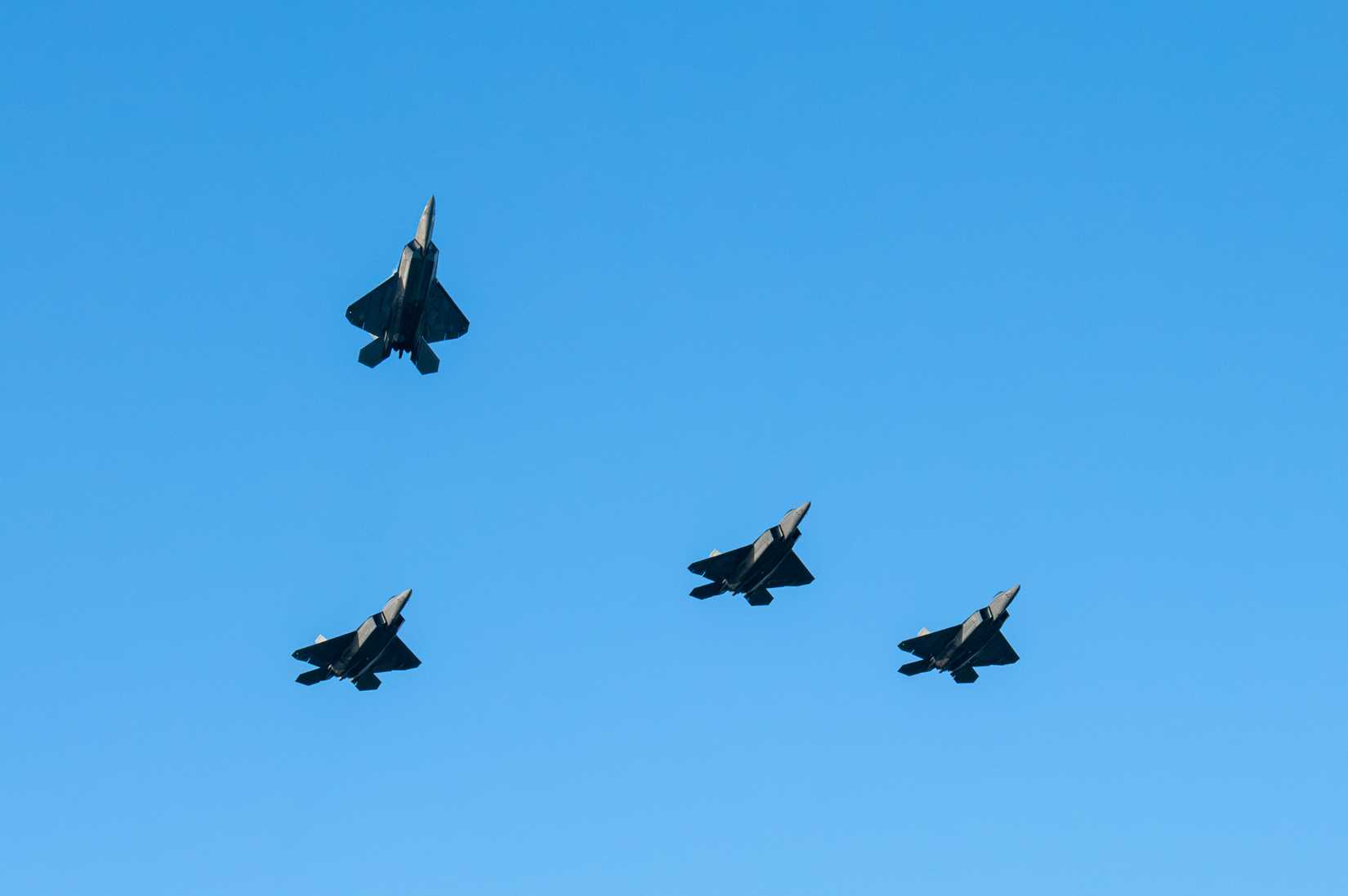
If you are not intimately familiar with the world of military aerospace, the ranking of the world’s most expensive fighter jets may include a few surprises for you. To even the most casual observer, the F-22 makes sense as the world’s most expensive fifth-generation fighter, given its status as the most technologically capable, highest performance, and most lethal in the world. On the other hand, the runners-up might be less obvious.
Below is a ranking of the most expensive fighter jets in the world, as data compiled by AeroTime illustrates:
|
Fighter Jets |
Country of Origin |
Price Tag |
|---|---|---|
|
Lockheed Martin F-22 Raptor |
USA |
$143–$334 million |
|
Dassault Rafale |
France |
$125 million |
|
Eurofighter Typhoon |
Multinational (Europe) |
$117 million |
|
Chengdu J-20 |
China |
$110 million |
|
Lockheed Martin F-35 Lightning II |
USA |
$80–$109 million (variant dependent) |
|
|
USA |
$97 million |
|
Sukhoi Su-35 |
Russia |
$85 million |


To most, it is probably strange that a non-stealth, 4th-Gen fighter is ranked second and third place. The reason why goes back to the same underlying cause that drove the cost of the F-22 so high. Low production and a lack of sales to produce economies of scale have made the Rafale and the Eurofighter even more expensive than stealthy jets made elsewhere.
The newest 5th-Gen fighter in the world, the Lockheed Martin F-35 Lightning II, is actually less expensive than both of these 4th-Gen legacy fighters. The reason is simple: numbers matter. The F-35 fleet has already reached over 1,200 units, which is nearly double the total expected Eurofighter production volume before the assembly line is permanently closed.
The Rafale is expected to be even lower in total deliveries before its production line is finally shuttered. However, both of these aircraft are still far out past the F-22. Currently, projections for total F-35 deliveries fall around the mark of 3,000 airframes, which vastly overshadows every aircraft on this list, even the entire F-15 family.
Making The Raptor

The engineering and manufacturing development (EMD) phase began in 1991, involving the production of nine test aircraft. The manufacturing process was a complex, geographically distributed operation involving a team of major contractors.
Development began over a decade before the Soviet Union collapsed in 1991. The lengthy certification process would not see the F-22 enter service until 1997. Although it was delayed and fewer jets would be delivered than expected, the Raptor remains the apex predator of the air power realm. This is despite the rise of adversaries like the Russian Sukhoi Su-57 Felon and the Chengdu J-20 Mighty Dragon in the People’s Republic of China (PRC).
The F-22 Raptor program, initially known as the Advanced Tactical Fighter (ATF) program, involved decades of research, a rigorous design competition, and the development of revolutionary manufacturing techniques to achieve its stealth, speed, and agility capabilities. The F-22 is not only the stealthiest fighter jet in the world, but it’s also one of the few capable of supercruise and true supermaneuverability.
The program that created the F-22 did far more than just develop a fighter jet. Skunk Works and its partners developed a myriad of “first of its kind” novel new technologies that combined to produce the warplane that we know today. The aircraft was also built using a modular approach across several locations, a practice that has since continued in successor platforms like the F-35 Lightning II.


Which Country Has The Most Superior Fighter Jets In The World?
The best overall fighter jet is arguably the F-35, while the F-22 is the best at its specialized role.
An Airpower Paradigm Shift


The F-22 Raptor’s stealth technology was a revolutionary generational leap over the F-117 Nighthawk, moving beyond a specialized “stealth bomber” to the first fully integrated “stealth fighter” concept. This technological shift set the standard for all subsequent stealth aircraft, including the F-35. The F-22’s innovative, integrated RAM and durable coatings set the bar for reduced maintenance requirements compared to the F-117, even though the F-22’s specific coatings remain complex.
The F-22 proved that a highly maneuverable, supersonic fighter could also be extremely stealthy. Stealth became an integrated design element rather than a bolted-on feature that compromised aerodynamic performance. The Raptor pioneered the integration of a sophisticated sensor suite with data fusion, providing the pilot with a complete picture of the battlefield without emitting detectable signals. This “first-look, first-shot, first-kill” ability became the standard for the F-35 and beyond.
The F-35 benefited greatly by leveraging and refining technologies already paid for and proven by the F-22 program. The vast R&D costs were spread across the Raptor’s limited number, inflating the per-unit cost to over $330 million. The F-35 program was designed from the outset as a multinational effort with thousands of units planned at a far lower flyaway cost. But the F-22 was never intended for export, and an official US law banned its sale to other countries, which further limited production and cost mitigation.
The Raptor’s Fire-Breathing Heart

Pratt & Whitney not only made the first stealth fighter jet engines ever, the first production thrust vectoring as well. The F119 engines featured two-dimensional thrust-vectoring nozzles that could direct thrust 20 degrees up or down, providing the F-22 with unprecedented maneuverability. Even so, the total cost of developing this engine was far lower than the lifetime sustainment cost of the airframe.
The F119 allows the F-22 to sustain supersonic speeds, up to approximately Mach 1.8, without engaging the afterburners. This is a major tactical advantage, as afterburners consume a massive amount of fuel and create a large infrared signature. Most other fighters must use afterburners to achieve and maintain supersonic flight for only brief periods.
While other engines, like those on the Russian Su-35, use 3D thrust vectoring, the F119’s 2D system is optimized for stealth and aerodynamic efficiency. The rectangular nozzles and the integration of fuel injectors into curved vanes inside the afterburner prevent a direct line-of-sight to the hot turbine blades, reducing radar reflections.
The F119 produces approximately 35,000 pounds of thrust and was designed with significantly fewer parts than previous-generation engines like the F100, which increased its reliability and ease of maintenance. The F-22 Raptor’s “super maneuverability” gives it a distinct advantage in close-range aerial combat scenarios due to a unique combination of design features not found in competing stealth fighters like the F-35 and the J-20. This makes it superior in a dogfight.
Developing the F119’s revolutionary technology required immense research, testing, and engineering resources. The stringent performance demands for speed, agility, and stealth significantly drove up the complexity and cost of the F119’s design and materials. The engine had to be seamlessly integrated with the airframe’s advanced flight control and stealth systems, a major engineering challenge that added to the overall program complexity and cost.

Top 5: The World’s Most Advanced Fighter Jets
The US arguably has the most capable fighter jets, with China, Europe, and Russia also boasting advanced fighters.
Unmatched In Any Metric

Stealth is the F-22’s most significant advantage. The F-22’s design and radar-absorbent materials provide an extremely low radar cross-section (RCS), making it nearly impossible for the Rafale and Eurofighter to detect and track at meaningful combat ranges. In contrast, the European jets, especially when carrying external weapons and fuel tanks, have a much larger RCS, making them visible to the F-22’s powerful radar from hundreds of miles away.
The F-22’s combination of stealth, powerful AN/APG-77 AESA radar, and internal AIM-120 AMRAAM missiles allows it to engage and destroy enemy aircraft long before the opposing pilot even knows the F-22 is in the vicinity. The Rafale and Eurofighter must get significantly closer to using their radars effectively against a stealth target, putting them at a major disadvantage in modern air warfare where Beyond Visual Range (BVR) combat is standard.
The F-22 is faster and more maneuverable with a combat load. It can supercruise at speeds of Mach 1.5+ without using afterburners, allowing it to dictate engagement speeds and conserve fuel, a capability the European jets cannot match while fully armed. Its thrust-vectoring engines also provide unparalleled agility in close-range combat, giving it an advantage even if an enemy manages to get close.
source