


Business and first class are a carrier’s opportunity to get creative with its premium economy. Competitors battle to offer customers the height of luxury in the skies and on the ground. That often leaves premium economy as an afterthought. Airlines need to give passengers a better experience than standard economy, but there is little to drive them beyond that. As a result, premium economy services have plenty of overlap. This is even more the case with United and Delta, which both use the Collins Aerospace MiQ seat for their premium economy services. Even the Premium Select and Premium Plus names are quite similar.
Yet, if we look closer, there are some striking differences between the premium economy products available onboard 


Delta Air Lines’ Premium Select Overview

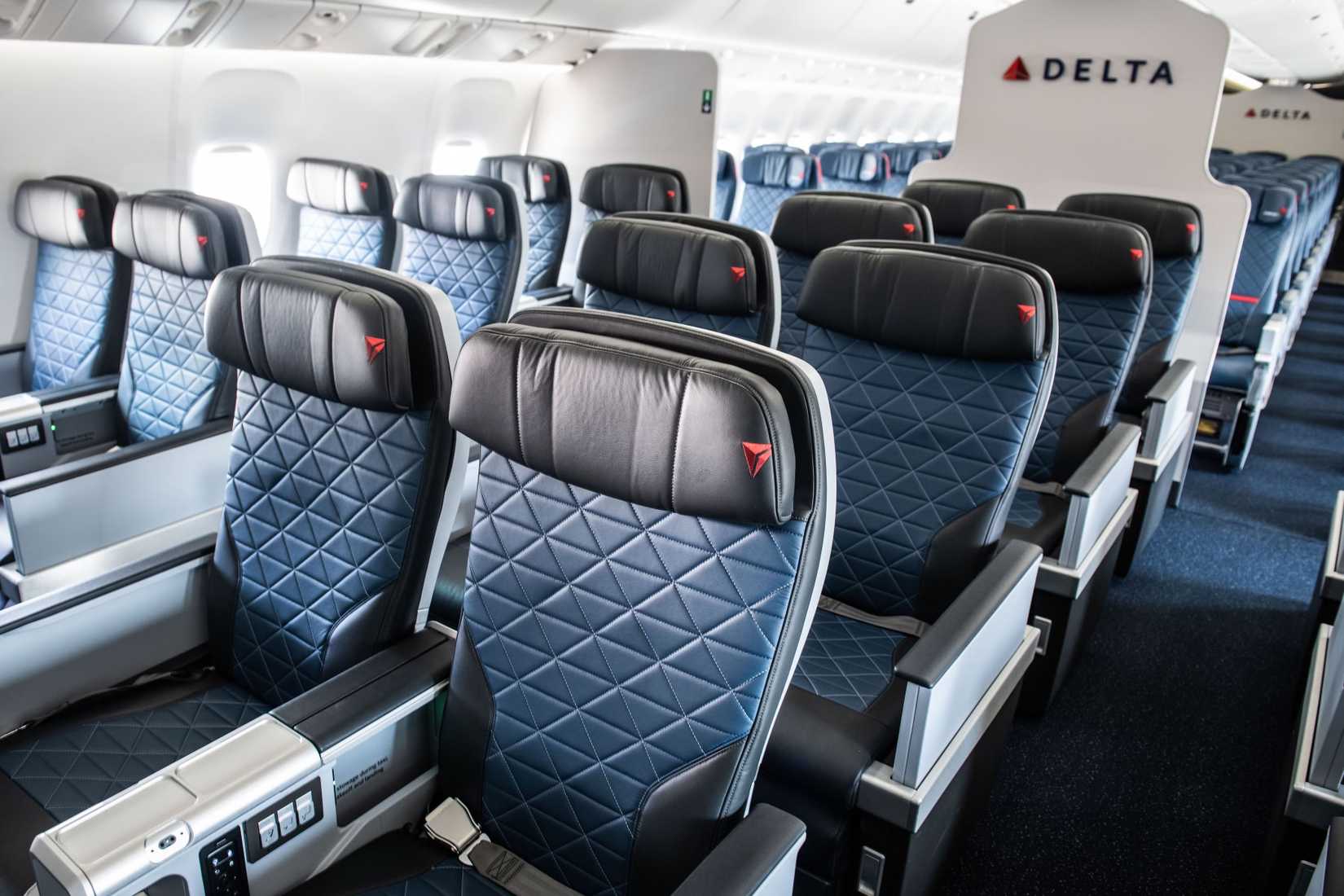
When Delta introduced Premium Select in 2017 onboard its Airbus A350-900, it was the second US carrier to offer premium economy. The product is now available on A350s (eight abreast), A330s (seven abreast), 767s (six abreast) and select transcontinental A321neos (four abreast).
Passengers will find it easiest to find space in Premium Select as the Delta A350 has the largest premium economy cabin of the three main US carriers. The seats available across each of Delta’s four classes for the A350-900 across both of the two layouts are detailed in the table below:
|
Class |
359 |
35H |
|---|---|---|
|
Delta One |
32 |
40 |
|
Premium Select |
48 |
40 |
|
Delta Comfort |
36 |
36 |
|
Delta Main |
190 |
159 |
|
Total |
306 |
272 |
On top of the standard seat also used by United, Delta has added a leg rest for each seat and a 13.3″ (33.8 cm) IFE screen. Delta also excels in its in-flight service, often considered the best for US legacy airlines.
United Airlines’ Premium Plus


Wikimedia Commons
United’s Premium Plus is the youngest premium economy product out of the US’ legacy carriers. Owing to its favor for different aircraft than Delta, this product is available exclusively on Boeing aircraft. You can find the product on all the carrier’s Boeing 777s with 24 seats in an eight-abreast configuration. Premium Plus is also available on the carriers’ Boeing 787s (seven abreast for 21 seats), the 767-400ER and the high-density Boeing 767-300ER (six abreast for 24 seats), and the premium configuration of the 767-300ER (six abreast for 22 seats).
The table below compares the number of seats available across United’s four classes for both layouts of the 767-300ER:
|
Class |
High-Density |
Premium |
|---|---|---|
|
Polaris |
30 |
46 |
|
Premium Plus |
24 |
22 |
|
Economy Plus |
32 |
43 |
|
Economy |
117 |
56 |
|
Total |
203 |
167 |
The carrier also has a marginally smaller IFE screen in premium economy at 13 inches (33 cm), although it is highly unlikely you’ll notice the extra third of an inch. The leather legrest and footrest are also comparable to Delta’s premium economy and is a substantial step up from the metal offering aboard American Airlines’ premium economy.

American Vs. Delta Vs. United: Which Carrier Has The Best Premium Economy?
These three airlines offer the most prominent premium economy offerings in the domestic aviation market.
United Airlines Doubles Down


As a late arrival in the premium economy market, United has had the least time to learn what makes this customer base tick. United’s chief commercial officer, Andrew Nocella, said that the carrier had underestimated demand: “We undersized the Premium Plus cabin. And that’s a cabin, I think, that’s generating very good returns, and the one that we’ll probably lean more into going forward.” This is unsurprising given that, aboard some of the carrier’s 777-300ER, premium economy accounted for just 7% of seats on board. United will address this issue by doubling down and expanding its Premium Plus offering.
You can expect to see the new Premium Plus from next year on double-daily Boeing 787-9 flights from San Francisco to Singapore, followed by the route from San Francisco to London. 222 seats across four classes will be available onboard. The new cabin configuration, which has a much larger offering for premium economy passengers, is detailed in the table below. The large number of Polaris seats available is also noteworthy:
|
Class |
Seats Available |
|---|---|
|
Polaris |
64 |
|
Premium Plus |
35 |
|
Economy Plus |
33 |
|
Economy |
90 |
It also appears that the coming years will see United moving further away from its US competitors, starting with the new cabins aboard the carrier’s Boeing 787-9s. These retrofits will update both the economy and premium economy seats, creating more diversion with Premium Plus seats that will have larger 4K OLED IFE screens, privacy wings, and more. It should be noted that these are changes to the add-ons only, while Premium Plus will continue to have the same Collins Aerospace seats.
Delta Premium Select Has Expanded

Delta is another carrier that has taken opportunities in recent years to expand its premium economy services. As of September 2024, select flights from New York JFK to 
Maurico Parise, Vice President – Brand Experience Design at Delta, commented on what the carrier is now offering passengers for this route: “Delta Premium Select will bring a new level of comfort, luxury and practicality to one of Delta’s most important routes in the domestic U.S. as we continue to work to deliver more premium experiences to our customers. This product has been a success internationally, especially following the recent investments we’ve made onboard, and we know that customers flying between New York and Los Angeles will enjoy the opportunity to treat themselves to a more spacious seat and premium experience.”
The premium economy product itself has seen little change. However, one upgrade is to the onboard Wi-Fi. A fast and free connection from T-Mobile onboard select flights has also been rolled out, so that Premium Select passengers can have a more productive and entertaining trip. The carrier is currently working to expand this connectivity to all flights.

The New Delta Air Lines Long-Haul Aircraft Coming In 2026
A look at what these planes will bring to Delta, where they could fly, how they fit into Delta’s network, and what they may look like on the inside.
A Shared Seat

It is clear that passengers can expect a difference between the services, but the overall experience remains broadly similar. That is because both carriers continue to use the MiQ® family (pronounced M-I-Q) of premium economy aviation seating from Collins Aerospace. These seats are also used by Cathay Pacific, Air China and American Airlines. The main differences are the branding that both airlines have applied to the seats and the IFE systems attached to the seats in front.
Collins Aerospace list a host of features that are shared across all airlines that use their seats. This includes a four-way adjustable headrest, recline of up to 10 inches, a full-size bi-fold table, and adjustable aisle armrest, and space to store airline literature and personal items.
One reason that this seat has become so popular among airlines that expanded into the premium economy market is that it has been effectively future-proofed, giving unique longevity to the airlines using it. Mark Vaughan, vice president of sales and marketing for Collins Aerospace’s seating business, told Runway Girl network: “We designed modular elements into the seat, like the seat console, and preserved space elsewhere in the seat frame where future features, and technology could be incorporated. A good example of this is the requirements from airlines and their passengers and the amount of power they would need.”
Similar On-Ground Experience

Another key similarity between United and Delta’s premium economy products is that they have a unified service to make everything in the airport easier and less stressful. It should be noted that American Airlines also offers these perks, but they are not branded correctly, which increases the risk of passengers not taking full advantage of all of them.
Delta’s Premium Select product gives passengers access to Sky Priority®. Passengers can enjoy accelerated check-in, security without the long queues, and an exclusive baggage service. These passengers will also be the first invited to board the aircraft when it’s time to get underway. Along with Premium Select fliers, Diamond, Platinum and Gold Medallion®, and SkyTeam Elite Plus Members also get access. Finally, Sky Priority® services are also extended to Delta One® and Delta First passengers.
United’s Premier Access service is almost identical, giving passengers access to a faster check-in lane and priority boarding. These passengers also skip the line at security and are the first to receive their checked bags after the flight. Flying on Premium Plus isn’t the only way that you can access these perks. They can be bought directly and are also available to members of MileagePlus Premier®, Star Alliance™ Gold, and MileagePlus Club and Presidential Plus credit card members. Passengers in United Polaris business class and United First® also get Premier Access.
source